

Loading, please wait...
Loading, please wait...

Clinicians frequently face intricate management decisions when drug-resistant focal epilepsy coexists with an identifiable germline mutation. Historically, many centers viewed genetic epilepsies and surgical intervention as mutually exclusive treatment pathways. Practitioners assumed that germline alterations inevitably cause diffuse, widespread neural dysfunction that cannot benefit from localized resective therapy. However, emerging genomic discoveries have fundamentally challenged this assumption over the past decade. Contemporary epileptologists and neurosurgeons now recognize that focal epilepsy commonly develops in patients harboring specific monogenic variants. Consequently, evaluating epilepsy surgery genetic variants has become an essential component of comprehensive presurgical assessments.
A landmark pooled analysis of 272 individual participants evaluated postoperative seizure outcomes across distinct germline etiologies. The researchers synthesized individual patient data from 65 published studies, three tertiary institutional cohorts, and the Pediatric Epilepsy Research Consortium registry. Notably, the study excluded patients with tuberous sclerosis complex and neurofibromatosis to evaluate less characterized germline etiologies. Patients underwent resective surgery or laser ablation with a median follow-up of 24 months. Ultimately, the investigators demonstrated that surgical success correlates strongly with the specific biologic category of the mutation. Therefore, an identified germline variant should not automatically disqualify patients from surgical consideration.
To contextualize surgical efficacy, investigators categorized patients into biologically informed groups. These classifications included GATORopathies, vascular malformations, copy number variants, overgrowth syndromes, channelopathies, synaptopathies, and miscellaneous disorders. Statistical comparisons revealed highly significant differences in seizure freedom across these biological categories.
Specifically, patients with vascular anomalies achieved the highest rate of seizure freedom at 73.6 percent. Individuals with GATORopathies followed closely, demonstrating complete seizure freedom in 65.8 percent of surgical cases. GATOR1 complex genes, specifically DEPDC5, NPRL2, and NPRL3, encode essential upstream inhibitors of the mTOR signaling cascade. Pathogenic variants in these genes frequently drive focal cortical dysplasia through a localized somatic second-hit mutation. Consequently, completely resecting this dysplastic tissue eliminates the primary epileptogenic driver and cures seizures in most individuals.
In addition, patients with copy number variants experienced favorable surgical outcomes, attaining seizure freedom in 58.0 percent of cases. Similarly, individuals with overgrowth syndromes achieved seizure freedom in 56.6 percent of cases. Miscellaneous conditions yielded an intermediate seizure freedom rate of 44.0 percent. Statistical odds of seizure freedom were more than two-fold higher for vascular disorders and GATORopathies compared to other categories. Thus, biological pathways reliably stratify postoperative seizure prognosis.
In sharp contrast to focal mTORopathies, patients with channelopathies and synaptopathies experienced significantly lower rates of postoperative seizure control. Channelopathies, involving genes such as SCN1A and KCNQ2, yielded seizure freedom in only 30.0 percent of patients. Furthermore, individuals with synaptopathies, including pathogenic variants in STXBP1 and SYNGAP1, attained seizure freedom in just 22.2 percent of cases. Univariate analyses revealed that patients with channelopathies had 4.5-fold lower odds of postoperative seizure freedom. Similarly, patients with synaptopathies exhibited 4.2-fold lower odds of achieving complete seizure remission compared to other groups.
Sensitivity analyses confirmed that this reduced efficacy persisted even when excluding GATORopathies from the comparison. Why do these patients respond less favorably to surgical resection? Fundamentally, ion channels and synaptic proteins function broadly across distributed neural networks. While focal electrographic discharges may localize to one brain region, underlying cellular hyperexcitability remains generalized. Consequently, resecting a focal zone often leaves residual hyperexcitable cortex behind.
Nevertheless, resective or ablative surgery can still provide valuable palliative relief for select patients. Interventions frequently decrease seizure frequency, shorten seizure duration, and lower the risk of status epilepticus. Therefore, clinicians should approach these conditions with realistic expectations rather than immediate exclusion.
Structural neuroimaging findings provide crucial context when evaluating surgical candidates with monogenic epilepsy. In this pooled analysis, 82.2 percent of patients with available imaging demonstrated definitive epileptogenic magnetic resonance imaging lesions. Strikingly, structural lesions were present in 64 percent of channelopathy patients and 80 percent of synaptopathy patients. Despite exhibiting visible structural lesions, patients in these two categories experienced significantly worse outcomes than those with GATORopathies.
This discordance underscores a vital neurobiological principle. In GATORopathies, the structural lesion, typically focal cortical dysplasia type II, represents the true epicenter of epileptogenesis. Complete surgical excision of this abnormal dysplastic tissue generally terminates seizures. Conversely, in channelopathies or synaptopathies, a visible lesion may represent an incidental malformation or simply one component of an intrinsically abnormal global network. Thus, finding a lesion on imaging does not guarantee equal surgical curability across differing genetic etiologies.
Accordingly, surgical teams must interpret structural imaging in close conjunction with genomic data. Advanced neuroimaging protocols, such as volumetric high-resolution magnetic resonance imaging and functional positron emission tomography, help delineate the true epileptogenic zone. Furthermore, intracranial monitoring with stereoelectroencephalography helps verify whether electrographic onsets align strictly with structural abnormalities. When widespread network hyperexcitability exists, teams can modify surgical plans accordingly.
Precise genetic identification fundamentally reshapes clinical decision-making and patient counseling during presurgical evaluations. Historically, clinicians viewed an identified germline mutation as a reason to abandon surgical workups. Today, multidisciplinary epilepsy boards use specific genetic etiologies to guide patient selection, manage family expectations, and personalize operative strategies. For instance, families of children with GATOR1 complex mutations can receive optimistic guidance regarding seizure freedom when presurgical mapping demonstrates focal concordance.
Conversely, counseling must convey realistic prognostic expectations for individuals with channelopathies and synaptopathies. Clinicians should clarify that while surgical resection or laser ablation may significantly reduce seizure burden, complete medication freedom remains unlikely. Furthermore, early genetic testing should occur routinely in drug-resistant focal epilepsy. Deploying targeted gene panels or exome sequencing early prevents unnecessary invasive monitoring in suboptimal candidates while expediting curative surgery for high-yield cases.
In addition, multidisciplinary epilepsy conferences must unite neurologists, neurosurgeons, geneticists, and neuropsychologists. These teams determine whether resective surgery, laser ablation, or neuromodulation represents the best therapeutic strategy. For patients with broad network hyperexcitability, neuromodulation modalities like responsive neurostimulation offer safer palliative alternatives to extensive resections.
No, germline genetic variants do not automatically exclude patients from epilepsy surgery. While channelopathies and synaptopathies have lower seizure freedom rates, conditions like GATORopathies and vascular syndromes achieve high cure rates. Comprehensive presurgical evaluation remains essential to assess electroclinical and neuroimaging concordance before determining individual surgical eligibility.
GATORopathies, involving genes such as DEPDC5, NPRL2, and NPRL3, hyperactivate the mTOR pathway. These mutations often cause focal cortical dysplasia through a localized somatic second-hit mutation. Because the epileptogenic zone remains anatomically discrete, complete surgical resection or laser ablation of the visible lesion effectively terminates seizures in most patients.
Clinicians must approach channelopathies with caution, as widespread network dysfunction typically yields lower seizure freedom rates around 30 percent. Nevertheless, surgery can significantly reduce seizure frequency and status epilepticus risks. Multidisciplinary teams should counsel families carefully and consider neuromodulation techniques when resective surgery offers limited curative potential.
Disclaimer: This content is for informational and educational purposes only... Refer to the latest local and national guidelines for clinical practice.
References

Read summarized clinical updates, watch expert medical content, and earn CME certifications right from your smartphone.
Open your smartphone camera to scan and install.





A pooled analysis of 272 patients reveals that epilepsy surgery outcomes vary substantially by underlying germline genetic etiology. Seizure freedom reached 73.6% in vascular disorders and 65.8% in GATORopathies, but dropped significantly to 30.0% in channelopathies and 22.2% in synaptopathies.
Today

A retrospective study of 6,113 adults shows that combining GLP-1 receptor agonists with digital health apps nearly doubles the odds of achieving significant weight loss. Frequent progress logging serves as a primary behavioral driver of long-term metabolic success.
Today

Sexual dysfunction affects a high proportion of reproductive-age females with multiple sclerosis. This comprehensive review highlights multi-tier etiologies, proactive clinical screening tools, preconception counseling considerations, and integrated therapeutic options across multidisciplinary care pathways.
Today
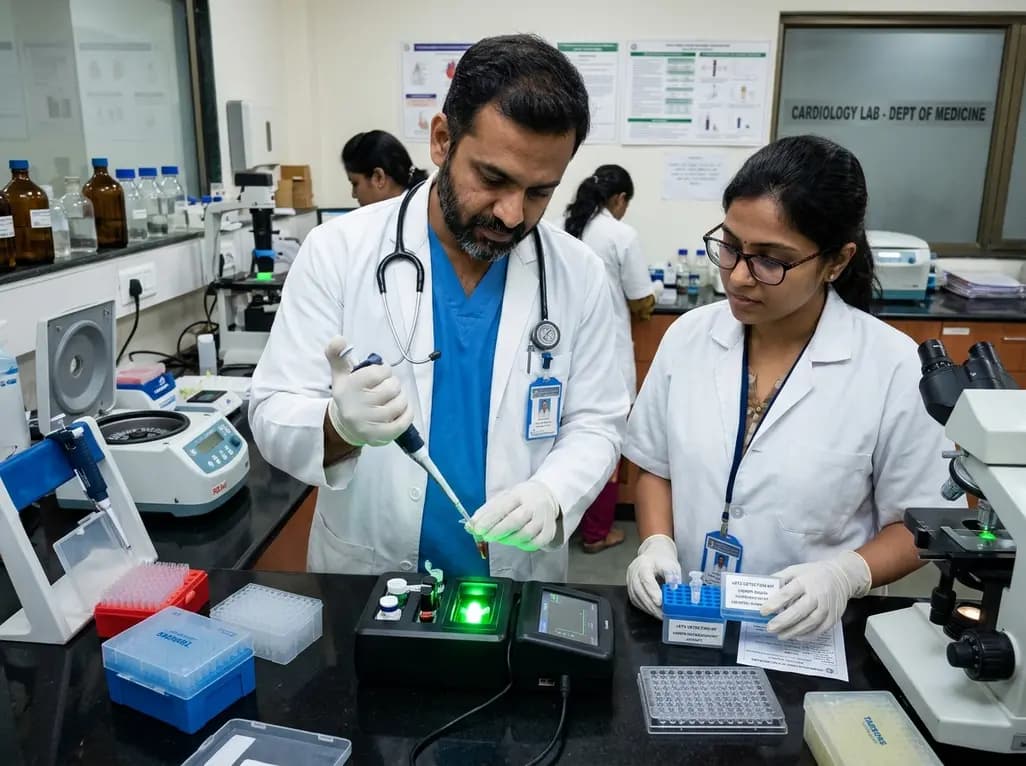
Researchers have engineered an innovative CRISPR-Cas12a fluorescent diagnostic kit for clinical sST2 detection. By combining nanotechnology with enzymatic trans-cleavage, this platform enables rapid, ultrasensitive heart failure diagnosis and risk stratification, outperforming conventional laboratory ELISA methods.
Today

Non-union fractures occur in 2-5% of cases, causing significant disability and cost. Conservative modalities such as LIPUS, PEMF, and focused ESWT offer non-surgical healing options for defects up to 5-10 mm when adequate mechanical stability exists without infection.
Today

India is poised to transform chronic disease management through wearable health technology. Discover how continuous remote monitoring and predictive algorithms empower clinicians to detect early cardiovascular signals, personalize metabolic interventions, and deliver equitable preventive care across populations.
Yesterday
