.webp&w=384&q=75)

Loading, please wait...
Loading, please wait...
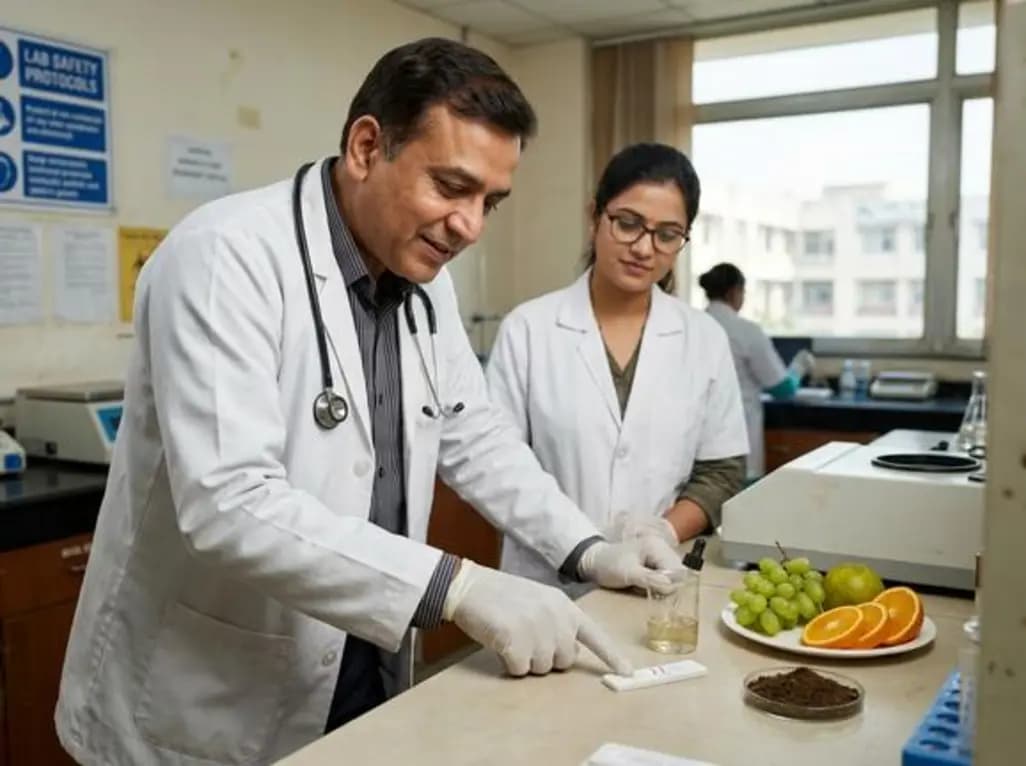
Agricultural expansion in India frequently involves the application of synthetic plant growth regulators to enhance crop yield and quality. Forchlorfenuron (FCF) is a common cytokinin-type regulator used extensively in grape and citrus farming. However, the overapplication of FCF creates substantial risks for consumers. Consequently, there is a rising demand for reliable forchlorfenuron residue detection platforms to ensure food safety and public health. A recent study has successfully developed an ultrasensitive visual detection system that enables rapid, on-site monitoring of these residues.
The research team employed computational quantum chemical analyses to design haptens that accurately reflect the 3D structure of FCF. This precision allowed for the production of a highly specific monoclonal antibody. Furthermore, the scientists integrated this antibody into an AuNP-labeled double-T immunochromatographic assay. This platform simplifies the testing process, allowing for the quantification of FCF in grapes, oranges, and soil without sophisticated laboratory infrastructure. Therefore, this technology facilitates real-time surveillance in agricultural and environmental matrices.
The researchers confirmed the high sensitivity of the assay through rigorous validation. For example, the assay recorded a limit of detection (LOD) for grapes at 1.069 µg/kg. This value is significantly lower than the standard limits set by regulatory bodies like the FSSAI. Moreover, the results showed excellent agreement with traditional liquid chromatography-tandem mass spectrometry (LC-MS/MS) methods. In addition to its sensitivity, the assay offers a rapid turnaround time. Consequently, implementing such tools can help prevent the health complications associated with chronic pesticide exposure, such as potential hepatotoxicity and carcinogenicity.
Chronic exposure to high levels of forchlorfenuron residues is linked to potential hepatotoxicity and oxidative stress in liver cells. Symptoms of acute ingestion may include nausea, vomiting, and neurological distress.
The double-T assay provides rapid, on-site, and visual quantification of residues. While traditional methods like LC-MS/MS are highly accurate, they require expensive equipment and extensive sample preparation. This new platform offers a cost-effective alternative for real-time monitoring.
The assay features detection limits as low as 1.069 µg/kg in grapes. This is well within the 0.01 mg/kg (10 µg/kg) maximum residue limit (MRL) typically suggested for various fruits, ensuring that even trace amounts are identified.
Disclaimer: This content is for informational and educational purposes only. It does not constitute medical advice or professional services. Always consult a qualified healthcare provider for any health concerns. Refer to the latest local and national guidelines for clinical practice.
References
1. Kou S et al. An ultrasensitive visual detection platform for forchlorfenuron: from simulation-assisted hapten and antibody production to double-T immunochromatographic assay application. J Mater Chem B. 2026 Jun 19. doi: 10.1039/d6tb00792a. PMID: 42318762.
2. Food Safety and Standards Authority of India (FSSAI). FSSAI Data Portal - FPDP: Pesticide Details for Forchlorfenuron. 2024.
3. Zhang Y, et al. Forchlorfenuron Exposure Induces Hepatocyte Apoptosis via MKK3/P38/ATF2 Pathway. Journal of Agricultural and Food Chemistry. 2026.

Read summarized clinical updates, watch expert medical content, and earn CME certifications right from your smartphone.
Open your smartphone camera to scan and install.





Researchers have developed a new ultrasensitive visual detection platform for Forchlorfenuron (FCF) residues. This double-T immunochromatographic assay provides rapid, on-site monitoring in grapes, oranges, and soil to safeguard public health from overapplied plant growth regulators.
4 months ago

Review how tailored exercise programs benefit frail older patients with heart failure. Explore pathophysiological mechanisms, individualized training prescriptions, and strategies to overcome adherence barriers in clinical practice.
Today

Leucine Rich Bio has introduced South Asia's first comprehensive vaginal microbiome test, BugSpeaks. By profiling microbial dysbiosis, pathogens, and antimicrobial resistance, this next-generation diagnostic platform provides clinicians with deeper insights into recurrent infections, fertility, and reproductive health.
Today

In high-risk pulmonary embolism complicated by severe anemia and active uterine bleeding, systemic thrombolysis is contraindicated. Large-bore aspiration thrombectomy provides rapid hemodynamic rescue without fibrinolysis, supported by inferior vena cava filter placement and multidisciplinary critical care.
Today

This comparative study evaluates posterior labral tears with and without glenohumeral instability, highlighting distinct demographic patterns, MRI underestimation in stable shoulders, and successful arthroscopic repair outcomes.
Today

A clinical study demonstrates that early intervention with tocilizumab, either as monotherapy or bridged with corticosteroids, achieves significant proptosis reduction and resolves active inflammation in treatment-naive thyroid eye disease.
Today
