.webp&w=384&q=75)

Loading, please wait...
Loading, please wait...

Precision in total hip arthroplasty (THA) through the direct anterior approach (DAA) is essential for successful outcomes. However, identifying the correct femoral neck osteotomy level remains a significant challenge for many surgeons. The DAA often provides limited exposure of the proximal femur. Furthermore, the absence of a standardized intraoperative landmark often leads to inconsistent bone resection. A recent study suggests that the intertrochanteric line (ITL) serves as a reproducible bony marker to address these technical difficulties.
Researchers evaluated the anatomical relationship between the ITL and the ideal cutting height using 3D-CT models and cadaveric specimens. Specifically, they focused on three references: ITL height (ITL-H), ITL angle (ITL-A), and femoral saddle height (SH). The findings demonstrated that ITL-H is remarkably consistent. Unlike other markers, ITL-H showed no significant differences based on sex or age. Consequently, this consistency makes it a highly reliable reference point for determining the femoral neck osteotomy level during surgery.
The study highlights a practical rule for orthopedic surgeons. Performing the osteotomy approximately 23 mm above the ITL-H yields high success rates. This measurement effectively maintains a safe lower margin, which prevents excessive resection of the calcar bone. Moreover, using this landmark helps ensure that the cutting height remains between 10 to 15 mm above the lesser trochanter. This range is critical for maintaining leg length and joint stability.
Although the ITL-H is a robust landmark, surgeons must still prioritize individualized planning. Preoperative templating remains necessary to account for patient-specific anatomy. Surgeons should adjust the cutting level intraoperatively based on the patient's unique ITL-H. By integrating this landmark into their workflow, clinicians can improve the accuracy of the femoral neck osteotomy level and reduce the risk of postoperative complications.
The intertrochanteric line (ITL) is easily accessible during the direct anterior approach. Its height is consistent across different patient demographics, making it more reliable than other variable bony features.
Research suggests that an osteotomy level of approximately 23 mm above the intertrochanteric line height (ITL-H) provides a safe and accurate cutting margin for most patients.
No, studies indicate that ITL height does not correlate with age or sex. This stability makes it an excellent reproducible landmark for orthopedic procedures.
Disclaimer: This content is for informational and educational purposes only. It does not constitute medical advice or a professional healthcare service. Always seek the advice of a physician or other qualified health provider with any questions you may have regarding a medical condition. Refer to the latest local and national guidelines for clinical practice.
References
Limmahakhun S et al. Anatomical relationship between the intertrochanteric line and femoral neck osteotomy level in direct anterior approach total hip arthroplasty: a 3D morphometric and cadaveric validation study. Arthroplasty. 2026 Mar 03. doi: undefined. PMID: 41776709.
Yang L, Zheng Z, Chen W, Wang J, Zhang Y. Femoral neck osteotomy guide for total hip arthroplasty. BMC Surg. 2015 Mar 18;15:29. doi: 10.1186/s12893-015-0014-4. PMID: 25887586.
O’Donnell J. Direct Anterior Approach to the Hip Joint. In: Iyer KM, editor. Hip Joint in Adults: Advances and Developments. Jenny Stanford Publishing; 2018.
"
Read summarized clinical updates, watch expert medical content, and earn CME certifications right from your smartphone.
Open your smartphone camera to scan and install.





A new study identifies the intertrochanteric line as a reliable landmark to standardize the femoral neck osteotomy level during DAA total hip arthroplasty....
7 months ago

The TREM-AB open-label pilot study evaluated a wearable passive nonlinear vibration absorber for essential tremor. The Nonlinear Energy Sink bracelet reduced clinical Fahn-Tolosa-Marin tremor scores by 32.1% and electrophysiological tremor power by 49.2% with no adverse effects reported.
Today

A population-based study of 20,928 children reveals that small vulnerable newborns face sex-divergent mental capital outcomes at ages 6-7: term SGA girls show higher behavioral difficulties and lower resilience, while preterm non-SGA boys experience increased behavioral problems.
Today
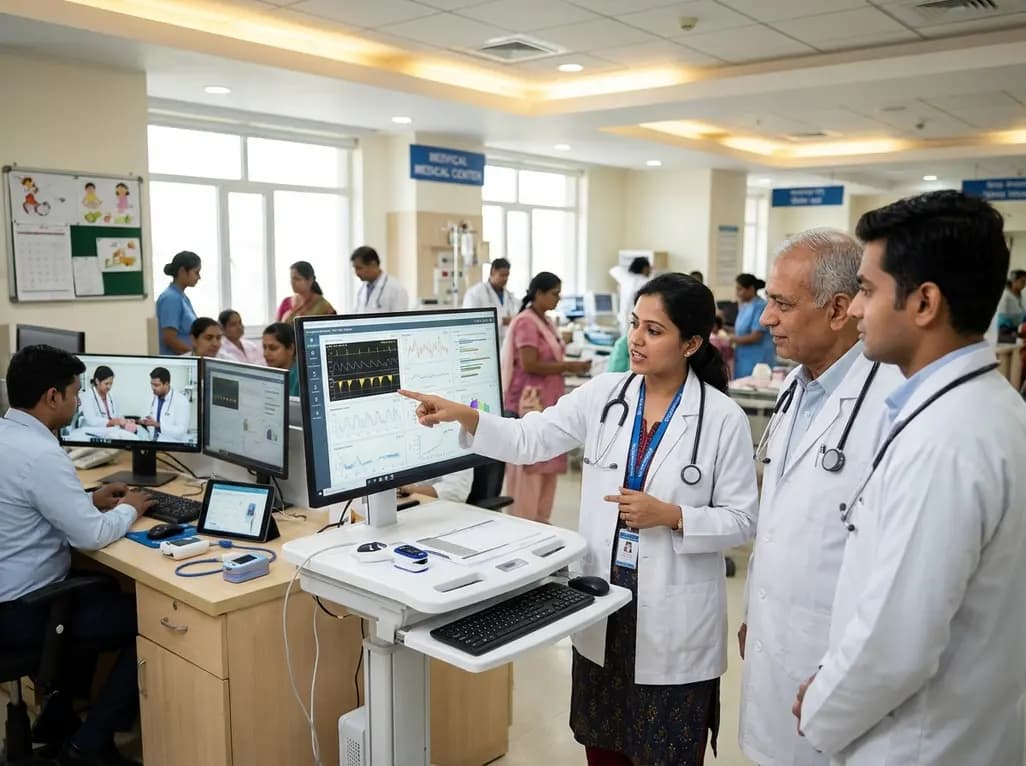
A landmark study details how an enterprise pediatric remote patient management model expanded from a single cardiology pilot to 16 diverse specialty programs by combining centralized digital operations with specialty clinical leadership.
Today
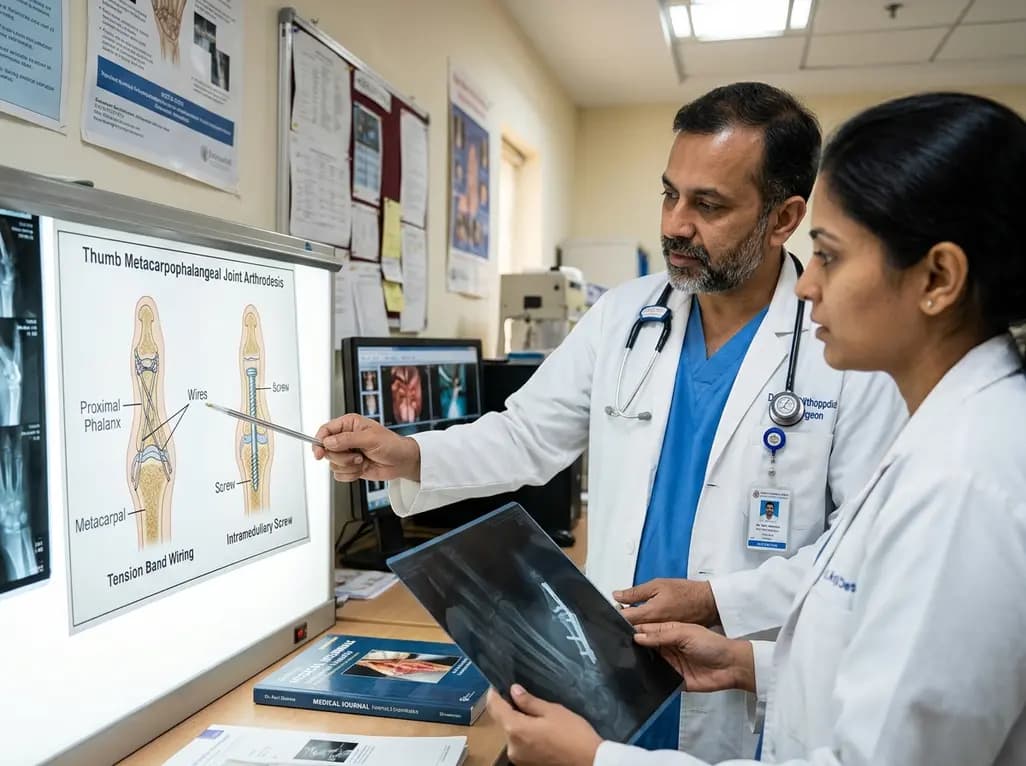
A comparative review of tension band wiring and intramedullary screw fixation in thumb metacarpophalangeal arthrodesis, evaluating union rates, hardware complications, and clinical outcomes.
Today

A breakthrough ultrathin multimodal sensor decouples physical hemodynamic monitoring from disposable electrochemical calibration, achieving long-term wearable glucose prediction with 81.36% accuracy and a 9.12% MARD. This offers a robust, drift-free solution for outpatient metabolic surveillance.
Today
