.webp&w=384&q=75)

Loading, please wait...
Loading, please wait...
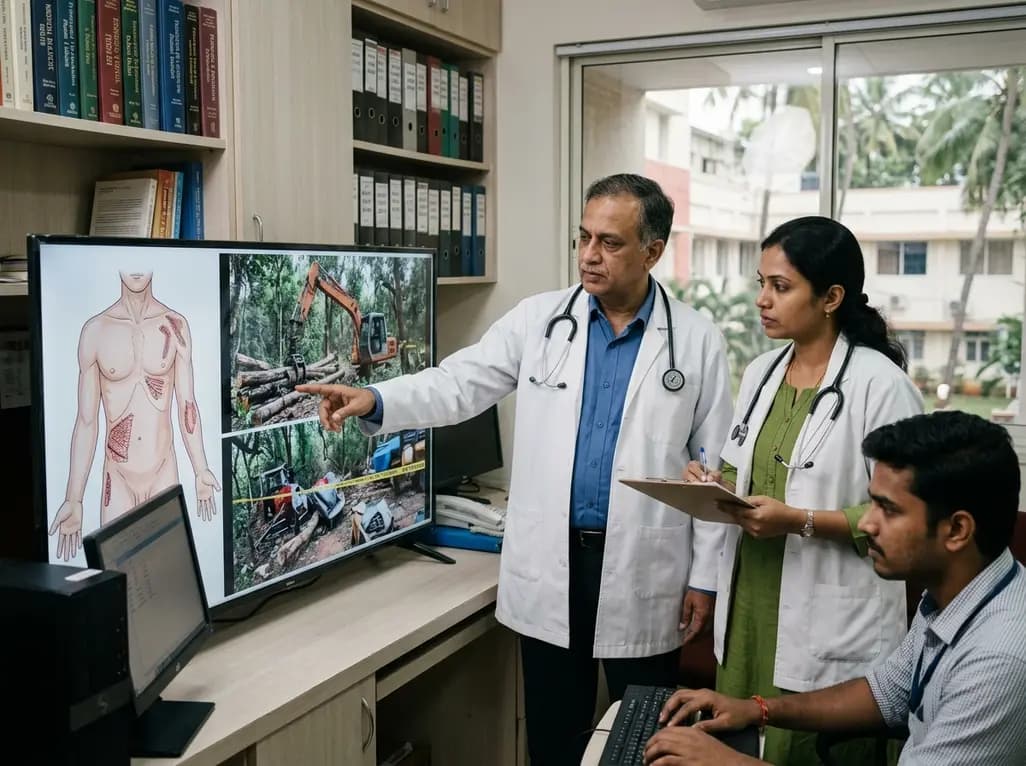
Forestry work remains one of the most hazardous occupational sectors worldwide. Despite significant technological advances in mechanization, ergonomic design, and safety regulation, fatal forestry operations continue to cause tragic worker mortality. These catastrophic fatalities stem from a complex interaction of heavy machinery, dense vegetation, unstable terrain, and worker fatigue. Consequently, forensic pathologists and medicolegal death investigators encounter major reconstructive challenges. Accurately determining whether mechanical failure, environmental hazards, or human error caused a fatality requires a multidisciplinary diagnostic protocol.
Forensic literature categorizes forestry fatalities into five distinct accident classifications. First, chainsaw kickback presents a high-velocity hazard that causes fatal lacerations to the neck, face, and chest. Second, misdirected tree-fall events, including widow-makers and unexpected trunk torsion, deliver massive crushing blunt trauma to ground crews. Third, environmental hazards, such as steep slopes and falling boulders, present unpredictable terrain perils. Fourth, heavy machinery accidents involve tractor rollovers, skidder collapses, and hydraulic crushing. Finally, operator falls from height severely threaten arborists working in tree canopies.
Consequently, each accident category produces unique biomechanical injury patterns that examiners must recognize. Chainsaw injuries produce jagged soft-tissue wounds with vascular transection. In contrast, tree impacts cause extensive skeletal fractures, internal organ rupture, and traumatic asphyxia. Moreover, environmental factors frequently accelerate fatal outcomes through rapid hypothermia or delayed emergency rescue. Therefore, forensic teams must identify the precise operational mechanism during initial scene processing to guide subsequent legal and medicolegal inquiries.
Understanding specific trauma mechanisms is essential when investigating fatal forestry operations. High-velocity chainsaw injuries inflict combined incised and lacerated wounds with severe soft-tissue devastation. The rapidly moving chain teeth cause jagged epidermal margins, micro-fractures of cortical bone, and massive hemorrhage. Consequently, victims rapidly succumb to hypovolemic shock. Furthermore, misdirected trees produce catastrophic deceleration injuries and severe crush trauma.
When massive trunks collapse onto laborers, the physical impact inflicts comminuted skull fractures, atlanto-occipital disruption, and flail chest. In addition, compressive loads from heavy machinery frequently cause traumatic asphyxia. Pathologists identify classic signs of chest compression, such as intense facial petechiae, conjunctival hemorrhage, and marked cervicofacial cyanosis. Moreover, heavy logging equipment causes pelvic disruption, limb amputations, and bilateral lung contusions. Therefore, forensic experts must carefully differentiate primary impact injuries from secondary crushing trauma. Establishing this injury sequence enables examiners to reconstruct the physical dynamics of the fatal incident.
A rigorous death scene analysis forms the foundation of every forestry accident investigation. Investigators must systematically examine the forest environment before weather changes alter crucial physical evidence. For example, wind direction, precipitation, ambient temperature, and slope steepness directly affect timber stability and felling trajectories. Investigators must document tree lean, undercut angles, and remaining stump hinges to establish how the logging cut progressed.
Furthermore, qualified mechanical specialists must inspect all chainsaws, winches, cables, and skidders directly at the scene. Examiners inspect vital safety components, including chain brakes, throttle interlocks, and roll-over protective structures. In many instances, poor equipment maintenance precipitates catastrophic machine failure. In addition, investigators should record spatial coordinates, cutting angles, and final equipment positions using drone photography. Consequently, combining environmental observations with mechanical data prevents speculative conclusions. Forensic teams thereby generate objective spatial reconstructions that verify witness statements and clarify legal liability.
The medicolegal post-mortem examination provides critical biological evidence to verify the exact cause and mechanism of death. Forensic experts begin with full-body post-mortem computed tomography (PMCT) whenever feasible. Virtual imaging rapidly documents occult skeletal fractures, massive pneumothorax, and internal vascular disruptions before physical dissection. Subsequently, pathologists perform a thorough external examination to correlate cutaneous wounds with tools, tree bark, or mechanical components.
Pathologists must photograph patterned contusions that match machinery profiles or chainsaw chain links. Furthermore, internal examination establishes whether trauma caused instantaneous death or whether the individual survived for an extended post-injury interval. Histological evaluation of wound margins verifies tissue vitality and rules out post-mortem artifactual damage. In addition, comprehensive toxicological screening remains mandatory in all workplace death investigations. Pathologists evaluate biological specimens for ethanol, narcotics, and psychoactive medications that impair cognitive alertness. Ultimately, post-mortem diagnostics ensure an evidence-based conclusion that distinguishes pure accidental trauma from prior medical incapacitation.
Modern industrial forestry increasingly utilizes advanced machinery, including mechanized harvesters, GPS monitors, and fleet telemetry systems. Consequently, forensic investigations now integrate digital telemetry alongside classical pathology techniques. Heavy logging vehicles record vehicle velocity, boom positions, hydraulic line pressures, and seat occupancy in continuous electronic logs. Forensic investigators download this black-box telemetry to reconstruct the final seconds before impact.
Moreover, modern forensic researchers apply probabilistic reasoning models and Bayesian networks to analyze complex industrial fatalities. These mathematical frameworks weigh organizational safety standards, mechanical variables, and environmental factors to calculate the most probable accident sequence. In addition, wearable digital telemetry monitors operator heat stress, physical exhaustion, and heart rate variability prior to death. Therefore, integrating digital systems data with post-mortem findings modernizes occupational accident reconstruction. As a result, safety agencies can establish targeted preventive protocols, improved vehicle cabs, and automated emergency braking systems to protect forestry laborers.
Crush injuries and traumatic asphyxia represent the leading causes of death in machinery-related forestry incidents. Heavy timber skidders and tractors frequently roll over on steep slopes, trapping operators beneath structural chassis. This severe thoracic compression restricts ventilation and venous blood return to the heart, producing rapid hypoxia. Consequently, victims rapidly succumb to mechanical asphyxia, extensive pelvic fractures, and massive internal hemorrhage before field emergency personnel can arrive on scene.
Digital telemetry captures continuous operational metrics, such as vehicle velocity, engine parameters, hydraulic line pressures, and cabin safety interlocks. When investigators correlate these electronic log files with physical autopsy findings, they establish an objective timeline of the fatal incident. Furthermore, this electronic data objectively reveals whether machine failure, sudden brake malfunction, or human operator misjudgment triggered the collision. As a result, digital analytics significantly eliminates subjective speculation from the comprehensive medicolegal reconstruction.
Multidisciplinary collaboration integrates specialized forensic pathology, occupational engineering, digital telemetry analysis, and environmental science. A solitary post-mortem examination cannot independently distinguish between mechanical equipment malfunction, poor felling technique, or unforeseen structural tree collapse. By synchronizing autopsy trauma patterns with mechanical inspections and topographical surveys, investigators establish a comprehensive, scientifically sound reconstruction. Consequently, this collaborative approach guarantees definitive legal attribution, resolves insurance disputes, and establishes meaningful workplace safety reforms across industrial forestry sectors.
Disclaimer: This content is for informational and educational purposes only... Refer to the latest local and national guidelines for clinical practice.
References

Read summarized clinical updates, watch expert medical content, and earn CME certifications right from your smartphone.
Open your smartphone camera to scan and install.





Forensic investigation of fatal forestry operations requires integrating scene analysis, machine telemetry, and detailed medicolegal autopsy. This review outlines the five primary accident categories, injury patterns, and modern reconstructive methodologies essential for forensic pathologists and investigators.
last month

As monsoon seasons elevate arboviral disease threats, Tamil Nadu has initiated an ICMR-monitored evaluation of the tetravalent dengue vaccine in Tenkasi district. Clinicians emphasize clinical monitoring, public prevention, and high-quality early pediatric care to reduce disease morbidity across endemic regions.
Today

Leucine Rich Bio has introduced South Asia's first comprehensive vaginal microbiome test, BugSpeaks. By profiling microbial dysbiosis, pathogens, and antimicrobial resistance, this next-generation diagnostic platform provides clinicians with deeper insights into recurrent infections, fertility, and reproductive health.
Today

Review how tailored exercise programs benefit frail older patients with heart failure. Explore pathophysiological mechanisms, individualized training prescriptions, and strategies to overcome adherence barriers in clinical practice.
Today

This comparative study evaluates posterior labral tears with and without glenohumeral instability, highlighting distinct demographic patterns, MRI underestimation in stable shoulders, and successful arthroscopic repair outcomes.
Today

A clinical study demonstrates that early intervention with tocilizumab, either as monotherapy or bridged with corticosteroids, achieves significant proptosis reduction and resolves active inflammation in treatment-naive thyroid eye disease.
Today
