.webp&w=384&q=75)

Loading, please wait...
Loading, please wait...
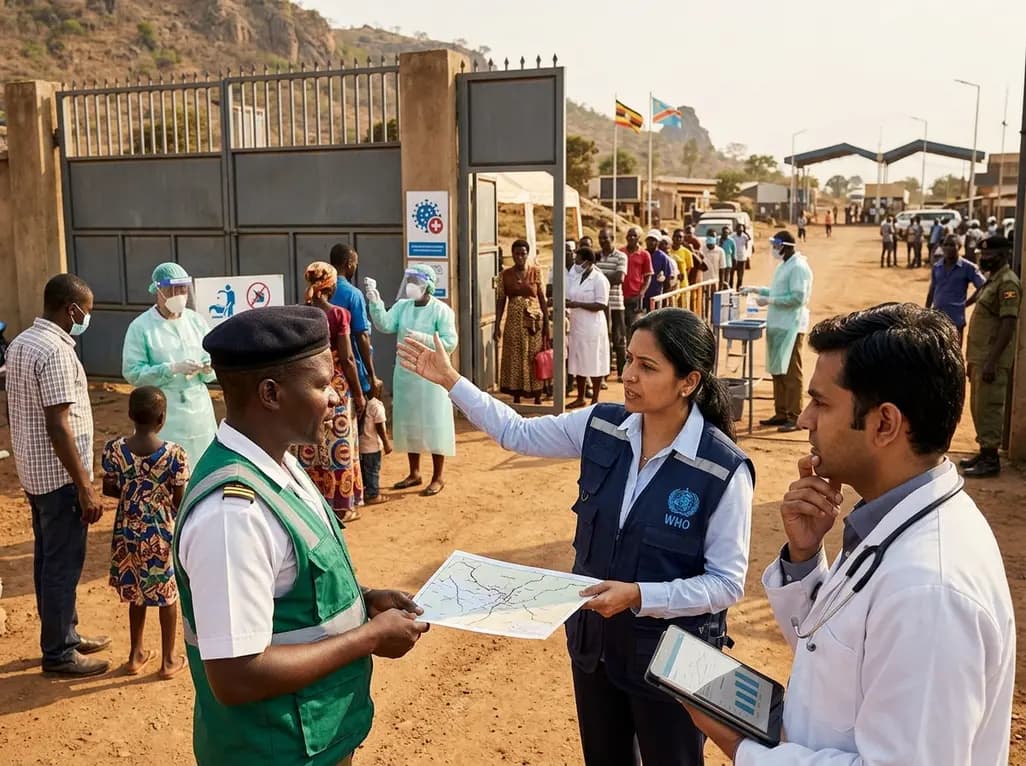
Recently, the World Health Organization urged Uganda to reconsider its border closure with the Democratic Republic of Congo. Specifically, WHO Director-General Tedros Adhanom Ghebreyesus warned that blanket Ebola travel restrictions fail to contain outbreaks. During his hospital visit, Tedros emphasized that strict screening works better than outright closures.
However, public health experts argue that shutting borders does not stop transmission. Instead, such measures often push travelers underground. Consequently, people cross through unmonitored routes, which increases infection risks. Therefore, the WHO advocates for strong surveillance instead of total closures. Furthermore, travel bans can trigger economic instability in volatile regions.
Currently, the outbreak remains a public health emergency of international concern. Specifically, Congo's Ituri province serves as the epicentre. Meanwhile, Uganda has reported nineteen confirmed cases, mostly from cross-border travelers. Although Uganda's response has been prompt, international leaders stress that cooperation is vital.
Q1: Why does the WHO oppose border closures during an Ebola outbreak?
The WHO opposes border closures because blanket restrictions often drive travel underground. This makes it harder to monitor and screen travelers, thereby increasing transmission risk.
Q2: What is the current epicentre of the Bundibugyo Ebola outbreak?
The epicentre of this outbreak is in Ituri province within the Democratic Republic of Congo, which accounts for the vast majority of confirmed cases.
Disclaimer: This content is for informational and educational purposes only. It does not constitute medical advice or replace professional judgment. Refer to the latest local and national guidelines for clinical practice.
References

Read summarized clinical updates, watch expert medical content, and earn CME certifications right from your smartphone.
Open your smartphone camera to scan and install.





A summary of the WHO's stance on Uganda's Ebola border closure, explaining why blanket restrictions fail to control the spread of the Bundibugyo strain....
4 months ago

As monsoon seasons elevate arboviral disease threats, Tamil Nadu has initiated an ICMR-monitored evaluation of the tetravalent dengue vaccine in Tenkasi district. Clinicians emphasize clinical monitoring, public prevention, and high-quality early pediatric care to reduce disease morbidity across endemic regions.
Today

Leucine Rich Bio has introduced South Asia's first comprehensive vaginal microbiome test, BugSpeaks. By profiling microbial dysbiosis, pathogens, and antimicrobial resistance, this next-generation diagnostic platform provides clinicians with deeper insights into recurrent infections, fertility, and reproductive health.
Today

Review how tailored exercise programs benefit frail older patients with heart failure. Explore pathophysiological mechanisms, individualized training prescriptions, and strategies to overcome adherence barriers in clinical practice.
Today

This comparative study evaluates posterior labral tears with and without glenohumeral instability, highlighting distinct demographic patterns, MRI underestimation in stable shoulders, and successful arthroscopic repair outcomes.
Today

A clinical study demonstrates that early intervention with tocilizumab, either as monotherapy or bridged with corticosteroids, achieves significant proptosis reduction and resolves active inflammation in treatment-naive thyroid eye disease.
Today
