.webp&w=384&q=75)

Loading, please wait...
Loading, please wait...

Recently, a health scare in Bengaluru has highlighted the status of Ebola preparedness in India. Specifically, health officials isolated a 28-year-old Ugandan traveler in Bengaluru after she developed mild body aches. The patient had recently traveled from an Ebola-affected region. Consequently, authorities acted quickly to isolate her as a precautionary measure.
The medical team in Bengaluru immediately collected blood samples from the patient. Subsequently, they sent these samples to the ICMR-National Institute of Virology (NIV) in Pune for confirmatory testing. According to health department officials, her condition remains stable. However, as per standard protocol, the hospital will conduct a repeat test after 48 hours. Therefore, the patient will only receive a discharge after testing negative twice. Fortunately, her initial test results have returned negative, confirming no active transmission in India.
This incident occurred after the WHO declared the African Ebola outbreak a Public Health Emergency of International Concern. In response, the Karnataka Health Department issued a comprehensive travel advisory. Specifically, this advisory requires recent travelers from affected countries to undergo self-monitoring for 21 days. Additionally, the department put Rapid Response Teams (RRTs) on high alert to undertake immediate surveillance. To ensure readiness, the state government designated specific facilities for quarantine and treatment.
In Bengaluru, the Rajiv Gandhi Institute of Chest Diseases (RGICD) serves as the isolation center. Meanwhile, the Epidemic Diseases Hospital acts as the quarantine and treatment facility. Furthermore, Mangaluru has designated Srinivas Port Hospital and Wenlock District Hospital for similar emergency services.
Q1: What are the primary symptoms of Ebola virus disease?
Ebola symptoms usually include fever, severe weakness, muscle pain, headache, and sore throat. As the disease progresses, patients may experience vomiting, diarrhea, rash, and impaired kidney or liver function.
Q2: What quarantine protocols has Karnataka established for travelers?
The Karnataka Health Department mandates that travelers returning from Ebola-affected countries undergo self-monitoring for 21 days. If they develop symptoms, they must report to the nearest health facility immediately.
Q3: Which hospitals in Bengaluru handle suspected Ebola cases?
In Bengaluru, the Rajiv Gandhi Institute of Chest Diseases serves as the designated isolation center. Additionally, the Epidemic Diseases Hospital functions as the quarantine and treatment facility.
Disclaimer: This content is for informational and educational purposes only. It does not constitute medical advice or replace professional judgment. Refer to the latest local and national guidelines for clinical practice.
References

Read summarized clinical updates, watch expert medical content, and earn CME certifications right from your smartphone.
Open your smartphone camera to scan and install.





A suspected Ebola case in Bengaluru prompts strict quarantine, highlighting India's robust virus monitoring protocols and travel guidelines....
4 months ago
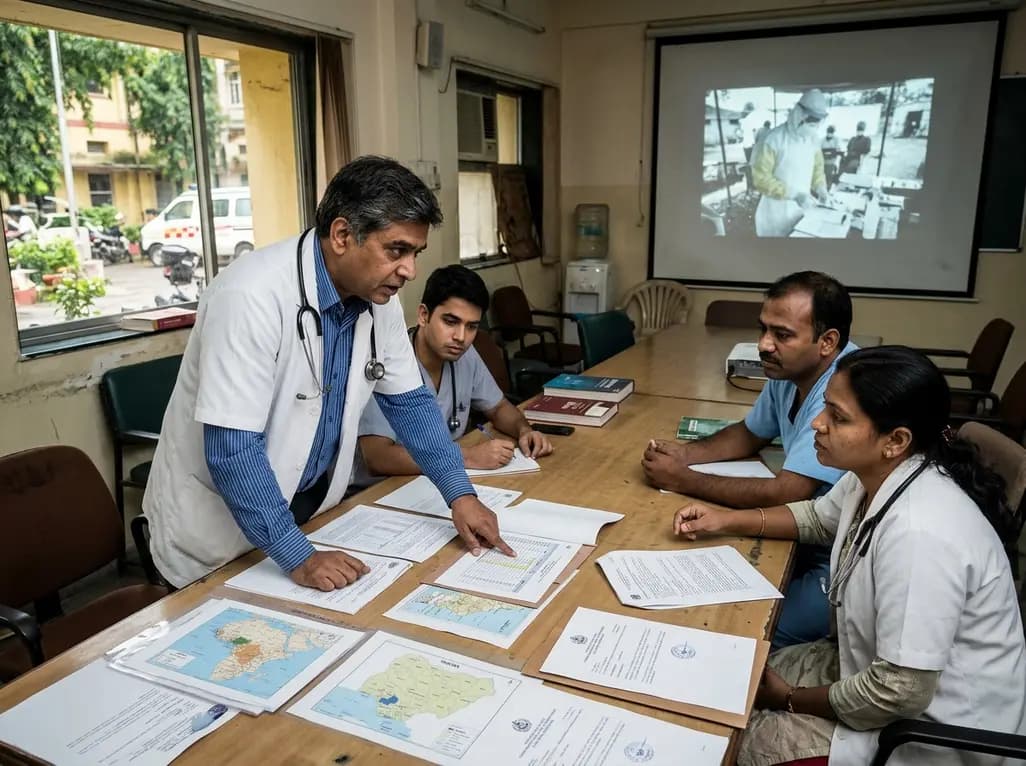
Following Nigeria's first recorded Ebola case linked to regional travel, the Africa CDC has convened an emergency ministerial summit. This alert underscores critical clinical priorities for healthcare professionals, including differentiating early viral infection from malaria, implementing barrier nursing, and triage.
Today

Leucine Rich Bio has introduced South Asia's first comprehensive vaginal microbiome test, BugSpeaks. By profiling microbial dysbiosis, pathogens, and antimicrobial resistance, this next-generation diagnostic platform provides clinicians with deeper insights into recurrent infections, fertility, and reproductive health.
Today

Review how tailored exercise programs benefit frail older patients with heart failure. Explore pathophysiological mechanisms, individualized training prescriptions, and strategies to overcome adherence barriers in clinical practice.
Today

This comparative study evaluates posterior labral tears with and without glenohumeral instability, highlighting distinct demographic patterns, MRI underestimation in stable shoulders, and successful arthroscopic repair outcomes.
Today

A clinical study demonstrates that early intervention with tocilizumab, either as monotherapy or bridged with corticosteroids, achieves significant proptosis reduction and resolves active inflammation in treatment-naive thyroid eye disease.
Today
