.webp&w=384&q=75)

Loading, please wait...
Loading, please wait...
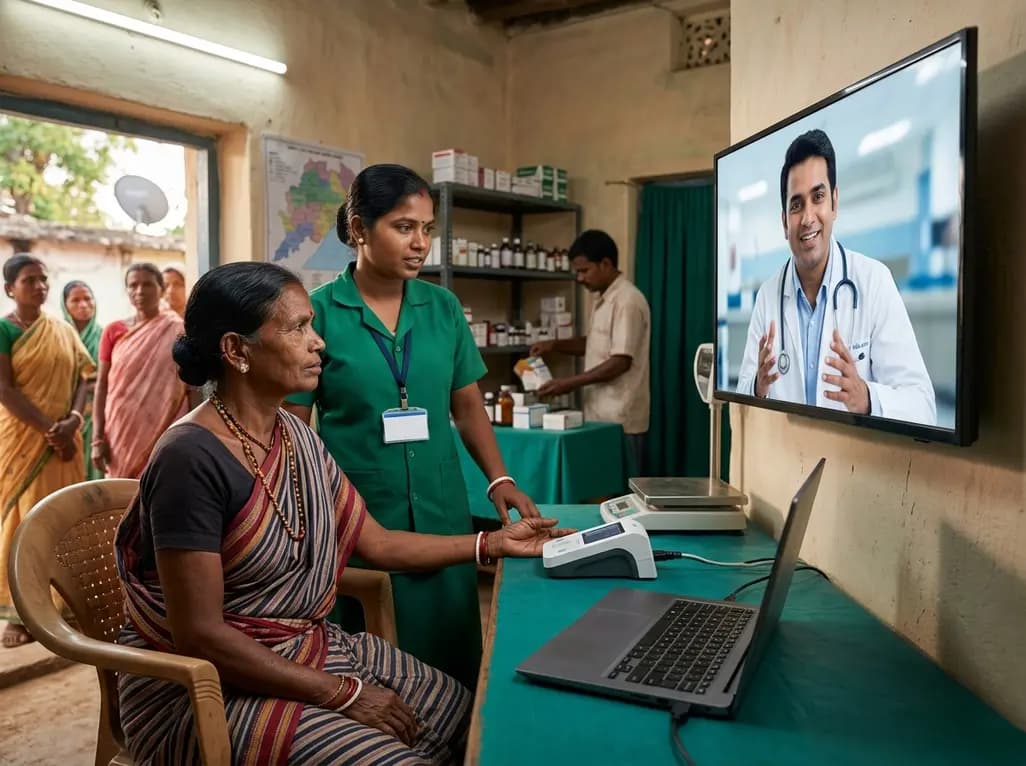
The delivery of primary healthcare in geographically isolated regions has long presented formidable logistical challenges. Recently, Apollo TeleHealth achieved a major landmark by logging over one million digital dispensary teleconsultations through its Keonjhar Digital Dispensary Initiative in Odisha. Furthermore, this initiative demonstrates how digital technology can bridge severe healthcare access gaps across remote tribal and mining communities. Consequently, the program has established a resilient model for equitable medical access in resource-limited rural settings.
Over the past three years, the Keonjhar project has expanded into a robust network of 66 digital dispensaries. As a result, the initiative currently serves more than 30,000 patients every month across isolated regions. Initially, remote tribal and mining communities faced immense difficulties in accessing basic clinical advice. Consequently, patients often delayed seeking care due to severe geographical barriers and high travel expenses. Digital dispensaries now provide rapid point-of-care evaluations that connect rural citizens directly with qualified medical practitioners. In addition, average patient waiting times have dropped significantly to between five and eight minutes. Notably, over 90 percent of attending patients receive complete clinical management right at their local center. Therefore, families no longer need to sacrifice vital daily wages to travel long distances for essential primary consultations. Furthermore, this rapid delivery of care prevents minor health issues from escalating into life-threatening emergencies. Ultimately, the program showcases how digital infrastructure can level the healthcare playing field for vulnerable populations. Specifically, the continuity of care provided by trained paramedics and digital interfaces has fostered immense trust within local communities.
The remarkable scale of this rural health initiative relies heavily on structured institutional collaboration. Specifically, Apollo TeleHealth implements the program in direct partnership with the Chief District Medical and Public Health Officer of Keonjhar. Furthermore, crucial financial and logistical backing comes from the District Mineral Foundation. This public-private partnership model combines private sector technological agility with public sector administrative reach. Consequently, public health infrastructure in underserved mining belts has gained substantial clinical capacity. In addition, the involvement of local district administrators ensures that services align directly with regional health priorities. Therefore, the initiative operates as an integrated component of the state public health system rather than a standalone vertical project. Moreover, structured administrative oversight guarantees standardized quality protocols across all participating centers. As a result, resource allocation remains highly efficient across all 66 digital dispensaries. Ultimately, this collaborative framework offers a proven blueprint for state governments seeking to modernize rural healthcare infrastructure without incurring prohibitive operational expenditure. Consequently, healthcare workers on the ground receive continuous technical support and supervision from central medical hubs.
Virtual consultations alone cannot resolve complex health challenges without accessible laboratory support and essential medicines. Therefore, the Keonjhar Digital Dispensary model incorporates on-site diagnostic testing alongside certified drug dispensing. To date, the program has enabled more than 200,000 diagnostic tests for rural beneficiaries. Furthermore, onsite paramedics utilize connected medical devices to perform rapid blood tests, electrocardiograms, and vital sign monitoring. As a result, tele-consulting physicians receive real-time clinical parameters to formulate accurate diagnostic decisions. In addition, the dispensaries maintain inventory of over 60 essential generic medicines. Patients receive prescribed medications immediately after their virtual consultation at no personal cost. Consequently, medication compliance has improved dramatically across remote patient cohorts. Furthermore, for patients requiring tertiary intervention, the network has facilitated over 20,000 timely specialist referrals. Thus, the digital dispensary operates as a comprehensive health hub rather than a simple tele-calling station. Ultimately, this seamless integration of diagnosis, prescription, and referral ensures holistic care delivery. Specifically, real-time diagnostic reporting enables physicians to initiate targeted therapies during the initial patient visit.
Beyond routine outpatient care, the digital dispensary network plays a vital role in disease surveillance and preventive medicine. Specifically, the initiative has strengthened early detection and management of endemic infectious diseases such as malaria and dengue. In addition, early clinical intervention has markedly reduced acute complications associated with pediatric malnutrition. Furthermore, chronic non-communicable diseases, including hypertension and diabetes, are now identified and managed before organ damage occurs. Notably, maternal healthcare outcomes have improved due to increased utilization of antenatal care services. Pregnant women in remote tribal hamlets now undergo routine antenatal checkups, hemoglobin screenings, and high-risk monitoring locally. Consequently, healthcare workers identify obstetric risks early and arrange planned hospital referrals well before delivery. Therefore, maternal and neonatal morbidity rates in the district show promising downward trends. Moreover, digital records enable continuous tracking of immunizations and developmental milestones in infants. As a result, preventive public health indicators across Keonjhar district have recorded substantial improvements over recent years. Thus, early diagnostic screening mitigates long-term disease burden and reduces secondary healthcare costs for rural households.
The success of the Keonjhar project offers valuable strategic insights for medical practitioners and healthcare policy architects across India. First, it unequivocally demonstrates that rural and tribal populations readily accept digital health solutions when coupled with local human support. Second, general practitioners can leverage hybrid telemedicine models to expand their clinical footprint into underserved rural catchments. Furthermore, integrating digital diagnostics with virtual care allows clinicians to deliver evidence-based medicine remotely without compromising safety. In addition, public health planners must recognize digital dispensaries as essential tools for achieving universal health coverage. By diverting low-acuity cases away from overburdened district hospitals, digital dispensaries preserve tertiary resources for severe illnesses. Consequently, public healthcare systems operate with greater efficiency and reduced financial strain. Therefore, medical associations and training institutes should actively incorporate telemedicine skills into primary care medical education. Ultimately, scaling similar technology-enabled models across other states will significantly accelerate India's progress toward comprehensive health equity. Moreover, establishing digital clinical registers provides valuable epidemiological data for targeted regional health planning.
Q1: What is the Keonjhar Digital Dispensary Initiative?
The Keonjhar Digital Dispensary Initiative is a technology-enabled primary healthcare project in Odisha implemented by Apollo TeleHealth in partnership with district health authorities and funded by the District Mineral Foundation. It operates 66 digital dispensaries that provide free virtual consultations, point-of-care laboratory diagnostics, essential medicines, and specialist referrals to remote tribal and mining communities across Keonjhar district.
Q2: How does the digital dispensary model improve rural healthcare delivery?
The model combines virtual consultations with physical point-of-care support managed by trained paramedics. Patients undergo rapid diagnostic testing and consult qualified physicians remotely within five to eight minutes. Additionally, dispensaries provide free prescribed medicines and facilitate secondary or tertiary hospital referrals when necessary. This integrated approach eliminates long travel times, lowers healthcare expenses, and ensures that over 90 percent of patients receive care locally.
Q3: What clinical benefits have been observed through this initiative?
The initiative has improved early detection and treatment of infectious diseases like malaria and dengue, alongside chronic conditions like diabetes and hypertension. Furthermore, it has boosted antenatal care adoption among pregnant women, strengthened pediatric malnutrition screening, and facilitated over 20,000 specialist referrals. Overall, the program has completed over one million teleconsultations and 200,000 diagnostic tests, significantly enhancing primary care outcomes across the district.
Disclaimer: This content is for informational and educational purposes only. It does not constitute medical advice or replace professional judgment. Refer to the latest local and national guidelines for clinical practice.
References

Read summarized clinical updates, watch expert medical content, and earn CME certifications right from your smartphone.
Open your smartphone camera to scan and install.





Apollo TeleHealth's Keonjhar Digital Dispensary Initiative has logged 1 million teleconsultations across remote tribal communities in Odisha. Operating 66 centers, the project integrates virtual consultations, point-of-care diagnostics, and essential medicine delivery to strengthen last-mile primary care.
last month

Patient tech testing panels offer an effective framework to assess digital health literacy in primary care. By engaging diverse patient cohorts across language preferences and technical skill levels, healthcare organizations can co-design equitable, accessible patient portals and mobile health interventions.
Today

A multicentre RCT in China shows that the PAICS AI system significantly boosts sonographer sensitivity in detecting fetal intracranial malformations by 8.7% without compromising specificity, offering promising diagnostic support for prenatal neurosonography.
Yesterday

The PRIME-MR registry reveals that baseline severe tricuspid regurgitation significantly increases two-year mortality after transcatheter edge-to-edge repair for primary mitral regurgitation, highlighting the critical importance of early right heart assessment and comprehensive valvular management.
Today

A retrospective cohort study demonstrates that patients with anorexia nervosa and bulimia nervosa face significantly higher risks of lower extremity soft tissue injuries, including ACL tears and ligament sprains, along with heightened rates of orthopedic revision surgery, highlighting the need for systemic screening.
Today

Groundbreaking multiomics research reveals that adipose-derived miR-30e-5p travels via exosomes to vascular endothelial cells, silencing SLC7A11 and accelerating atherosclerosis. This discovery highlights novel therapeutic avenues within cardiovascular-kidney-metabolic syndrome.
Today
