

Loading, please wait...
Loading, please wait...

Clinicians frequently encounter young patients in acute psychiatric crises marked by severe affective dysregulation and repeated self-harm. In many cases, these presentations reflect adolescent borderline personality disorder, a condition that medical professionals historically hesitated to identify in minors. Diagnostic inertia often stems from outdated beliefs regarding personality stability during teenage years. Nevertheless, empirical data confirm that borderline pathology emerges reliably before adulthood. Prompt recognition allows inpatient units to deliver structured, compassionate interventions rather than fragmented medical responses. Consequently, evaluating acute presentations through an evidence-based lens ensures that hospitalized youth receive the timely therapeutic care they desperately require.
Historically, practitioners avoided diagnosing adolescent borderline personality disorder due to pervasive clinical misunderstandings. Many clinicians erroneously believed that diagnostic manuals prohibited personality disorder diagnoses prior to age eighteen. However, both the DSM-5 and ICD-11 explicitly permit this diagnosis when pervasive, maladaptive patterns persist for at least one year. Furthermore, clinicians often feared that documenting personality pathology would permanently stigmatize young individuals. In reality, withholding an accurate diagnostic formulation perpetuates confusion and denies youth targeted psychotherapeutic care.
Additionally, some practitioners mistakenly dismiss acute affective volatility as ordinary adolescent turbulence. Empirical investigations clearly indicate that typical adolescent development does not involve recurrent deliberate self-injury or chronic suicidal behavior. Research confirms that borderline traits in youth display comparable validity, structural stability, and severity to adult cohorts. Therefore, establishing diagnostic clarity provides tremendous relief to families seeking cohesive explanations for overwhelming behavioral crises. Early identification also counters therapeutic nihilism by framing the presentation as an eminently treatable condition.
Adolescents with borderline traits frequently arrive in emergency rooms and inpatient wards following severe crises. Recurrent suicide attempts and non-suicidal self-injury represent the most common triggers for acute medical admissions. When distress escalates, these youth experience extreme emotional pain alongside marked cognitive shifts. Consequently, inpatients may exhibit intense interpersonal conflicts, profound abandonment fears, and transient stress-induced paranoid ideation.
Moreover, acute medical teams frequently manage co-occurring conditions that obscure the underlying personality pathology. Depressive episodes, anxiety disorders, substance experimentation, and eating disturbances regularly co-exist with borderline features. When clinicians treat only secondary depressive symptoms, patients inevitably return with recurrent self-directed violence. Inpatient teams must therefore look beyond isolated crises to recognize longitudinal patterns of instability. Recognizing these persistent patterns enables clinicians to formulate comprehensive crisis plans that address underlying emotional dysregulation directly.
Inpatient psychiatric units require rapid, reliable instruments to detect emerging borderline traits during initial intake. Fortunately, researchers have thoroughly validated several self-report screening tools specifically within adolescent cohorts. The McLean Screening Instrument for Borderline Personality Disorder serves as an efficient ten-item measure adapted directly from established diagnostic criteria. Adolescents can complete this questionnaire independently within minutes, allowing admitting staff to evaluate critical symptom clusters swiftly.
Similarly, the Borderline Personality Features Scale for Children provides comprehensive assessment data across key developmental domains. This specialized instrument evaluates affective instability, identity problems, negative relationships, and behavioral self-harm. By systematically incorporating these validated screening inventories into standard nursing admissions, acute units prevent vulnerable adolescents from slipping through diagnostic cracks. Positive screening results should prompt detailed clinical interviews to corroborate functional impairment across home and academic environments. Consequently, systematic screening standardizes admission protocols and ensures equitable diagnostic scrutiny for all high-risk youth.
Psychotherapy represents the undisputed first-line treatment for borderline pathology across all age demographics. Specifically, dialectical behavior therapy for adolescents provides an exceptional, evidence-based clinical framework for acute inpatient environments. Inpatient clinicians can immediately introduce core distress tolerance and mindfulness modules to replace maladaptive coping behaviors. These practical skills teach hospitalized youth how to survive emotional crises without resorting to physical self-injury.
Furthermore, therapeutic teams can structure the acute milieu to reinforce daily emotional regulation practice. Consistent behavioral boundaries, predictable unit schedules, and validating nurse-patient interactions help stabilize volatile affective states. Crucially, clinical trials demonstrate that adolescents displaying subthreshold borderline symptoms benefit just as significantly from skills training as those meeting full diagnostic criteria. By introducing these behavioral modalities during acute hospitalizations, teams lay indispensable foundations for continuous outpatient recovery. Clinicians can thus utilize brief inpatient stays to instill genuine therapeutic optimism.
Inpatient admissions offer an invaluable opportunity to re-evaluate complicated, ineffective medication regimens. Medical providers often prescribe multiple psychotropic agents reactively to manage explosive behavioral outbursts. Consequently, vulnerable adolescents frequently arrive on polypharmacy combinations that yield negligible clinical benefit while causing substantial metabolic harm. Clinical guidelines firmly emphasize that no specific psychotropic medication cures core personality traits or repairs attachment disturbances.
Therefore, inpatient physicians must actively consider deprescribing redundant sedatives, mood stabilizers, and antipsychotic agents. Instead of escalating medication dosages, providers should utilize pharmacotherapy strictly as a temporary adjunct for acute comorbid psychiatric distress. Meanwhile, the multidisciplinary team must prioritize environmental predictability and behavioral containment over pharmacological restraint. Transparent treatment contracts, clear expectations, and empathetic limit setting provide necessary external safety. This rational, psychotherapeutically oriented strategy reduces adverse medication interactions while empowering young patients to develop internal coping mechanisms.
Successful inpatient discharge planning depends heavily on active, collaborative caregiver engagement. Parents often experience profound exhaustion, helplessness, and guilt after witnessing repetitive self-harm behaviors in their children. Inpatient clinicians should proactively provide structured psychoeducation using simple, validating, and entirely non-blaming language. De-escalating parental self-blame enables families to become effective partners in long-term safety planning.
Additionally, psychoeducation demystifies borderline symptoms by explaining that intense behavioral outbursts stem from neurological emotion sensitivity. Clinicians can instruct parents in basic validation techniques, teaching them how to soothe emotional escalation at home. Connecting families with specialized outpatient community resources, support groups, and family skills training prevents post-discharge relapse. When clinical teams foster mutual empathy between parents and teens, they establish a cohesive support system. Ultimately, compassionate communication transforms a terrifying inpatient admission into a collaborative journey toward sustained healing.
Yes, clinicians can definitively diagnose this condition in adolescents. Both the DSM-5 and ICD-11 permit the diagnosis when pervasive patterns of emotional dysregulation, interpersonal instability, and impulsivity persist for at least one year. Early formal diagnosis avoids therapeutic delays, eliminates clinical confusion, and connects youth with proven, specialized treatments like dialectical behavior therapy before maladaptive coping patterns become deeply entrenched into adulthood.
Clinical units primarily utilize the McLean Screening Instrument for Borderline Personality Disorder and the Borderline Personality Features Scale for Children. The McLean tool provides an efficient ten-item self-report questionnaire that youth complete rapidly upon admission. Meanwhile, the childhood features scale systematically evaluates affective instability, negative relationships, identity disturbance, and self-harm. Both instruments offer high sensitivity and specificity for identifying adolescents needing thorough clinical evaluation.
Inpatient teams should prioritize non-pharmacological interventions, as medications do not resolve underlying personality structure. Hospitalization provides an ideal window to deprescribe ineffective polypharmacy regimens that accrued during previous crises. Clinicians should reserve medications solely for targeted, short-term management of severe comorbid psychiatric conditions, such as major depression or acute anxiety, while actively directing the patient toward psychotherapy and skills acquisition.
Disclaimer: This content is for informational and educational purposes only and should not be considered medical advice. Always consult with a qualified healthcare professional regarding any medical condition or treatment. Refer to the latest local and national guidelines for clinical practice.
References
Shapiro MA et al. Diagnosing adolescent borderline personality disorder in the inpatient setting. Curr Probl Pediatr Adolesc Health Care. 2026 Oct 23. doi: undefined. PMID: 42919793.
Zanarini MC, Vujanovic AA, Parachini EA, Boulanger JL, Frankenburg FR, Hennen J. A screening measure for BPD: the McLean Screening Instrument for Borderline Personality Disorder (MSI-BPD). J Pers Disord. 2003;17(6):568-573.
Mehlum L, Tørmoen AJ, Ramberg M, Haga E, Diep LM, Laberg S, Larsson B, Stanley BH, Miller AL, Sund AM, Groholt B. Dialectical behavior therapy for adolescents with repeated suicidal and self-harming behavior: a randomized trial. J Am Acad Child Adolesc Psychiatry. 2014;53(10):1082-1091.
Chanen AM, Sharp C, Hoffman P. Prevention and early intervention for borderline personality disorder: a novel public health priority. World Psychiatry. 2017;16(2):215-216.

Read summarized clinical updates, watch expert medical content, and earn CME certifications right from your smartphone.
Open your smartphone camera to scan and install.





Adolescent borderline personality disorder is frequently underdiagnosed in acute inpatient settings. Early identification using validated screening tools, structured psychotherapeutic stabilization, and compassionate family psychoeducation can transform acute crises into pivotal opportunities for recovery.
Today
The TREM-AB open-label pilot study evaluated a wearable passive nonlinear vibration absorber for essential tremor. The Nonlinear Energy Sink bracelet reduced clinical Fahn-Tolosa-Marin tremor scores by 32.1% and electrophysiological tremor power by 49.2% with no adverse effects reported.
Today

A population-based study of 20,928 children reveals that small vulnerable newborns face sex-divergent mental capital outcomes at ages 6-7: term SGA girls show higher behavioral difficulties and lower resilience, while preterm non-SGA boys experience increased behavioral problems.
Today

A breakthrough ultrathin multimodal sensor decouples physical hemodynamic monitoring from disposable electrochemical calibration, achieving long-term wearable glucose prediction with 81.36% accuracy and a 9.12% MARD. This offers a robust, drift-free solution for outpatient metabolic surveillance.
Today

A comparative review of tension band wiring and intramedullary screw fixation in thumb metacarpophalangeal arthrodesis, evaluating union rates, hardware complications, and clinical outcomes.
Today
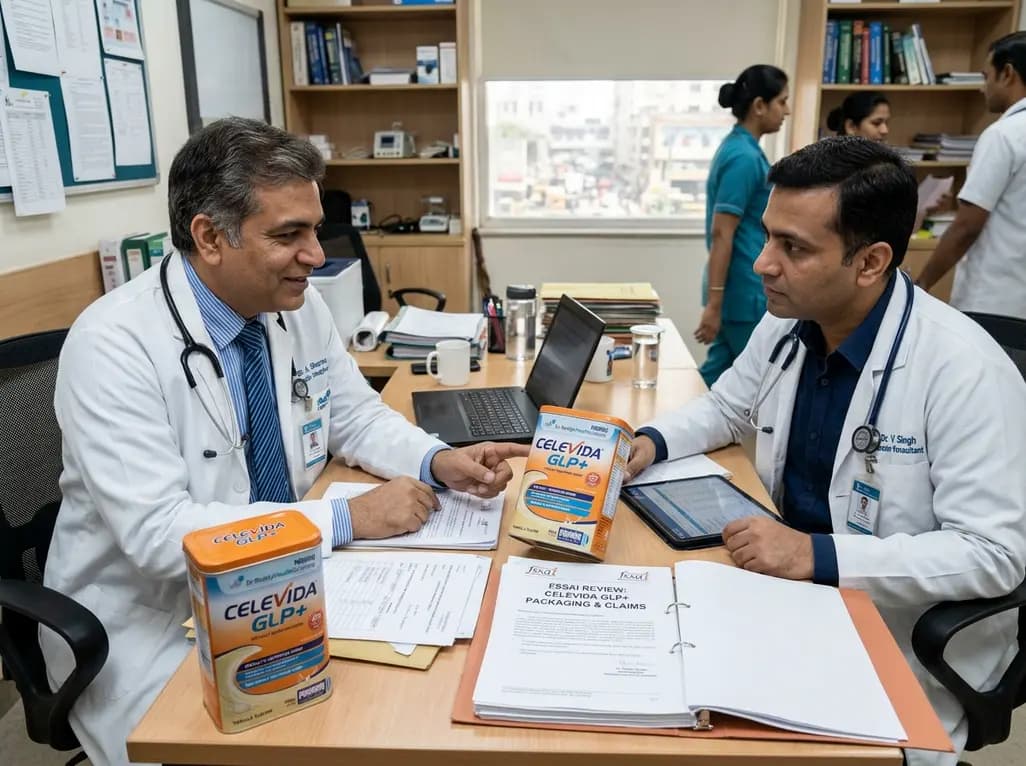
Following regulatory scrutiny from FSSAI regarding promotional representations and lean muscle preservation claims, Dr. Reddy's Laboratories and Nestlé Health Science are currently reviewing the branding and marketing strategy for their joint nutritional supplement Celevida GLP+.
Today
