.webp&w=384&q=75)

Loading, please wait...
Loading, please wait...

Intracranial aneurysms represent a critical challenge in modern neurovascular care, particularly in India where the prevalence of risk factors like uncontrolled hypertension and tobacco use remains significantly high. These localized dilations of cerebral arteries often remain asymptomatic until the catastrophic event of a subarachnoid hemorrhage occurs. Recent scientific investigations have shifted focus from simple mechanical wall stress to the complex immunological environment within the vessel wall. Specifically, the role of CXCL13 in Intracranial Aneurysms has emerged as a pivotal factor in understanding how these lesions progress and eventually fail. Understanding the immune cell landscape is no longer just an academic exercise; it is a clinical necessity for developing targeted therapies that could prevent rupture. Historically, inflammation was viewed as a general, non-specific response. However, modern multi-omics approaches now reveal a highly structured and sophisticated immune architecture. By characterizing the spatial composition of immune cells, researchers are identifying specific pathways that drive the weakening of the arterial wall. This article explores how specific immune clusters and signaling molecules coordinate the destructive processes within an aneurysm, providing a new roadmap for risk stratification and pharmacological intervention in neurosurgery.
One of the most striking findings in recent vascular research is the identification of tertiary lymphoid structures (TLS) within the aneurysm wall. These are organized aggregates of immune cells that form in non-lymphoid tissues during chronic inflammation. They resemble secondary lymphoid organs like lymph nodes but arise locally at the site of pathology. In the context of intracranial aneurysms, the presence of these structures strongly correlates with an increased risk of rupture. This discovery suggests that the aneurysm wall is not merely a passive tissue undergoing mechanical stretching but an active site of intense, organized immune activity. Furthermore, the spatial transcriptomics data indicates that these structures contain distinct zones for B-cells and T-cells, facilitating a local adaptive immune response. This local recruitment and organization of immune cells likely accelerate the degradation of the extracellular matrix. Consequently, the presence of TLS could serve as a biological marker for identifying high-risk patients who require urgent surgical or endovascular intervention. Therefore, understanding the formation of TLS is essential for neurosurgeons who aim to move beyond anatomical imaging toward biological risk assessment.
The signaling molecule CXCL13 in Intracranial Aneurysms acts as a master regulator of the immune landscape. This chemokine is primarily responsible for the recruitment of B-cells and the structural organization of tertiary lymphoid structures. Researchers have observed a significant expansion of a specific T-cell subset known as CXCL13 T-follicular helper (Tfh) cells within the aneurysm wall. These cells produce high levels of CXCL13, which in turn draws in more immune cells, creating a self-sustaining cycle of chronic inflammation. This signaling axis appears to be fundamental to the structural integrity, or lack thereof, of the arterial wall. Moreover, the study demonstrates that CXCL13 is not just a bystander but a driver of the disease process. When B-cells are recruited to these sites, they may contribute to tissue damage through the production of autoantibodies or the secretion of pro-inflammatory cytokines. Specifically, the interplay between T-follicular helper cells and B-cells within the TLS framework seems to dictate the speed of aneurysm advancement. By targeting this specific signaling pathway, clinicians might be able to halt the inflammatory cascade before the vessel wall reaches its breaking point.
To unravel the complexity of the immune environment, scientists employed an integrated multi-omics approach. This involved combining single-cell RNA sequencing, spatial transcriptomics, and multiplex immunofluorescence on human IA tissues. Such high-resolution techniques allow for the systematic characterization of every cell type present in the aneurysm wall. The data revealed a diverse immune cell atlas, showing that the inflammation is far more complex than previously thought. For instance, the research identified specific macrophage polarizations and T-cell phenotypes that are unique to ruptured versus unruptured aneurysms. Notably, the spatial architecture showed that immune cells are not randomly distributed; instead, they form precise clusters that facilitate cell-to-cell communication. This spatial organization is critical because it allows the immune system to concentrate its destructive enzymes, such as matrix metalloproteinases, in specific regions of the aneurysm. Consequently, these multi-omics findings provide a massive leap in our understanding of the disease, moving from a histological description to a molecular map. This depth of information is vital for developing personalized medicine approaches where treatment is tailored to the specific molecular profile of the patient’s aneurysm.
The transition from bench to bedside is perhaps the most exciting aspect of this research. Using a mouse model of intracranial aneurysm, researchers tested the efficacy of CXCL13 neutralization. The results were highly promising, as the intervention effectively suppressed both the formation of new aneurysms and the rupture of existing ones. This experimental success highlights the CXCL13 signaling axis as a high-value therapeutic target. Currently, the primary treatment for intracranial aneurysms is invasive surgery or endovascular coiling, both of which carry inherent risks. A pharmacological alternative that could stabilize the aneurysm wall by modulating the immune response would be a paradigm shift in neurovascular medicine. Additionally, the study suggests that drugs targeting T-follicular helper cells or their secreted chemokines could potentially be repurposed or developed to treat patients who are not suitable candidates for surgery. However, further clinical trials are necessary to determine the safety and efficacy of these treatments in humans. Nevertheless, the ability to prevent rupture through targeted molecular therapy offers a glimpse into a future where subarachnoid hemorrhage becomes a preventable condition rather than an unpredictable disaster.
In the Indian clinical landscape, where access to advanced neuroimaging may be limited in rural areas, identifying molecular targets like CXCL13 offers new hope for diagnostic development. If blood-based biomarkers reflecting the CXCL13-TLS axis can be validated, they could assist in screening high-risk populations more effectively. Furthermore, the high burden of vascular diseases in India necessitates a deeper look into the genetic and environmental factors that drive these immune responses. Consequently, Indian neurosurgeons and neurologists should stay informed about these molecular advancements, as they may lead to new guidelines for aneurysm monitoring. Ultimately, the integration of molecular biology into the clinical management of vascular disorders will enhance our ability to protect patients from life-threatening hemorrhages. This research underscores the importance of continued investment in vascular immunology to improve long-term patient outcomes.
Tertiary lymphoid structures (TLS) are organized clusters of immune cells, including T-cells and B-cells, that form at sites of chronic inflammation like the aneurysm wall. Their presence is significant because they indicate an active, local adaptive immune response. Research shows that TLS are strongly associated with a higher risk of aneurysm rupture, making them a critical biological marker for disease severity and progression in patients with intracranial dilations.
CXCL13 is a chemokine that serves as a chemoattractant for B-cells and organizes the formation of tertiary lymphoid structures. In intracranial aneurysms, CXCL13 T-follicular helper cells expand and recruit B-cells to the vessel wall. This recruitment triggers a localized inflammatory cascade that degrades the extracellular matrix and structural proteins of the artery. Consequently, the vessel wall loses its integrity, leading to aneurysm growth and an increased likelihood of fatal rupture.
Yes, experimental evidence from animal models suggests that neutralizing CXCL13 can effectively suppress both the formation and the rupture of intracranial aneurysms. By blocking this signaling axis, the organized immune response and subsequent tissue degradation are halted. While human clinical trials are still required, this pathway represents a promising non-invasive therapeutic target that could complement or potentially replace traditional surgical and endovascular interventions for managing high-risk aneurysms.
Disclaimer: This content is for informational and educational purposes only. It is not intended to be a substitute for professional medical advice, diagnosis, or treatment. Always seek the advice of your physician or other qualified health provider with any questions you may have regarding a medical condition. Refer to the latest local and national guidelines for clinical practice.
References
Zheng Z et al. Tertiary Lymphoid Structures and CXCL13 as Targets in Intracranial Aneurysm. Circ Res. 2026 Jul 21. doi: 10.1161/CIRCRESAHA.125.328094. PMID: 42478375.

Read summarized clinical updates, watch expert medical content, and earn CME certifications right from your smartphone.
Open your smartphone camera to scan and install.





A breakthrough study identifies Tertiary Lymphoid Structures and CXCL13 T-follicular helper cells as central drivers of intracranial aneurysm progression and rupture risk, suggesting new pharmacological targets to prevent subarachnoid hemorrhage.
3 months ago

The TREM-AB open-label pilot study evaluated a wearable passive nonlinear vibration absorber for essential tremor. The Nonlinear Energy Sink bracelet reduced clinical Fahn-Tolosa-Marin tremor scores by 32.1% and electrophysiological tremor power by 49.2% with no adverse effects reported.
Today

A population-based study of 20,928 children reveals that small vulnerable newborns face sex-divergent mental capital outcomes at ages 6-7: term SGA girls show higher behavioral difficulties and lower resilience, while preterm non-SGA boys experience increased behavioral problems.
Today

A landmark study details how an enterprise pediatric remote patient management model expanded from a single cardiology pilot to 16 diverse specialty programs by combining centralized digital operations with specialty clinical leadership.
Today
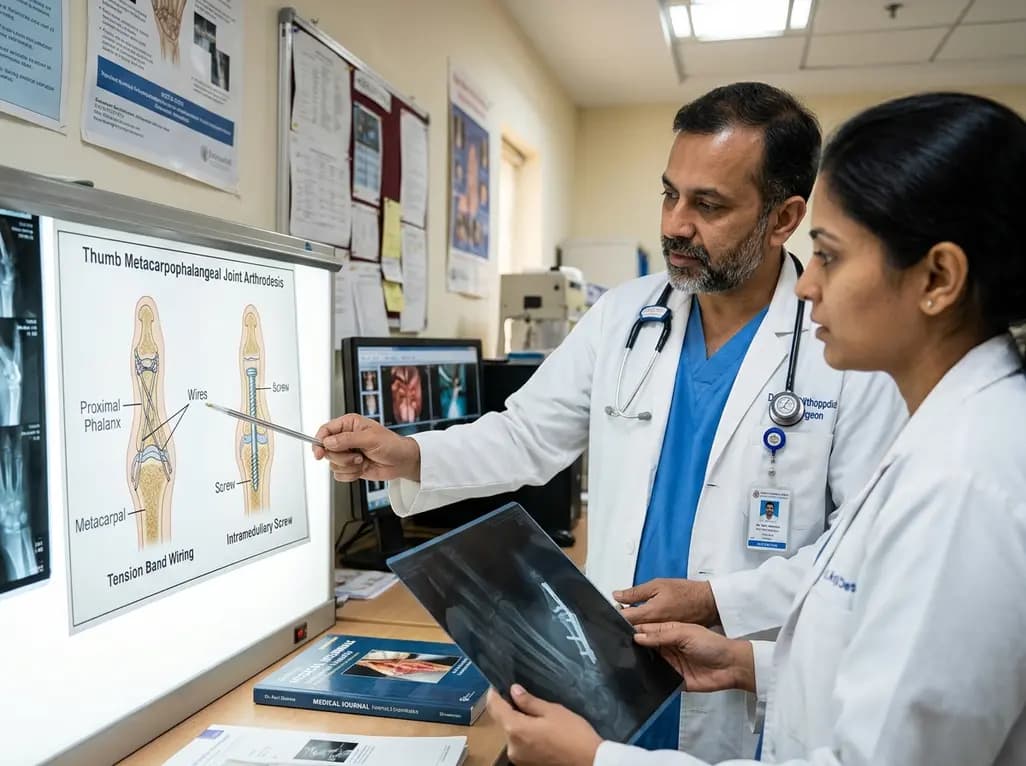
A comparative review of tension band wiring and intramedullary screw fixation in thumb metacarpophalangeal arthrodesis, evaluating union rates, hardware complications, and clinical outcomes.
Today

A breakthrough ultrathin multimodal sensor decouples physical hemodynamic monitoring from disposable electrochemical calibration, achieving long-term wearable glucose prediction with 81.36% accuracy and a 9.12% MARD. This offers a robust, drift-free solution for outpatient metabolic surveillance.
Today
