.webp&w=384&q=75)

Loading, please wait...
Loading, please wait...
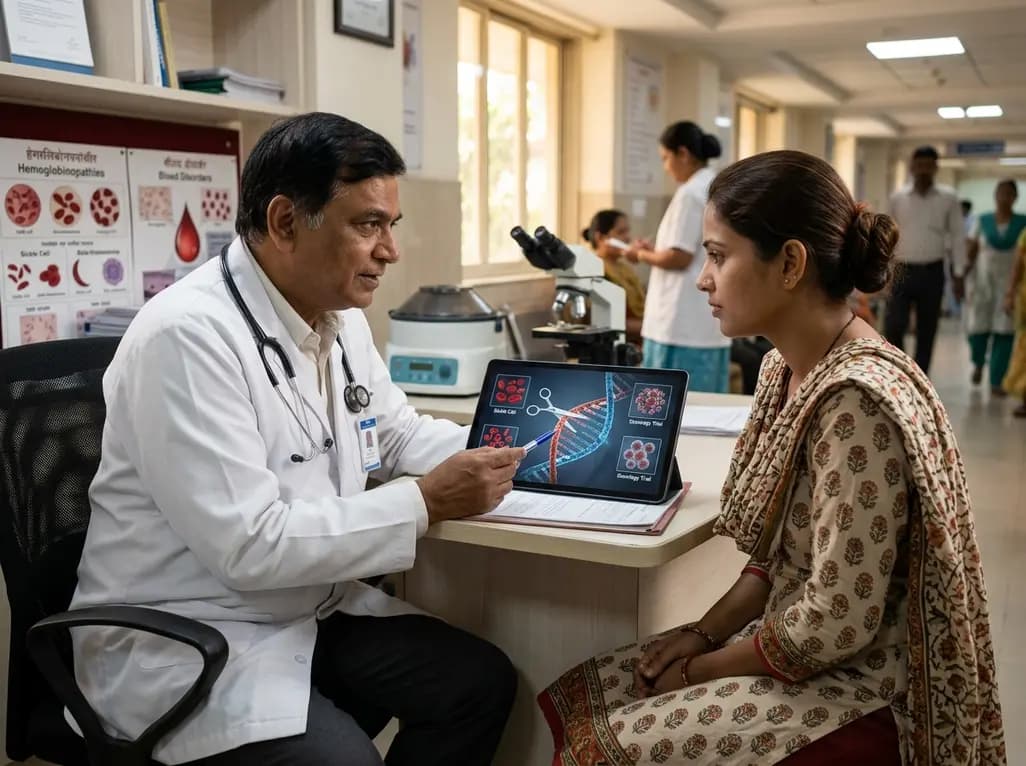
The approval of exagamglogene autotemcel marks a historic milestone in molecular medicine. Consequently, CRISPR gene editing therapy has evolved from a laboratory concept into a curative-intent modality for severe sickle cell disease and transfusion-dependent beta-thalassemia. By harvesting autologous hematopoietic stem cells and editing them ex vivo, clinicians can now offer a durable genetic solution without relying on matched donors. Furthermore, this approach eliminates the traditional risks of graft rejection and graft-versus-host disease that often complicate allogeneic hematopoietic cell transplantation. Clinicians must now understand how to integrate this complex technology into everyday practice while managing the logistical, toxicity, and monitoring challenges that accompany cellular therapeutics.
Understanding the molecular target helps clinicians appreciate how gene editing achieves such durable responses. In normal physiology, erythroid precursors express the transcription factor BCL11A, which represses the production of gamma-globin and switches red cell production to adult beta-globin. In conditions like sickle cell disease and beta-thalassemia, abnormal or absent adult beta-globin causes severe vaso-occlusion or severe hemolytic anemia. Therefore, researchers designed exagamglogene autotemcel to target the erythroid-specific enhancer region of the BCL11A gene within CD34-positive hematopoietic stem and progenitor cells.
By disrupting this regulatory enhancer with Cas9 endonuclease and precise single-guide RNA, the cellular machinery downregulates BCL11A expression specifically in the erythroid lineage. As a direct result, the reinfused stem cells produce high concentrations of fetal hemoglobin. This elevated fetal hemoglobin prevents the intracellular polymerization of sickle hemoglobin in sickle cell erythrocytes. Similarly, it compensates for the missing beta-globin chains in thalassemia major. Clinical trials show that this targeted disruption yields persistent transfusion independence in thalassemia and durable protection against debilitating vaso-occlusive crises in sickle cell disease.
Implementing gene editing demands an organized multidisciplinary care pathway rather than isolated hematology visits. First, clinicians must thoroughly assess patient eligibility by evaluating baseline organ function. Severe pulmonary hypertension, end-stage renal failure, significant hepatic cirrhosis, or advanced cardiomyopathy may preclude safe participation. Furthermore, pre-existing alloimmunization and cerebrovascular disease require careful risk stratification prior to proceeding.
Once clinicians confirm candidacy, the procedural journey begins with peripheral blood stem cell mobilization. Patients often require plerixafor and granulocyte colony-stimulating factor to collect sufficient CD34-positive cells. After successful apheresis, the collected cells travel to centralized manufacturing cleanrooms for precision CRISPR editing and quality control testing. In the meantime, comprehensive psychosocial evaluations, patient counseling, and fertility preservation remain paramount. Because the subsequent conditioning regimen reliably causes gonadal toxicity, clinicians must proactively offer sperm banking or oocyte cryopreservation before initiating any cytotoxic chemotherapy.
Although gene editing modifies the patient's own autologous cells, successful engraftment still requires profound marrow clearance. Consequently, patients must receive pharmacokinetic-guided myeloablative busulfan conditioning to eradicate unedited endogenous progenitors. Therapeutic drug monitoring ensures that clinicians achieve target systemic exposure while minimizing hepatic veno-occlusive disease and neurotoxicity risks.
Following conditioning and cell infusion, patients enter a phase of severe prolonged cytopenia that closely mirrors conventional autologous stem cell transplantation. Therefore, transplant teams must deliver intensive supportive care in specialized isolation units. This standard includes antimicrobial prophylaxis against viral, fungal, and bacterial pathogens, along with irradiated blood product transfusions. In addition, clinicians must monitor mucosal barrier injury, manage severe mucositis, and treat neutropenic fevers aggressively until neutrophil and platelet engraftment occur. Ultimately, primary hematologists and cellular therapy centers must maintain open communication channels to facilitate a safe transition back to outpatient care.
Beyond non-malignant hematology, researchers are actively translating programmable nucleases into oncologic cellular therapies. Early-phase clinical trials explore multiplex CRISPR editing to enhance chimeric antigen receptor T-cell therapies. Specifically, investigators disrupt checkpoint molecules such as PD-1 or remove endogenous human leukocyte antigens and T-cell receptors to create off-the-shelf allogeneic CAR-T products.
Currently, these investigational approaches target refractory B-cell acute lymphoblastic leukemia, aggressive non-Hodgkin lymphomas, relapsed multiple myeloma, and selected acute myeloid leukemias. Furthermore, translational oncologists are testing CRISPR tools to overcome T-cell exhaustion in solid tumors by modifying regulatory intracellular checkpoints. Although clinical oncology applications remain investigational, early proof-of-concept data confirm feasibility and robust target specificity. However, oncology teams must remain cautious regarding off-target genomic cleavage, chromosomal translocations, and clonal selection during manufacturing. Disciplined clinical trial execution remains essential before broad regulatory approvals expand into routine cancer practice.
Despite extraordinary therapeutic potential, several practical hurdles limit widespread adoption. First, the extraordinary manufacturing expense and complex logistics create substantial payer friction and health system strain. Furthermore, the specialized infrastructure needed for high-dose busulfan conditioning and apheresis restricts availability to advanced tertiary medical centers, exacerbating global health disparities.
In addition, regulatory agencies mandate prolonged real-world surveillance lasting at least fifteen years. Longitudinal follow-up through standardized registries allows clinicians to detect delayed genotoxicity, such as secondary myeloid neoplasms or insertional mutagenesis. Moreover, long-term surveillance evaluates enduring organ preservation, fertility restoration, and sustained quality-of-life benefits. By participating diligently in national and international registries, hematologists ensure that gene-edited cellular therapies provide accountable, safe, and equitable cures for generations to come.
CRISPR gene editing uses the patient's own autologous CD34-positive hematopoietic stem cells rather than donor cells. Because the modified stem cells carry identical major histocompatibility complex antigens, the immune system recognizes them as self. Consequently, the therapy completely eliminates allogeneic immune activation, avoiding both graft rejection and graft-versus-host disease entirely. This provides a curative option for patients who lack human leukocyte antigen-matched sibling donors.
Myeloablative conditioning using pharmacokinetic-targeted busulfan clears physical and metabolic space within the bone marrow niche. Without eliminating existing, unedited hematopoietic stem cells, the reinfused CRISPR-edited progenitors cannot successfully engraft and repopulate the marrow space. Therefore, full myeloablation remains essential to achieve high levels of donor-independent chimerism, ensuring that newly generated erythrocytes produce sufficient therapeutic fetal hemoglobin to alleviate clinical disease manifestations.
The primary long-term safety concerns include potential off-target genomic cutting, unintended chromosomal rearrangements, and therapy-related secondary myeloid malignancies resulting from busulfan conditioning. Additionally, clinicians must monitor long-term gonadal function, organ preservation, and the durability of fetal hemoglobin production. Regulatory bodies mandate minimum fifteen-year registry surveillance to systematically track late clinical toxicities and assess ongoing real-world treatment efficacy over time.
Disclaimer: This content is for informational and educational purposes only. It does not constitute medical advice, diagnosis, or treatment recommendations. Healthcare professionals must exercise independent clinical judgment and verify information with primary medical literature and regulatory authorities. Refer to the latest local and national guidelines for clinical practice.
References

Read summarized clinical updates, watch expert medical content, and earn CME certifications right from your smartphone.
Open your smartphone camera to scan and install.





CRISPR gene editing therapy has transitioned from laboratory bench to bedside, offering curative potential for severe sickle cell disease and transfusion-dependent beta-thalassemia while expanding into oncology trials.
last month

A qualitative study in Mzuzu highlights profound struggles faced by patients with NCD complications, including sanitation barriers, loss of dignity, and severe health access delays. Clinicians in resource-limited healthcare environments must address systemic hurdles through integrated, patient-centered chronic care.
Today
A meta-analysis of nine RCTs comparing remimazolam versus propofol in hysteroscopy reveals remimazolam significantly reduces injection pain, hypotension, and respiratory depression while maintaining comparable sedation success, recovery times, and procedural duration.
Today
Radiofrequency catheter ablation of the cavotricuspid isthmus successfully terminates typical atrial flutter. This article reviews the mechanisms driving coronary sinus electrogram changes, wavefront activation pathways, and clinical criteria to verify bidirectional block during electrophysiology studies.
Today
A 5-year study of lateral unicompartmental knee arthroplasty in patients ≤55 years demonstrated 100% component revision-free survival and high functional scores, though residual varus alignment increased the risk of medial osteoarthritis progression.
Today
A breakthrough study leverages natural language processing to accurately identify incident medication-related osteonecrosis of the jaw and track antiresorptive drug holidays from clinical narratives in electronic health records, advancing osteoporosis pharmacovigilance and dental safety.
Today
