.webp&w=384&q=75)

Loading, please wait...
Loading, please wait...

Cardiac surgery inherently triggers a transient release of myocardial biomarkers into the systemic circulation, creating diagnostic ambiguity for clinicians evaluating potential perioperative complications. In routine clinical practice, serum concentrations of cardiac biomarkers almost invariably rise following both on-pump and off-pump procedures. However, differentiating expected procedural tissue trauma from acute perioperative myocardial infarction remains a persistent clinical challenge. Recent diagnostic advancements have introduced targeted immunoassays capable of quantifying intact and mildly degraded forms, specifically designated as long cardiac troponin T. This novel approach provides refined insights into the biochemical composition and clearance kinetics of circulating troponins, offering superior discrimination of true ischemic damage.
Conventional high-sensitivity cardiac troponin T (hs-cTnT) assays capture a heterogeneous mixture of circulating molecules. These include intact full-length troponin proteins along with extensively degraded small fragments. Consequently, standard hs-cTnT levels remain elevated for days or weeks, even in uncomplicated recoveries. In contrast, novel immunoassays specifically isolate long cardiac troponin T, which comprises only full-length and mildly fragmented protein species. Therefore, measuring long forms isolates acute cellular disruption from lingering degraded peptides. Clinical investigation reveals that while conventional assays demonstrate widespread and prolonged elevations exceeding upper reference limits, long forms exhibit distinct kinetic behavior that mirrors acute operative trauma rather than prolonged systemic retention.
The magnitude of biomarker release correlates directly with intraoperative factors, particularly the duration of cardiopulmonary bypass and aortic cross-clamp times. During on-pump coronary artery bypass grafting and valve operations, global myocardial ischemia-reperfusion stress causes an immediate efflux of intracellular proteins. Peak release of long forms occurs early in the postoperative period, typically within three to six hours. Furthermore, quantitative peak release shows a positive correlation with cardiopulmonary bypass duration. In off-pump procedures, mechanical manipulation and localized regional ischemia also release troponin, but the overall absolute peak values often remain lower. Consequently, the presence of intact troponin forms in the immediate postoperative phase reflects the direct physical and ischemic impact of the surgical intervention.
A fundamental distinction between biomarker variants lies in their systemic elimination rates. Long forms of troponin T decline rapidly from peak levels within the first 24 to 72 hours. By postoperative days three to seven, median concentrations of long troponin return nearly to baseline values, with fewer than one percent of uncomplicated patients exceeding ten times the upper reference limit. In sharp contrast, conventional hs-cTnT concentrations remain substantially elevated, exceeding ten times the reference threshold in over half of all patients during the same convalescent window. This persistent elevation in standard assays results from slow renal clearance and the continuous circulation of small degraded fragments rather than ongoing active myocardial necrosis.
Evaluating suspected perioperative myocardial infarction requires separating baseline surgical injury from graft failure or acute coronary occlusion. Because conventional hs-cTnT stays markedly elevated throughout the first postoperative week, detecting secondary ischemic spikes remains notoriously difficult. However, because intact troponin clears swiftly, persistent or newly rising levels beyond postoperative day three provide high specificity for acute secondary ischemia. For example, clinical data demonstrates that isolated elevations of intact troponin past day three correspond with new conduction abnormalities, such as left bundle-branch block, or documented graft thrombosis. Thus, measuring long troponin forms eliminates diagnostic noise, enabling clinicians to identify secondary ischemic events promptly.
Integrating intact troponin assays into intensive care workflows can significantly streamline postoperative management. Intensive care teams frequently face dilemmas when standard troponin values return markedly elevated without overt hemodynamic compromise. Unnecessary coronary angiographies, redundant echocardiographic examinations, and prolonged intensive care stays frequently result from uninterpretable conventional troponin elevations. By utilizing assays that track intact troponin clearance, intensive care units can establish reliable rule-out algorithms. When intact troponin levels decline on expected trajectories, clinicians can confidently proceed with standard extubation, mobilization, and ward transfer protocols, thereby optimizing critical care resource utilization and reducing healthcare costs.
The transition toward molecularly selective biomarker quantification represents a major evolution in postoperative cardiovascular medicine. Future diagnostic platforms aim to incorporate rapid point-of-care testing for intact troponin forms alongside standard biomarker panels. Additionally, ongoing clinical trials are evaluating whether specific intact-to-fragmented troponin ratios can predict long-term ventricular remodeling and major adverse cardiovascular events. As laboratory technologies advance, the adoption of assays measuring intact troponin will refine clinical decision-making. Consequently, cardiovascular surgeons and intensivists will gain precise tools to deliver targeted interventions, ultimately improving safety profiles and procedural outcomes for patients undergoing complex cardiac surgical procedures.
Conventional high-sensitivity troponin assays detect both intact proteins and small degraded fragments. Following surgical tissue disruption, degraded peptide fragments remain in the systemic circulation for prolonged periods due to slow clearance mechanisms and extensive protein breakdown. Consequently, standard assays reflect lingering molecular fragments rather than active, ongoing myocardial necrosis, creating persistent elevations that can last for more than a week postoperatively.
Long troponin T comprises intact, full-length troponin molecules and minimally fragmented protein chains. Standard assays detect these large molecules alongside heavily truncated, short peptide fragments. Because the novel assay isolates only intact and long forms, it selectively reflects acute, immediate myocardial cellular disruption. Furthermore, these larger molecular forms clear rapidly from the bloodstream, avoiding prolonged systemic background elevation.
Intact troponin levels normally decline precipitously within three to seven days after uncomplicated cardiac surgery. If an intact troponin assay shows a secondary rise or sustained elevation during this late window, it specifically indicates new or ongoing myocardial injury. This allows clinicians to differentiate acute graft thrombosis or coronary occlusion from routine operative trauma, facilitating timely diagnostic imaging and revascularization.
Disclaimer: This content is for informational and educational purposes only and should not be considered as medical advice. Always consult a qualified healthcare professional for diagnosis and treatment decisions. Refer to the latest local and national guidelines for clinical practice.
References
Airaksinen KEJ et al. Composition of Troponin Release After Elective On-Pump and Off-Pump Cardiac Surgery. J Am Heart Assoc. 2026 Aug 28. doi: 10.1161/JAHA.126.051842. PMID: 42663617.
Airaksinen KEJ, Paana T, Wittfooth S, et al. Long forms of cardiac troponin T for myocardial infarction diagnosis: the SuperTROPO study. Eur Heart J. 2025;46(12):1120-1131.
Thygesen K, Alpert JS, Jaffe AS, et al. Fourth Universal Definition of Myocardial Infarction (2018). Circulation. 2018;138(20):e618-e651.
Wittfooth S, Paana T, Hellman T, et al. Composition of cardiac troponin release differs after strenuous exercise and acute myocardial infarction. Clin Chem. 2024;70(6):835-844.

Read summarized clinical updates, watch expert medical content, and earn CME certifications right from your smartphone.
Open your smartphone camera to scan and install.





Cardiac surgery routinely elevates troponin levels, complicating perioperative myocardial infarction detection. Novel data shows intact long cardiac troponin T clears rapidly post-surgery, unlike conventional hs-cTnT, providing a clearer diagnostic window for true ischemic injury.
last month

Following 37,899 reported cases and 9 deaths, Odisha has scaled up active case detection, rapid diagnostic testing, and vector control across high-burden districts. Here is a comprehensive clinical breakdown of the state's aggressive containment protocols, diagnostic pathways, and targeted field management.
Today

Endometriosis affects millions of women across India, yet diagnostic delays frequently exceed five years. Recent multi-centre genomic research has identified 21 novel genetic regions, notably on chromosome 13, establishing crucial population-specific insights to transform clinical screening and therapeutic strategies.
Today
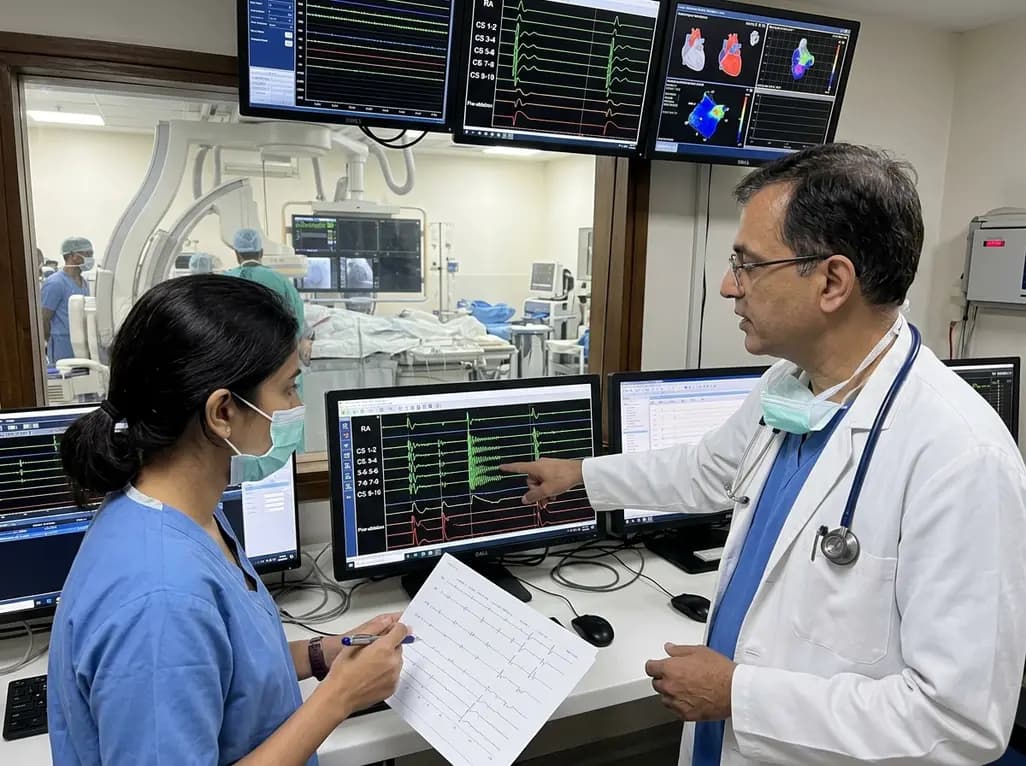
Radiofrequency catheter ablation of the cavotricuspid isthmus successfully terminates typical atrial flutter. This article reviews the mechanisms driving coronary sinus electrogram changes, wavefront activation pathways, and clinical criteria to verify bidirectional block during electrophysiology studies.
Today

A study comparing four knee flexion strength tests after ACL reconstruction using hamstring tendon autografts reveals marked variability in limb symmetry indices. Clinicians must recognize that different strength testing modalities yield divergent return-to-sport clearance rates.
Today

Discover how to identify superimposed entrapment neuropathy in diabetic patients. This review details clinical evaluation, surgical decompression evidence, and a structured algorithm for primary care referrals to prevent ulcers and preserve limb function.
Yesterday
