

Loading, please wait...
Loading, please wait...

Longitudinal research provides vital insights into the aging process, yet researchers frequently overlook the profound impact of competing events in geriatrics. When studying older populations, an individual often faces multiple mutually exclusive outcomes over time. For example, all-cause mortality frequently prevents the observation of non-fatal geriatric syndromes, including severe functional disability, cognitive decline, or falls. Consequently, applying standard survival methods without adjustments leads to substantial statistical distortion. Geriatricians and clinical researchers must understand how competing risks alter prognostic calculations. By recognizing these analytical pitfalls, clinicians can interpret clinical trial evidence more accurately and optimize individualized care for frail older adults.
In traditional time-to-event survival analysis, biostatisticians typically employ the classic Kaplan-Meier estimator alongside Cox proportional hazards regression models. These conventional models operate on the assumption of non-informative censoring, which presumes that censored individuals remain at identical risk for the primary outcome. However, this fundamental assumption fails when death or another terminating event occurs before the outcome of interest. In clinical reality, a deceased patient cannot subsequently sustain an injurious fall or experience restricted activity. Therefore, treating death as ordinary independent censoring violates core statistical premises. When analysts artificially censor participants who die, the mathematical model incorrectly acts as though these patients could still develop the primary outcome in the future. As a result, standard Kaplan-Meier estimates systematically inflate the cumulative probability of non-fatal geriatric events. Furthermore, this overestimation becomes substantially worse over extended follow-up intervals where mortality rates naturally climb. Clinicians reviewing published prognostic scores or cumulative risk curves must identify whether authors accounted for such mortality hazards. Without proper statistical handling, risk prediction tools can mislead healthcare teams regarding a patient's true prognosis.
A major source of confusion in observational geriatric research stems from conflating outcome rates with outcome risks. Although these terms are often used interchangeably in casual discourse, they represent distinct mathematical concepts. An outcome rate, often modeled through cause-specific hazards, reflects the instantaneous incidence of an event among individuals who currently survive without having experienced the event. In contrast, risk denotes the actual cumulative probability that a patient experiences the outcome over a specified time window. In the presence of competing mortality, a risk factor can exert conflicting influences on rates versus risks. For instance, an exposure might accelerate the cause-specific hazard rate of a functional deficit. Yet, observed cumulative risk could decrease if that exposure accelerates early mortality. Because decedents leave the population at risk, fewer individuals survive long enough to exhibit the non-fatal outcome. Consequently, evaluating rate models alone without cumulative incidence functions produces an incomplete picture. Researchers must analyze both metrics to avoid erroneous clinical deductions. Healthcare providers need clarity on whether an intervention reduces the rate of an adverse event or merely alters survival dynamics.
To illustrate these mathematical disparities, investigators examined longitudinal data from the landmark Precipitating Events Project cohort. This prospective study tracked community-living adults aged seventy and older to evaluate functional trajectories, injurious falls, and restricted activity. When investigators applied standard statistical methods that ignored competing mortality, the estimated risk of non-fatal geriatric outcomes appeared strikingly inflated. Furthermore, ignoring competing events altered the observed risk differences across various strata of clinical predictors, such as baseline frailty or cognitive performance. Crucially, the researchers demonstrated that statistical associations with outcome rates did not consistently align with cumulative risk associations. For example, a predictor might achieve statistical significance in a rate model but show negligible association in a subdistribution risk model. This discordance proves that clinicians cannot safely infer absolute patient risk directly from hazard ratios alone. By employing cumulative incidence functions and Fine-Gray subdistribution regression, investigators obtained realistic, unbiased prognostic estimates. These findings highlight why geriatric outcome studies require analytical approaches that respect the biological reality of competing mortality.
Despite well-established methodological guidelines, suboptimal analytical reporting persists throughout contemporary medical literature. A systematic review of studies published in the Journal of the American Geriatrics Society during 2024 revealed significant methodological shortcomings. Specifically, only forty-seven percent of published articles evaluated and reported both risk and rate when examining geriatric outcomes. Moreover, authors frequently utilized ambiguous epidemiological terminology that clouded the distinction between rates, hazards, and absolute risks. This imprecise communication hampers the translation of high-level observational research into bedside clinical decision-making. When investigators report only cause-specific hazard ratios, clinicians might assume that lower hazards automatically translate into fewer patient events. In geriatric populations where competing mortality is elevated, this assumption is often incorrect. Furthermore, failing to display cumulative incidence curves leaves readers unable to judge the true clinical magnitude of an intervention. Geriatric research demands higher reporting rigor so that medical professionals can critically appraise trial results and guidelines. Addressing these literature gaps will improve the clinical relevance of future geriatric evidence.
To ensure clinical evidence guides patient care reliably, researchers and peer reviewers must adhere to standardized analytical frameworks. First, investigators should always prespecify how they will handle competing events before analyzing prospective geriatric cohorts. Second, research protocols should pair cause-specific hazard models with the Fine-Gray subdistribution model or non-parametric cumulative incidence functions. While cause-specific models clarify biological effects on event rates, subdistribution models estimate absolute risk for clinical prognosis. Third, medical journals should enforce explicit terminology, requiring authors to distinguish clearly between hazards, rates, and cumulative incidence. For practicing geriatricians and general practitioners, critical appraisal requires verifying whether competing mortality was treated as informative. When assessing clinical prognostic tools, clinicians should seek models validated using competing risks methodology. Similarly, when counseling older adults about preventive therapies, clinicians must consider whether high competing mortality diminishes long-term preventive benefits. Adopting these best practices strengthens geriatric medicine and safeguards patients from misguided clinical interventions.
Ignoring competing events forces standard models like Kaplan-Meier to treat deceased individuals as ordinary censored observations. Consequently, the calculation assumes these individuals remain capable of developing the primary outcome later. Because deceased participants can never experience a non-fatal geriatric outcome, this false assumption artificially inflates the estimated cumulative probability. Applying competing risk models, such as cumulative incidence functions, eliminates this upward bias and provides an accurate reflection of absolute patient risk.
An outcome rate measures the instantaneous speed at which events occur among surviving individuals currently free from the condition. In contrast, outcome risk represents the actual proportion of patients who will experience the event over a given time horizon. When competing mortality is substantial, an intervention might reduce the event rate but have minimal impact on cumulative risk if early mortality alters the pool of surviving patients who remain eligible to experience the outcome.
Researchers should ideally report both cause-specific Cox models and Fine-Gray subdistribution hazard models. Cause-specific models address etiological questions by evaluating how an exposure influences the instantaneous rate of an event among surviving participants. Meanwhile, the Fine-Gray model and non-parametric cumulative incidence functions directly estimate absolute risk over time. Combining both approaches enables clinicians to understand the underlying biological mechanism while accurately evaluating the patient’s overall prognosis and real-world clinical risk.
Disclaimer: This content is for informational and educational purposes only and does not constitute medical advice or establish a doctor-patient relationship. Healthcare professionals must exercise independent clinical judgment and consult official diagnostic criteria and management recommendations. Treatments, medications, and procedures carry risks; always verify dosages and contraindications against current prescribing information. Refer to the latest local and national guidelines for clinical practice.
References

Read summarized clinical updates, watch expert medical content, and earn CME certifications right from your smartphone.
Open your smartphone camera to scan and install.





Failing to account for competing events like mortality in longitudinal geriatric studies produces biased risk estimates and misleading inferences. This review highlights key methodological principles, insights from the Precipitating Events Project, and practical approaches for clinical research appraisal.
Today

A study in JAMIA Open shows lightweight open-source reasoning LLMs achieve up to 95% sensitivity and accelerate evidence synthesis screening by nearly twentyfold, presenting a cost-effective, scalable AI solution for biomedical research and systematic reviews.
Today
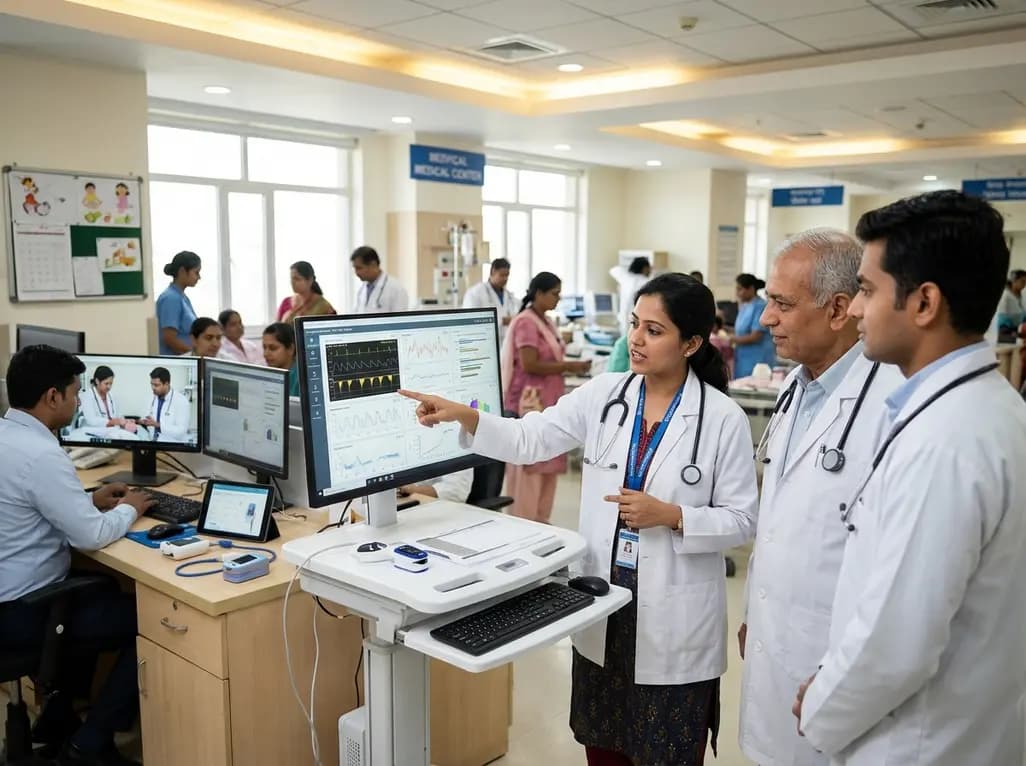
A landmark study details how an enterprise pediatric remote patient management model expanded from a single cardiology pilot to 16 diverse specialty programs by combining centralized digital operations with specialty clinical leadership.
Today

A comparative review of tension band wiring and intramedullary screw fixation in thumb metacarpophalangeal arthrodesis, evaluating union rates, hardware complications, and clinical outcomes.
Today

A breakthrough ultrathin multimodal sensor decouples physical hemodynamic monitoring from disposable electrochemical calibration, achieving long-term wearable glucose prediction with 81.36% accuracy and a 9.12% MARD. This offers a robust, drift-free solution for outpatient metabolic surveillance.
Today
