.webp&w=384&q=75)

Loading, please wait...
Loading, please wait...

Endoscopic removal of premalignant lesions remains essential for effective colorectal cancer prevention. Currently, clinicians routinely select cold snare polypectomy to excise diminutive and small polyps measuring between 3 and 9 mm. However, endoscopists encounter occasional technical challenges when snaring flat or broad-based lesions. In particular, incomplete tissue capture can lead operators to exert forced traction. Consequently, incomplete resection rates may increase significantly. To address this issue, researchers investigated whether preliminary submucosal injection facilitates cleaner mechanical transection. A recent randomized controlled trial evaluated this exact clinical comparison.
Conventionally, endoscopists resect small nonpedunculated polyps without electrocautery or fluid lifting. This strategy minimizes thermal injury and substantially reduces delayed bleeding risks. Nevertheless, some clinicians advocate injecting saline or colloid into the submucosa before snaring. Proponents argue that submucosal elevation cushions the muscularis propria and creates a prominent target. Furthermore, lifting may theoretically prevent incomplete resection by clearly delineating lateral lesion margins. However, fluid blebs can paradoxically alter surface tension. Consequently, the snare wire may slip across flattened mucosa during closure. Therefore, adding an injection step might complicate an otherwise swift, straightforward procedure. In addition, the supplementary needle puncture increases consumable costs and prolongs examination times. Earlier observational studies yielded conflicting observations regarding whether submucosal cushion expansion truly improves histologic clearance. Endoscopists therefore required high-quality randomized trial evidence to define standardized protocols. Clinicians must routinely balance technical precision with procedural speed during busy screening lists. As a result, assessing both techniques under identical conditions clarifies whether routine fluid expansion offers distinct clinical benefits. In conclusion, evaluating these specific mechanics helps endoscopists optimize daily interventions. Thus, investigators designed a rigorous protocol to resolve whether submucosal injection enhances specimen capture without compromising safety.
The investigators conducted a prospective randomized controlled trial enrolling 340 adult patients aged 40 to 79 years. All participants attended screening or surveillance colonoscopies and presented with at least one 3 to 9 mm adenoma or sessile serrated lesion. The team randomly assigned participants in a 1:1 ratio to either conventional cold snaring or injection-assisted resection. Crucially, the protocol established a strict rule prohibiting forced mechanical pulling during snare closure. If an operator could not guillotine the polyp cleanly without excessive traction, the protocol mandated conversion to hot endoscopic mucosal resection. This safety threshold prevented lacerations and deep muscular damage. After resecting each lesion, endoscopists retrieved the specimen for pathological staging. Subsequently, investigators obtained marginal biopsies from the resection defect edges to determine the incomplete resection rate objectively. Moreover, blinded pathologists analyzed all tissue specimens to evaluate architectural borders and neoplastic remnants. Consequently, this stringent methodology provided robust verification of margin clearance. The researchers also monitored immediate bleeding, delayed hemorrhage, and perforation events. By standardizing operator technique, the trial isolated the true mechanical effect of submucosal lifting. Furthermore, the authors systematically evaluated total procedure times, technical conversion frequency, and polyp retrieval success across both randomized arms.
The intention-to-treat analysis yielded compelling and highly instructive results for gastroenterologists. Most notably, the incomplete resection rate remained remarkably low across both trial groups. Specifically, the injection group achieved a 0% incomplete resection rate, whereas the conventional group showed a 1% rate. This difference demonstrated no statistical significance, confirming that cold snaring alone provides exceptional radicality when executed properly. However, the trial revealed a striking divergence in procedural conversion rates. Patients in the conventional arm experienced a 12% conversion rate to endoscopic mucosal resection because of perceived entrapment resistance. In contrast, only 1% of patients in the submucosal injection group required conversion. Therefore, submucosal lifting significantly facilitated complete snare closure without necessitating forced pull maneuvers. Furthermore, both arms exhibited excellent safety profiles with minimal adverse events. No perforation occurred in either group, and postprocedural bleeding rates remained negligible. Consequently, while injection did not alter histologic margin clearance, it noticeably reduced technical hurdles during snare transection. These findings demonstrate that fluid cushion creation primarily serves as a mechanical facilitator rather than an oncological booster. Additionally, histological evaluation confirmed high specimen retrieval rates exceeding 98% in both study cohorts, demonstrating consistent procedural execution.
These clinical findings carry immediate relevance for colonoscopy practice worldwide, including busy gastroenterology units across India. First, the data reinforce that conventional cold snaring remains the primary reference standard for small colorectal lesions. Because incomplete resection rates did not differ significantly, routine fluid injection appears unnecessary for typical small polyps. Omitting routine injections saves valuable time and reduces procedural costs during routine screening lists. Second, the study highlights the practical value of submucosal lifting when operators encounter difficult anatomical orientations. For example, flat lesions situated over prominent haustral folds often challenge snare engagement. In such instances, submucosal elevation prevents difficult entrapment and obviates the need for diathermy-based rescue. Clinicians should avoid forced pulling because aggressive traction tears submucosal vessels and invites muscularis propria injury. Instead, endoscopists can deploy fluid injection selectively whenever snaring faces mechanical resistance. Furthermore, avoiding unnecessary electrocautery preserves mucosal integrity and prevents post-polypectomy coagulation syndrome. Consequently, gastroenterologists should integrate these insights into structured training curricula to foster safe resection habits among trainees. Moreover, endoscopists can reserve injection needles for challenging anatomical sites rather than using them routinely for every diminutive lesion encountered.
Optimizing endoscopic resource allocation requires balancing clinical efficacy against consumable expenses and room turnover. Conventional cold snaring provides rapid lesion excision, typically requiring less than one minute per polyp. In contrast, preparing injection solutions, loading needles, and performing submucosal punctures inherently prolong procedural duration. Furthermore, endoscopic injection needles add tangible equipment expenses to every intervention. In healthcare settings managing substantial patient volumes, these cumulative costs and time increments become substantial. Therefore, gastroenterology departments should preserve standard cold snaring as their frontline approach for lesions under 10 mm. Clinicians can then adopt a selective injection strategy tailored strictly to challenging lesions. If a polyp lies in an awkward position or displays broad lateral borders, targeted injection offers a reliable fallback. Consequently, endoscopy services maximize operational efficiency while maintaining flawless safety and complete resection benchmarks. Moreover, standardized guidelines from major gastroenterology societies consistently endorse cold snaring without routine lifting for small polyps. Integrating trial evidence with international recommendations ensures cost-effective, evidence-based patient management across diverse clinical environments. Additionally, avoiding routine electrocautery protects patients from transmural thermal injury, substantially reducing post-procedure hospitalization and observational care needs.
Current randomized evidence demonstrates that submucosal injection does not significantly reduce incomplete resection rates for 3 to 9 mm polyps. In this clinical trial, conventional cold snaring achieved an incomplete resection rate of 1%, whereas injection yielded 0%. Both techniques provide outstanding oncological completeness. Therefore, endoscopists do not need routine fluid cushions to guarantee negative margins for small colorectal adenomas during standard colonoscopies.
The conventional group showed a 12% conversion rate because the trial protocol prohibited forced mechanical traction. When endoscopists encountered resistance during snare closure on non-lifted tissue, they converted to electrocautery-assisted mucosal resection to avoid muscular tearing. Conversely, submucosal injection cushioned the submucosal space, allowing clean snare capture without excessive resistance. Thus, fluid lifting reduces technical failure and mechanical resistance during cold snare transection.
Clinicians should consider submucosal injection selectively for flat lesions situated in technically difficult locations, such as behind haustral folds or near the ileocecal valve. In these settings, fluid lifting creates a clear target and prevents snare slippage. Furthermore, if a conventional snare fails to grasp the lesion without excessive traction, adding submucosal fluid facilitates smooth mechanical transection and avoids conversion to diathermy.
Disclaimer: This content is for informational and educational purposes only and should not be considered professional medical advice. It does not replace independent clinical judgment or individual diagnostic evaluations. Refer to the latest local and national guidelines for clinical practice.
References

Read summarized clinical updates, watch expert medical content, and earn CME certifications right from your smartphone.
Open your smartphone camera to scan and install.





A randomized controlled trial compared conventional cold snare polypectomy with submucosal injection for 3-9 mm polyps. Both techniques demonstrated exceptionally low incomplete resection rates, though injection lowered the need to convert to endoscopic mucosal resection when forced pull was avoided.
Today

Maternal anaemia contributes to nearly half of pregnancy-related fatalities across India. To prevent complications, Uttar Pradesh has added single-dose parenteral iron to its essential medicines list. This clinical transition aims to restore haemoglobin rapidly and protect high-risk mothers across rural facilities.
Today
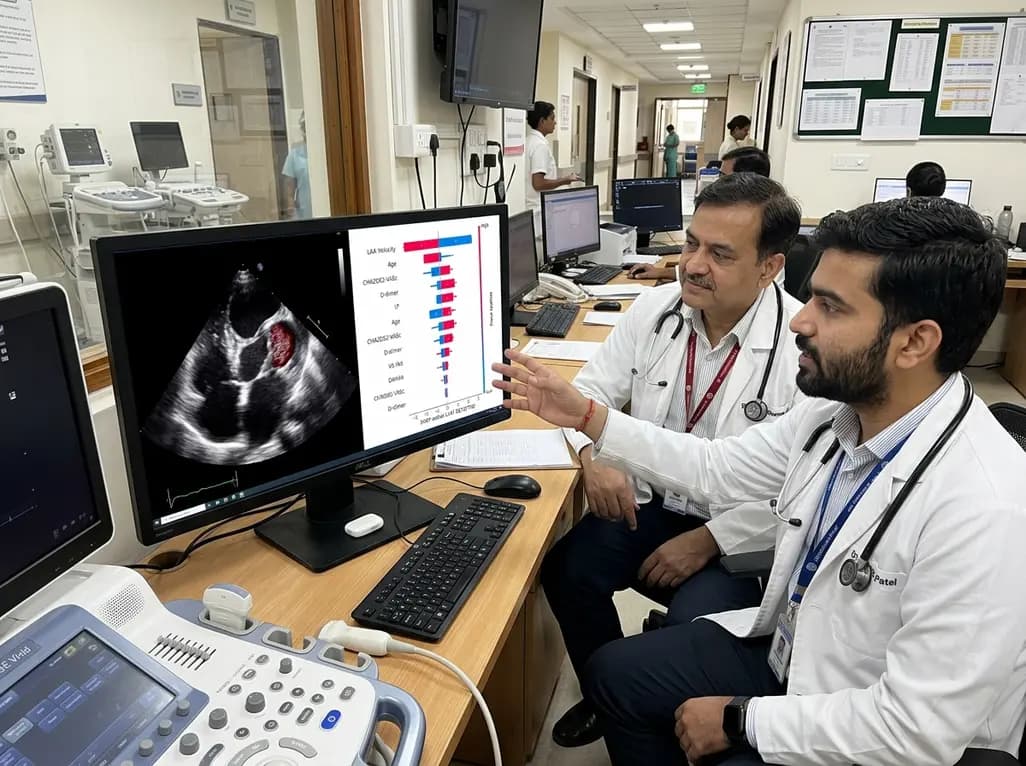
A study demonstrates an explainable machine learning framework integrating clinical and echocardiographic metrics to predict left atrial appendage thrombus in non-valvular atrial fibrillation, utilizing SHAP analysis for clinical interpretability.
Today
A longitudinal study of 1,055 chronic low back pain patients reveals that higher patient activation fosters constructive pain medication attitudes, reduces disability, and decreases short- and long-term opioid use through collaborative, multimodal care.
Today

A landmark cross-sectional study in Asian adults with type 2 diabetes identifies novel urinary metabolites linked to mild cognitive impairment. Elevated urinary sucrose and altered metabolites highlight non-invasive pathways for early cognitive risk stratification and targeted metabolic management.
Today
