.webp&w=384&q=75)

Loading, please wait...
Loading, please wait...
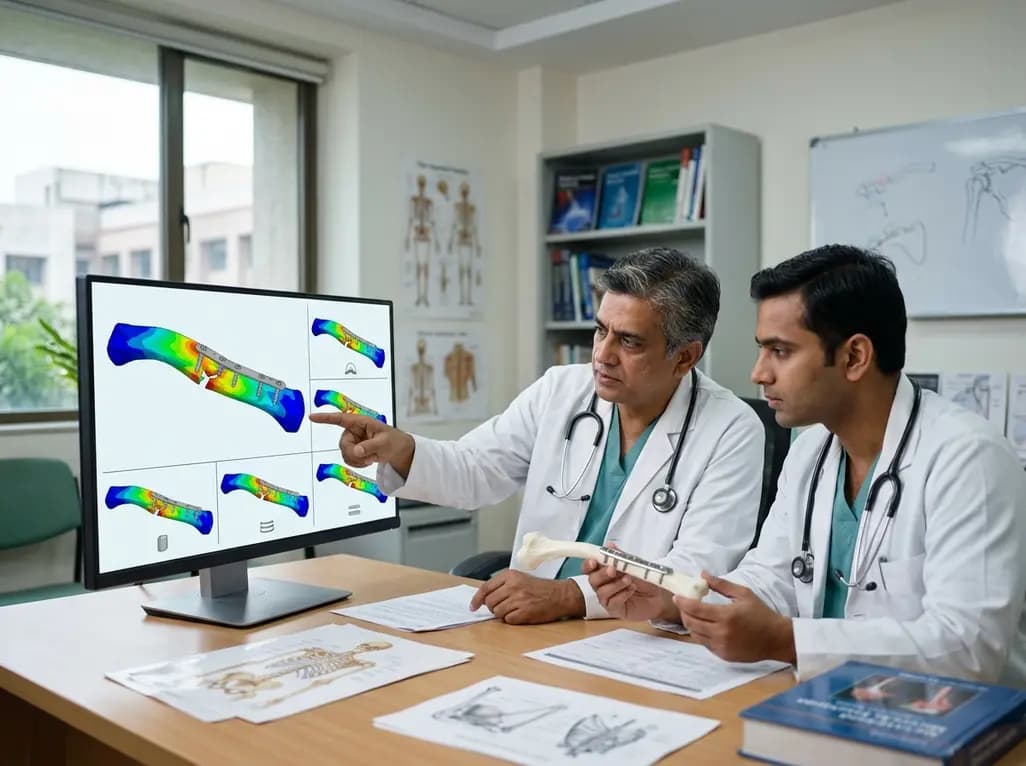
Clavicle fractures represent nearly 4% of all adult orthopedic injuries, frequently resulting from direct trauma during sports or high-impact accidents. Surgeons often prefer plate fixation for displaced midshaft fractures to restore anatomical alignment and ensure mechanical stability. However, the long-term success of these interventions hinges on the biomechanical integrity of the implant-bone construct. Recent research highlights that clavicle fixation plate performance is deeply influenced by the complex contact interactions between the plate, bone, and screws. Understanding these interactions through advanced computational tools allows clinicians to predict potential failures before they occur in a clinical setting.
Finite element analysis (FEA) has revolutionized how orthopedic specialists evaluate implant designs and surgical techniques. By creating high-fidelity three-dimensional models from computed tomography data, researchers can simulate various physiological loads with remarkable precision. This computational approach eliminates many variables found in cadaveric studies, providing a controlled environment to test clavicle fixation plate performance. Surgeons in India increasingly rely on these biomechanical insights to select the most appropriate hardware for complex trauma cases. Computational models allow for the assessment of stress distribution across the entire construct, identifying areas prone to fatigue or breakage. Furthermore, FEA provides a detailed look at interfragmentary strain, which is a critical predictor of secondary bone healing. By simulating conditions like inferior bending and axial compression, researchers can pinpoint how different fixation strategies respond to the daily physical demands placed on a patient's shoulder girdle. This level of detail is essential for developing next-generation implants that offer both strength and flexibility. Ultimately, these simulations bridge the gap between engineering theory and practical surgical application, ensuring that patients receive the most stable fixation possible.
A pivotal aspect of any finite element study is the selection of contact formulations, which define how surfaces interact under load. This study specifically investigated four distinct formulations: bonded, no-separation, frictionless, and frictional. Each model represents a different physical reality within the body, ranging from perfectly integrated surfaces to those that allow sliding. Notably, the bonded model consistently exhibited the highest structural stiffness across all loading conditions. Specifically, it showed a 66% increase in bending stiffness and a 60% increase in compression stiffness compared to other configurations. While high stiffness might seem beneficial for stability, it often leads to unfavorable stress concentrations. In contrast, the frictional and frictionless models produced lower stiffness values, reflecting more realistic, dynamic interactions between the implant and the bone. These models suggested a more balanced distribution of forces, which could potentially reduce the risk of stress shielding. Consequently, choosing the right contact model is not just a mathematical necessity but a clinical one. It allows researchers to mimic the biological environment accurately, leading to more reliable predictions of how an implant will perform over months of healing. Understanding these nuances helps in refining the design of pre-contoured plates used in modern trauma centers.
The biomechanical stability of a fixation construct must be resilient against multiple types of physical stress, including bending, compression, and torsion. During the study, researchers subjected a three-dimensional clavicle model to 200 N of inferior bending and 200 N of axial compression. They also applied 4 Nm of torsional loading to simulate the rotational forces encountered during arm movement. The results clearly demonstrated that clavicle fixation plate performance varies significantly depending on the nature of the load. For instance, the bonded model excelled in maintaining stiffness under compression and bending but faced challenges during torsional stress. Interestingly, the no-separation model demonstrated intermediate stiffness, suggesting it might serve as a middle ground for certain clinical simulations. These findings are particularly relevant for postoperative rehabilitation protocols in India, where early mobilization is often a goal. If a plate is highly rigid under bending but vulnerable under torsion, the surgeon might restrict specific movements during the initial healing phase. Moreover, the data suggests that the interface between the screw and the bone plays a major role in overall construct rigidity. By analyzing these specific load responses, medical professionals can better advise patients on activity levels that balance healing with the need for functional recovery.
While structural stiffness is vital for fracture union, excessive stress concentrations within the metal plate can lead to catastrophic hardware failure. The study revealed that peak plate stress varied considerably among the different contact formulations. The bonded model generated significant stress concentrations, reaching approximately 620.3 MPa under bending loads. However, the no-separation model produced even higher peak values, topping out at 655.3 MPa. Such high levels of stress are concerning, as they approach the fatigue limit of common implant materials like titanium or stainless steel. When stress is concentrated in a small area, the risk of the plate snapping or the screws loosening increases dramatically. Therefore, optimizing clavicle fixation plate performance requires a delicate balance between providing enough stability for the bone to heal and ensuring the plate itself does not fail. The analysis also showed that interfragmentary strain was lowest in the bonded model, which is ideal for primary bone healing. Nevertheless, the trade-off remains the high internal stress of the plate. Surgeons must consider these factors when treating active individuals who may inadvertently place high demands on their hardware. Using pre-contoured plates that match the anatomy closely can help distribute these stresses more evenly across the bone-implant interface, potentially lowering the risk of breakage.
The ultimate goal of studying clavicle fixation plate performance is to improve the quality of life for patients undergoing surgery. The data from this finite element study provides a clear roadmap for improving surgical techniques and implant selection. For example, knowing that certain contact models over-predict stiffness can help surgeons maintain a healthy skepticism of overly rigid constructs. In clinical practice, a construct that is too stiff may hinder the natural micro-motion required for robust callus formation. Conversely, a construct that is too flexible might lead to non-union or malunion of the fracture fragments. Indian orthopedic surgeons can use these insights to tailor their approach based on the specific fracture pattern and patient bone quality. Additionally, the study emphasizes the importance of secure screw purchase, as the interaction at the bone-screw interface is a primary driver of stability. As patient-specific modeling becomes more accessible, we may see a shift toward customized plates designed to optimize stress distribution for a single individual's anatomy. For now, the evidence suggests that choosing plates with proven biomechanical profiles and ensuring meticulous surgical technique remain the cornerstones of successful clavicle fracture management. By integrating engineering data with clinical expertise, the orthopedic community can continue to reduce complication rates and enhance recovery timelines.
Contact models define how the plate, bone, and screws interact. The bonded model assumes a perfect union, which often leads to an overestimation of construct stiffness. Conversely, frictional models allow for subtle sliding, providing a more biofidelic representation of the physical environment. Selecting the correct model is essential for accurately predicting stress distribution and the potential for hardware failure in a real-world clinical setting.
Peak stress refers to the maximum force concentrated in a specific area of the implant. If this stress exceeds the material's fatigue limit, the plate may bend or break before the bone fully heals. By understanding where these concentrations occur under different loads, surgeons can choose designs that distribute force more evenly, thereby reducing the likelihood of catastrophic implant failure and subsequent re-operation.
Interfragmentary strain describes the relative movement between bone fragments under load. A specific amount of strain is necessary to stimulate the formation of a hard callus during secondary bone healing. However, excessive strain can prevent union entirely. Finite element studies help identify the optimal stiffness that keeps strain within a therapeutic window, ensuring that the fracture site remains stable enough for biological repair to occur.
Disclaimer: This content is for informational and educational purposes only and does not constitute medical advice. It is not intended to be a substitute for professional medical judgment, diagnosis, or treatment. Always seek the advice of a qualified healthcare provider with any questions you may have regarding a medical condition. Refer to the latest local and national guidelines for clinical practice.
References
Kedadria A et al. Investigating Contact Models in Clavicle Fixation Plates: A Finite Element Study of Their Impact on Biomechanical Performance. J Biomech Eng. 2026 Jul 14. doi: 10.1115/1.4072325. PMID: 42446913.
Hillen RJ, et al. Biomechanical analysis of clavicle fracture fixation. International Orthopaedics. 2023;47(3):589-598.
Smith CA, et al. Finite element modeling of midshaft clavicle fractures: A comparative study of implant materials. Journal of Orthopaedic Research. 2024;42(1):112-124.

Read summarized clinical updates, watch expert medical content, and earn CME certifications right from your smartphone.
Open your smartphone camera to scan and install.





This study explores how finite element analysis optimizes clavicle fixation plate performance. By comparing different contact models—bonded, frictional, and frictionless—researchers provide critical data on stress distribution and stiffness to improve surgical outcomes for midshaft clavicle fractures.
3 months ago

Review how tailored exercise programs benefit frail older patients with heart failure. Explore pathophysiological mechanisms, individualized training prescriptions, and strategies to overcome adherence barriers in clinical practice.
Today

Leucine Rich Bio has introduced South Asia's first comprehensive vaginal microbiome test, BugSpeaks. By profiling microbial dysbiosis, pathogens, and antimicrobial resistance, this next-generation diagnostic platform provides clinicians with deeper insights into recurrent infections, fertility, and reproductive health.
Today

In high-risk pulmonary embolism complicated by severe anemia and active uterine bleeding, systemic thrombolysis is contraindicated. Large-bore aspiration thrombectomy provides rapid hemodynamic rescue without fibrinolysis, supported by inferior vena cava filter placement and multidisciplinary critical care.
Today

This comparative study evaluates posterior labral tears with and without glenohumeral instability, highlighting distinct demographic patterns, MRI underestimation in stable shoulders, and successful arthroscopic repair outcomes.
Today

A clinical study demonstrates that early intervention with tocilizumab, either as monotherapy or bridged with corticosteroids, achieves significant proptosis reduction and resolves active inflammation in treatment-naive thyroid eye disease.
Today
