.webp&w=384&q=75)

Loading, please wait...
Loading, please wait...
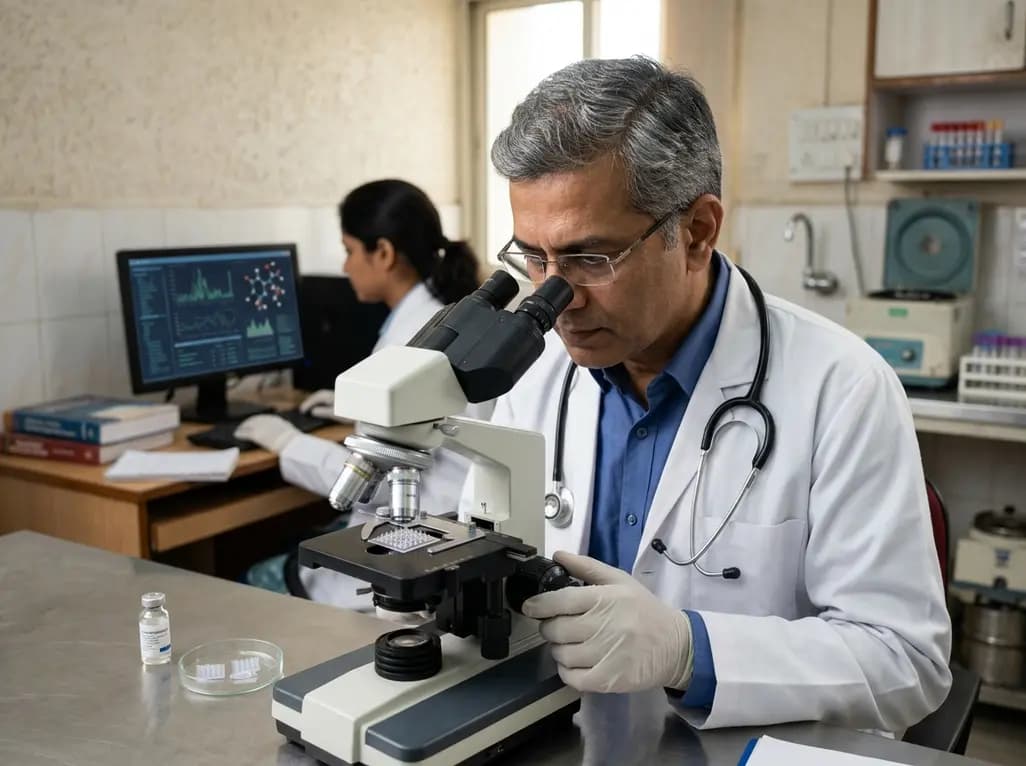
Chiral microneedle arrays represent a significant leap in the convergence of nanotechnology and biomedical engineering. Microneedle arrays (MNAs) are already widely recognized for their potential in painless drug delivery and minimally invasive biosensing. However, researchers have now introduced a novel fabrication pathway for Arrays of Chiral Microneedles (ARCHIMs). These advanced structures exhibit strong and predictable chiroptical resonances within the terahertz (THz) spectral window. Because chirality is fundamental to the biological function of most drugs and tissues, this development offers a precise method for monitoring therapeutic substances at the molecular level.
The fabrication of these chiral microneedle arrays involves a sophisticated glancing angle deposition of sequential gold layers. This process creates thin, non-centrosymmetric caps on each needle, which are essential for generating chiral plasmonic modes. These modes result in distinct Terahertz Circular Dichroism (TCD) bands and significant polarization rotations. Furthermore, the researchers demonstrated that these arrays could effectively emulate the behavior of chiral biologics. Specifically, they coated the ARCHIMs with L- and D-cystine biocrystals to observe how chiral phonons resonate with the microneedles' chiral plasmons.
Consequently, the coupling between these phonons and plasmons induces specific shifts in the TCD spectra. The team quantitatively described this photonic effect using modified temporal coupled mode theory. This mathematical framework incorporates polarization-dependent parameters, allowing for highly accurate sensing. In addition, the study highlights that this platform is scalable and tunable, making it suitable for diverse clinical applications ranging from chiral diagnostics to the detection of specific molecular handedness in pharmaceutical formulations.
The ability to detect chiral signatures via chiral microneedle arrays opens new opportunities in THz photonics and diagnostic medicine. Since many pharmaceuticals exist as enantiomers with different biological activities, ARCHIM technology could ensure drug purity and efficacy during delivery. Moreover, this innovation could lead to real-time, on-body sensing of chiral biomarkers, providing doctors with immediate data on a patient's metabolic state. Ultimately, this scalable platform bridges the gap between advanced light-matter interactions and practical clinical tools.
ARCHIMs are sub-millimeter needle arrays engineered with specific geometric chirality and gold coatings. They are designed to interact with terahertz light to detect the "handedness" of biological molecules and drugs.
TCD allows for the sensitive detection of chiral molecules, such as amino acids and proteins. This is crucial because the chirality of a molecule often determines its therapeutic effect or toxicity in the human body.
Potential applications include real-time biosensing of drug concentrations, advanced chiral diagnostics, and the development of high-precision THz photonics for medical imaging and analysis.
Disclaimer: This content is for informational and educational purposes only. It does not constitute medical advice or a professional recommendation. The technology described may still be in the research phase and not yet available for clinical use. Refer to the latest local and national guidelines for clinical practice.
References
Lee SH et al. Chiral Microneedle Arrays With Terahertz Chiroptical Activity With Chiral-Plasmon-Chiral-Phonon Resonance. Adv Mater. 2026 Jun 06. doi: 10.1002/adma.202521439. PMID: 42250207.
Wang P et al. Terahertz Chiral Metamaterials Enabled by Textile Manufacturing. Adv Mater. 2022 Apr;34(16):e2110590. doi: 10.1002/adma.202110590.
Li X et al. Metasurface-driven sensing in terahertz region: Principles, applications, fabrication, and challenges. Advanced Materials Technologies. 2025;10(20):e00886. doi: 10.1002/admt.202400886.
"
Read summarized clinical updates, watch expert medical content, and earn CME certifications right from your smartphone.
Open your smartphone camera to scan and install.





Researchers have developed ARCHIMs, chiral microneedle arrays that enhance terahertz sensing for drugs and biologics through chiroptical resonance technolog...
4 months ago

As monsoon seasons elevate arboviral disease threats, Tamil Nadu has initiated an ICMR-monitored evaluation of the tetravalent dengue vaccine in Tenkasi district. Clinicians emphasize clinical monitoring, public prevention, and high-quality early pediatric care to reduce disease morbidity across endemic regions.
Today

Leucine Rich Bio has introduced South Asia's first comprehensive vaginal microbiome test, BugSpeaks. By profiling microbial dysbiosis, pathogens, and antimicrobial resistance, this next-generation diagnostic platform provides clinicians with deeper insights into recurrent infections, fertility, and reproductive health.
Today

Review how tailored exercise programs benefit frail older patients with heart failure. Explore pathophysiological mechanisms, individualized training prescriptions, and strategies to overcome adherence barriers in clinical practice.
Today

This comparative study evaluates posterior labral tears with and without glenohumeral instability, highlighting distinct demographic patterns, MRI underestimation in stable shoulders, and successful arthroscopic repair outcomes.
Today

A clinical study demonstrates that early intervention with tocilizumab, either as monotherapy or bridged with corticosteroids, achieves significant proptosis reduction and resolves active inflammation in treatment-naive thyroid eye disease.
Today
