.webp&w=384&q=75)

Loading, please wait...
Loading, please wait...
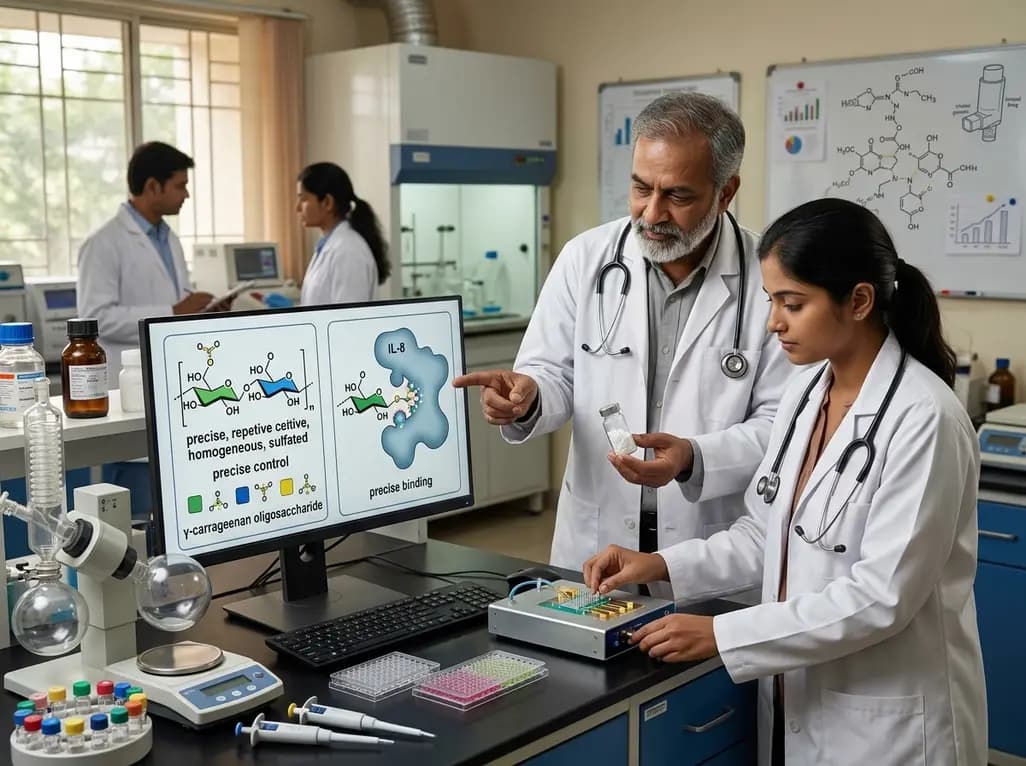
Researchers have achieved a landmark breakthrough in carrageenan oligosaccharide synthesis, providing a reliable pathway to create homogeneous marine galactans. Carrageenans, which are derived from red algae, play essential roles in drug delivery, cosmetics, and the global food industry. However, their natural structural complexity has historically hindered the development of precise medical applications. By utilizing a sophisticated protecting group hierarchy, scientists can now produce tailored oligosaccharides with specific sulfation patterns and chain lengths.
The ability to synthesize these molecules allows for a significantly deeper understanding of how they interact with biological systems. Specifically, the research team demonstrated how γ-carrageenan features influence Interleukin-8 (IL-8) binding preferences. Consequently, this study utilizes electrochemical sensing and surface analyses to elucidate these critical molecular interactions. Such precision is vital for creating immuno-active biomaterials that can modulate inflammatory responses in various therapeutic contexts.
Moreover, the integration of a conjugation-ready linker makes these synthetic oligosaccharides ideal for surface analysis and diagnostic tools. Traditionally, researchers struggled with the interdependent reactivity constraints of these complex marine sugars. This new synthetic route strategically resolves those trade-offs, ensuring high purity and precise monomer connectivity. Therefore, this advancement significantly enhances the potential for targeted drug delivery systems and advanced biosensing technologies.
The total synthesis of these oligogalactans represents a major leap for pharmaceutical science and pharmacy practice. Since these compounds can be precisely engineered, they offer a reliable platform for studying carbohydrate-protein interactions. This research will likely lead to the development of new anti-inflammatory agents and more efficient vaccine delivery vehicles. In summary, the transition from heterogeneous natural extracts to homogeneous synthetic molecules marks a new era in marine-derived medicine.
Interleukin-8 (IL-8) is a key cytokine involved in the inflammatory response. Understanding how carrageenan binds to IL-8 helps researchers design biomaterials that can either stimulate or inhibit specific immune pathways to treat inflammation.
Natural carrageenan extracts are often diverse and structurally complex, making them inconsistent for high-precision medicine. Total synthesis allows for the creation of homogeneous molecules with precise sulfation and length, which is essential for consistent results in medical research.
The synthesized oligosaccharides feature a conjugation-ready linker, allowing them to be easily attached to drug carriers or sensors. This improves the targeting and efficacy of therapeutics while providing a tool for real-time monitoring of disease markers.
Disclaimer: This content is for informational and educational purposes only. It does not constitute medical advice or a professional recommendation. Refer to the latest local and national guidelines for clinical practice.
References
Sukhran Y et al. Total Synthesis of Conjugation-Ready Sulfated Red Algae Carrageenan Oligosaccharides for Sensing Applications. J Am Chem Soc. 2026 Jun 10. doi: 10.1021/jacs.6c09827. PMID: 42267531.
Chan WI et al. Carrageenan activates monocytes via type-specific binding with interleukin-8: an implication for design of immuno-active biomaterials. Biomater Sci. 2020. doi: 10.1039/D0BM00494A.
Jabeena F et al. Carrageenan: structure, properties and applications with special emphasis on food science. RSC Publishing. 2025.
"
Read summarized clinical updates, watch expert medical content, and earn CME certifications right from your smartphone.
Open your smartphone camera to scan and install.





Researchers have achieved the first total synthesis of homogeneous carrageenan oligosaccharides. This breakthrough enables precise control over sulfation and chain length, allowing for better understanding of IL-8 binding and opening new doors for drug delivery and medical sensing technologies.
4 months ago

As monsoon seasons elevate arboviral disease threats, Tamil Nadu has initiated an ICMR-monitored evaluation of the tetravalent dengue vaccine in Tenkasi district. Clinicians emphasize clinical monitoring, public prevention, and high-quality early pediatric care to reduce disease morbidity across endemic regions.
Today

A comparative cohort study evaluates vNOTES vs TLH hysterectomy for benign conditions, demonstrating shorter operative duration, faster return to daily activities, and equivalent female sexual function scores without increased dyspareunia.
Today

Review how tailored exercise programs benefit frail older patients with heart failure. Explore pathophysiological mechanisms, individualized training prescriptions, and strategies to overcome adherence barriers in clinical practice.
Today

This comparative study evaluates posterior labral tears with and without glenohumeral instability, highlighting distinct demographic patterns, MRI underestimation in stable shoulders, and successful arthroscopic repair outcomes.
Today

A clinical study demonstrates that early intervention with tocilizumab, either as monotherapy or bridged with corticosteroids, achieves significant proptosis reduction and resolves active inflammation in treatment-naive thyroid eye disease.
Today
