.webp&w=384&q=75)

Loading, please wait...
Loading, please wait...
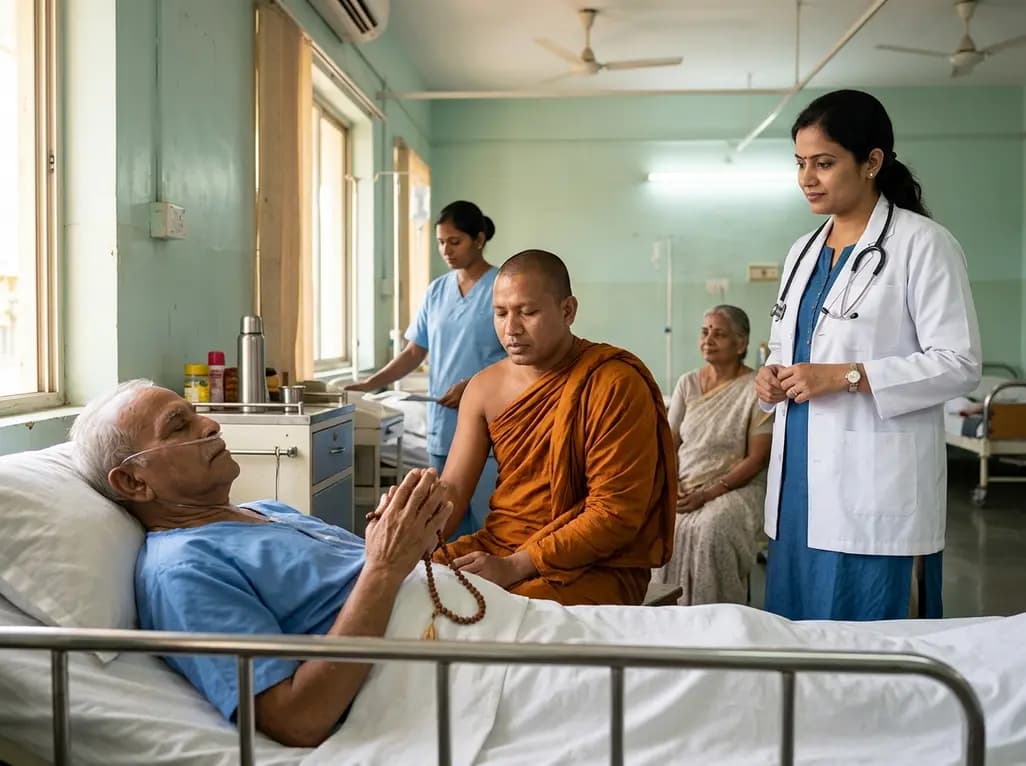
Buddhist end-of-life care represents a significant shift in how institutional settings approach the final stages of human existence. Recently, researchers conducted a qualitative study at Cihai Hospital in Shenzhen to explore the impact of \"zhunian,\" or assisted chanting. This practice involves a continuous 24-hour recitation of Amitabha Buddha's name to support the dying. Specifically, the study interviewed 34 participants, including patients, volunteers, and family members, between June and July 2025. Consequently, the findings revealed that this model addresses the spiritual and psychological dimensions of dying more effectively than traditional medical approaches alone. Therefore, clinicians should recognize how these rituals foster a mindful transition for the terminally ill. Moreover, the integration of these practices helps families find meaning during a difficult period. By examining these institutional settings, we can better understand the intersection of medicine and spiritual care. In addition, the study highlights the importance of cultural competence in palliative care. As a result, healthcare providers can offer more comprehensive support that respects the patient's beliefs. Furthermore, this approach challenges the standard unidirectional model where the patient is merely a recipient of care. Instead, it positions the dying individual as an active participant in their final journey. Notably, this study provides a framework for rendering death as a more humanistic process.
The religious framework of Buddhist end-of-life care emphasizes the importance of a calm and focused mind at the moment of death. Specifically, the practice of zhunian helps patients maintain their concentration on the Buddha's name, which many believe facilitates a favorable rebirth. This study identified that adherence to these rituals allows patients to accept death with greater ease. Moreover, the belief in rebirth provides a sense of continuity that alleviates the fear of annihilation. Consequently, patients often find it easier to release worldly attachments and focus on their spiritual goals. Furthermore, the presence of volunteers who chant continuously creates a supportive environment that reinforces the patient's faith. Interestingly, this religious framework does not just benefit the patient but also provides a structured path for the family. Therefore, the rituals serve as a bridge between the physical and spiritual realms. In addition, the study found that these practices help patients feel more connected to their community. As a result, the isolation often associated with terminal illness is significantly reduced. Notably, the iterative thematic analysis showed that spiritual readiness is a core component of a \"good death.\" Similarly, these findings suggest that integrating spiritual rituals can improve the overall quality of end-of-life care in modern hospitals.
Beyond its spiritual significance, Buddhist end-of-life care offers substantial psychosocial and relational benefits for both patients and their families. The Shenzhen study highlighted that the practice of assisted chanting provides much-needed companionship during the final hours. Specifically, the presence of dedicated volunteers ensures that the patient is never alone, which fosters a deep sense of peace and tranquility. Moreover, this constant support helps alleviate the emotional burden on family caregivers who may be struggling with grief. Consequently, the environment becomes one of collective mindfulness rather than individual despair. In addition, the study found that the association's support often extends to financial burden alleviation, as the services are often provided by volunteers. Therefore, families can focus on their emotional and spiritual needs without the added stress of high costs. Furthermore, the ritualized nature of the chanting provides a rhythmic, calming influence that reduces anxiety for everyone involved. As a result, the transition becomes a shared experience that strengthens family bonds. Interestingly, the researchers noted that the psychological calm achieved through chanting often leads to fewer requests for aggressive medical interventions. Thus, the practice supports a more natural and peaceful dying process. Notably, these relational dimensions show that palliative care must be holistic to be truly effective.
One of the most striking findings of the study involves the concept of patient agency within Buddhist end-of-life care. Traditionally, palliative care research views the patient as a passive recipient of support. However, this study found that dying patients often act as moral agents who actively tend to those around them. Specifically, many patients expressed concern for their caregivers' well-being and encouraged them to use the caregiving process as an opportunity for spiritual growth. Moreover, by resisting over-medicalization, these patients exercised personal control over their final days. Consequently, they transformed the act of dying into a final lesson in filial piety and faith for their children. In addition, this reciprocal model of care challenges the unidirectional caregiver-recipient dynamic. Therefore, the patient becomes a source of inspiration and strength for the family. Furthermore, this active engagement helps patients find profound meaning at the end of life. As a result, the sense of being a \"burden\" is replaced by a sense of purpose. Notably, the study emphasizes that spiritual practices empower patients to navigate their transition with dignity. Similarly, these findings suggest that healthcare providers should facilitate opportunities for patients to contribute to their own care plans. Thus, recognizing patient agency can lead to more empowering and respectful end-of-life experiences.
The findings from this study have significant implications for the future of modern palliative care and institutional medicine. Specifically, they characterize Buddhist end-of-life care as a reciprocal model that extends support far beyond the moment of physical death. Therefore, integrating such culturally and spiritually informed frameworks can help hospitals provide more personalized care. Moreover, the success of the Lotus Assisted Chanting Association suggests that community-based volunteer models can effectively supplement hospital resources. Consequently, healthcare systems can improve patient outcomes by collaborating with religious and spiritual organizations. In addition, this research highlights the need for clinicians to be aware of the diverse ways patients find meaning in death. Furthermore, prioritizing spiritual well-being can lead to higher satisfaction scores for both patients and their families. As a result, medical institutions can move toward a more humanistic approach that values the patient's life story and beliefs. Interestingly, the study shows that mindful processes can reduce the trauma often associated with institutional deaths. Notably, the results encourage a broader definition of palliative care that includes the relational and moral dimensions of dying. Therefore, by adopting these inclusive practices, modern medicine can better support the holistic needs of a diverse population. Similarly, these insights offer a valuable roadmap for improving end-of-life care globally.
The primary purpose of assisted chanting, or zhunian, is to help the dying patient maintain a focused and peaceful mind during their final transition. By continuously reciting the name of Amitabha Buddha, volunteers and family members create a spiritual environment that encourages the patient to release worldly attachments. Specifically, this practice aims to facilitate a favorable rebirth and ensure the patient feels supported and connected throughout the entire process.
The Buddhist model of care benefits family caregivers by providing a structured framework for processing grief and fulfilling filial duties. Through assisted chanting, caregivers participate in a collective spiritual practice that fosters emotional peace and reduces the sense of isolation. Moreover, the support from volunteer associations often alleviates the financial and physical burdens of caregiving, allowing the family to focus on finding meaning and strengthening their faith during a difficult time.
This study challenges the traditional view of the patient as a passive recipient by highlighting \"patient agency.\" In the Buddhist model, dying patients often act as moral agents who care for their families by resisting unnecessary medicalization and providing spiritual guidance. This reciprocal care model suggests that patients find dignity and purpose when they are allowed to actively participate in their end-of-life process, rather than being treated solely as subjects of medical intervention.
Disclaimer: This content is for informational and educational purposes only and does not constitute professional medical advice, diagnosis, or treatment. Always seek the advice of your physician or other qualified health provider with any questions you may have regarding a medical condition. Refer to the latest local and national guidelines for clinical practice.
References
Li SL et al. Assisted chanting and Buddhist end-of-life care in contemporary China. Palliat Support Care. 2026 Jul 13. doi: 10.1017/S1478951526103034. PMID: 42439096.
Thongpool R, Mahatthanadull S, Vuddhikaro PS. Buddhist Approach to Improve the Quality of Life of Palliative Patients. International Buddhist Studies College, Mahachulalongkornrajvidyalaya University. 2022.
Maungtoug N, Othaganont P, Liehr P. Adding Ritualized Chanting to the Palliative Care of Cancer Patients at the End of Life: A Randomized Controlled Trial. J Soc Work End Life Palliat Care. 2021 Jan-Mar;17(1):35-49.

Read summarized clinical updates, watch expert medical content, and earn CME certifications right from your smartphone.
Open your smartphone camera to scan and install.





This article explores a qualitative study on Buddhist assisted chanting (zhunian) in China, highlighting its role as a holistic model for end-of-life care that improves spiritual, emotional, and relational well-being while empowering patients as active agents in their own dying process.
3 months ago

As monsoon seasons elevate arboviral disease threats, Tamil Nadu has initiated an ICMR-monitored evaluation of the tetravalent dengue vaccine in Tenkasi district. Clinicians emphasize clinical monitoring, public prevention, and high-quality early pediatric care to reduce disease morbidity across endemic regions.
Today

Leucine Rich Bio has introduced South Asia's first comprehensive vaginal microbiome test, BugSpeaks. By profiling microbial dysbiosis, pathogens, and antimicrobial resistance, this next-generation diagnostic platform provides clinicians with deeper insights into recurrent infections, fertility, and reproductive health.
Today

Review how tailored exercise programs benefit frail older patients with heart failure. Explore pathophysiological mechanisms, individualized training prescriptions, and strategies to overcome adherence barriers in clinical practice.
Today

This comparative study evaluates posterior labral tears with and without glenohumeral instability, highlighting distinct demographic patterns, MRI underestimation in stable shoulders, and successful arthroscopic repair outcomes.
Today

A clinical study demonstrates that early intervention with tocilizumab, either as monotherapy or bridged with corticosteroids, achieves significant proptosis reduction and resolves active inflammation in treatment-naive thyroid eye disease.
Today
