

Loading, please wait...
Loading, please wait...

Clinicians frequently observe co-occurring neurodevelopmental differences and gender variance during psychiatric evaluations. Understanding autism in gender-diverse populations has therefore become an essential priority for contemporary healthcare professionals. Emerging clinical literature consistently reports an elevated prevalence of neurodivergence among transgender and gender-diverse individuals. However, many published investigations exhibit significant methodological discrepancies that complicate clinical interpretation. A systematic review and meta-analysis synthesized data to examine how clinicians evaluate autistic traits in these cohorts. By evaluating standard diagnostic procedures, the research highlights critical disparities between screening tools and clinical examinations. Consequently, mental health practitioners must refine their diagnostic frameworks to serve patients effectively.
Researchers analyzed twenty-eight studies published since 2013 to determine how diagnostic practices function across clinical settings. Notably, eighteen of these studies specifically examined confirmed diagnoses of autism spectrum disorder. However, only six studies, representing thirty-three percent, actually used robust diagnostic criteria to verify the condition. Across these rigorous investigations, clinicians identified one hundred participants with confirmed autism among 1855 individuals, reflecting a baseline rate of 5.4 percent. When researchers pooled these robust evaluations using random-effects meta-analysis, the estimated prevalence reached 12 percent. In contrast, the pooled prevalence for the broader autism phenotype reached 24 percent across twenty-three investigations. These findings indicate that diagnostic stringency fundamentally influences reported prevalence rates. Furthermore, reliance on heterogeneous assessment methodologies introduces substantial confounding variables into clinical conclusions. Consequently, psychiatrists cannot accept elevated screening figures without scrutinizing diagnostic rigor. Standardized clinical pathways remain sparse, leaving many individuals vulnerable to diagnostic overshadowing. Therefore, clinicians must distinguish between elevated subthreshold traits and formal neurodevelopmental diagnoses. Addressing these diagnostic gaps ensures equitable healthcare access and accurate clinical documentation.
The systematic analysis revealed substantial reliance on screening instruments rather than comprehensive diagnostic batteries. Across twenty-three studies examining autistic characteristics, investigators utilized thirteen distinct assessment tools. For example, many studies relied on brief self-report questionnaires, such as the Autism-Spectrum Quotient or the Social Responsiveness Scale. While these questionnaires efficiently capture self-perceived traits, they lack diagnostic specificity when clinicians use them in isolation. Moreover, self-report measures frequently conflate social communication differences with social anxiety or minority stress. Consequently, individuals experiencing gender-related marginalization may score higher on social difficulty indices without meeting core diagnostic thresholds. Methodological quality assessments using Joanna Briggs Institute appraisal tools demonstrated considerable risk of bias across multiple datasets. Many published studies failed to recruit representative control groups or adjust for confounding psychiatric conditions. In addition, retrospective chart reviews often lacked standardized verification of previous psychiatric findings. Thus, the literature presents an inflated perception of diagnostic certainty. Healthcare providers should prioritize multi-informant assessments over quick questionnaires whenever neurodevelopmental questions arise in clinical practice.
Gold-standard diagnostic protocols require multidisciplinary evaluation, detailed developmental history, and semi-structured observational tools. For instance, instruments like the Autism Diagnostic Observation Schedule provide validated developmental benchmarks. Nevertheless, very few studies incorporated these structured observations into their research designs. Instead, most studies accepted medical chart notations or unverified patient recollections as evidence of autism spectrum disorder. This procedural divergence creates a striking gap between research assertions and clinical reality. Consequently, clinicians may inadvertently mistake elevated screening metrics for confirmed clinical diagnoses during patient encounters. Furthermore, screening tools often fail to account for unique communication profiles in diverse demographic cohorts. Sensory differences and social communication styles in gender-diverse individuals frequently interact with identity development. Therefore, clinicians cannot substitute brief self-administered surveys for comprehensive clinical evaluations. Implementing structured observational tools alongside longitudinal assessments substantially reduces diagnostic errors. Additionally, multidisciplinary collaboration between pediatricians, psychiatrists, and psychologists ensures that diagnostic decisions reflect genuine developmental profiles. Adhering to these established gold standards protects patients while ensuring timely neurodevelopmental support.
Clinicians must carefully evaluate phenotypic camouflaging and masking behaviors during neurodevelopmental evaluations. In particular, gender-diverse individuals often develop sophisticated compensation strategies to navigate social expectations. These masking behaviors can obscure classic autistic traits during brief clinical interviews. Consequently, high-masking individuals may present with secondary mental health conditions, including severe anxiety, depression, or chronic burnout. At the same time, clinicians must avoid confusing autistic social exhaustion with distress caused by gender dysphoria. For example, social withdrawal might stem from sensory overload or from fear of discrimination. Similarly, rigid thinking patterns regarding gender roles can reflect autistic cognitive styles rather than internalized gender incongruence. In addition, the broader autism phenotype frequently overlaps with common adolescent adjustment challenges. Therefore, practitioners must conduct comprehensive differential diagnoses that evaluate early childhood development before societal stressors emerged. Longitudinal follow-up allows healthcare teams to observe how social functioning evolves as gender affirmation progresses. Ultimately, untangling these nuanced presentations requires clinicians to remain observant, empathetic, and methodologically thorough throughout evaluation.
Improving clinical care requires structured educational training for all healthcare professionals evaluating neurodivergence. Specifically, clinicians must understand the intersection between neurodiversity and gender variance to deliver competent care. Training programs should emphasize that gender-diverse individuals have unique healthcare experiences that standard diagnostic models historically ignored. Furthermore, medical institutions must establish interdisciplinary clinics where neurodevelopmental experts and gender specialists collaborate directly. Such collaborative models prevent diagnostic overshadowing, where one condition obscures the symptoms of another. Moreover, clinicians should adopt neurodiversity-affirming language that respects patient identity while maintaining strict diagnostic rigor. In practice, physicians should always obtain comprehensive developmental histories from multiple sources, including caregivers when accessible. Clinicians must also account for sensory sensitivities, executive dysfunction, and communication preferences within affirming clinical spaces. Additionally, continuous professional development regarding validated diagnostic tools ensures that clinicians interpret screening results appropriately. By integrating gold-standard evaluations with cultural competence, healthcare systems can eliminate existing diagnostic barriers. Consequently, patients receive accurate diagnoses, individualized therapeutic accommodations, and affirming mental health support.
Recent meta-analyses indicate that approximately twelve percent of gender-diverse individuals receive a robust, clinically confirmed autism diagnosis. However, studies examining broader autistic traits report a higher prevalence of twenty-four percent. Diagnostic variability occurs because many studies rely on self-report questionnaires rather than validated clinical assessments.
Autism screening tools frequently capture general social anxiety, minority stress, and behavioral compensation rather than core neurodevelopmental features. Consequently, self-reported scores often reflect elevated distress related to societal marginalization. Structured clinical examinations and longitudinal evaluations are necessary to distinguish between subthreshold traits and formal diagnostic criteria.
Clinicians should implement gold-standard diagnostic instruments, including structured observational tools and comprehensive developmental histories. Furthermore, healthcare professionals require targeted training in both neurodiversity and gender variance. Fostering multidisciplinary collaboration between psychiatric and gender-affirming care teams prevents diagnostic overshadowing and ensures comprehensive, individual-centered evaluations.
Disclaimer: This content is for informational and educational purposes only... Refer to the latest local and national guidelines for clinical practice.
References

Read summarized clinical updates, watch expert medical content, and earn CME certifications right from your smartphone.
Open your smartphone camera to scan and install.





A systematic review and meta-analysis reveals that only 33% of studies evaluating autism in gender-diverse populations use robust diagnostic criteria. While broader autistic traits reach 24%, confirmed autism spectrum disorder is 12%, highlighting critical methodological gaps and the need for specialized clinician training.
Today

A retrospective study of 6,113 adults shows that combining GLP-1 receptor agonists with digital health apps nearly doubles the odds of achieving significant weight loss. Frequent progress logging serves as a primary behavioral driver of long-term metabolic success.
Today

Sexual dysfunction affects a high proportion of reproductive-age females with multiple sclerosis. This comprehensive review highlights multi-tier etiologies, proactive clinical screening tools, preconception counseling considerations, and integrated therapeutic options across multidisciplinary care pathways.
Today
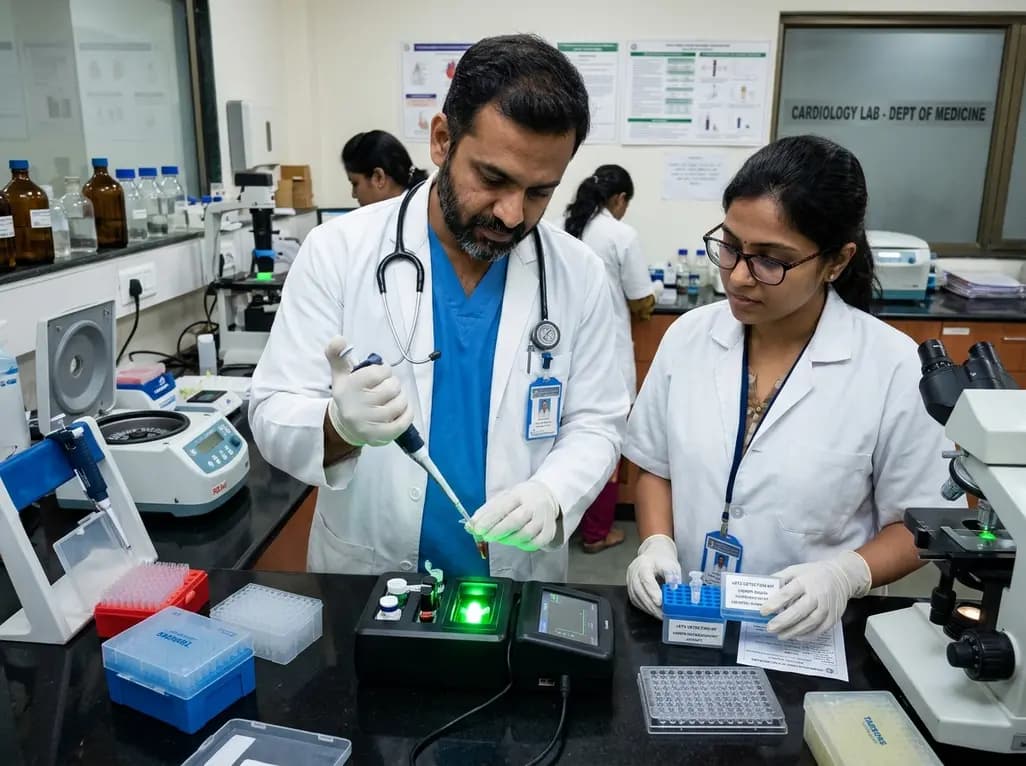
Researchers have engineered an innovative CRISPR-Cas12a fluorescent diagnostic kit for clinical sST2 detection. By combining nanotechnology with enzymatic trans-cleavage, this platform enables rapid, ultrasensitive heart failure diagnosis and risk stratification, outperforming conventional laboratory ELISA methods.
Today

Non-union fractures occur in 2-5% of cases, causing significant disability and cost. Conservative modalities such as LIPUS, PEMF, and focused ESWT offer non-surgical healing options for defects up to 5-10 mm when adequate mechanical stability exists without infection.
Today

India is poised to transform chronic disease management through wearable health technology. Discover how continuous remote monitoring and predictive algorithms empower clinicians to detect early cardiovascular signals, personalize metabolic interventions, and deliver equitable preventive care across populations.
Yesterday
