

Loading, please wait...
Loading, please wait...

Children frequently encounter substantial delays when seeking tertiary healthcare, as specialist shortages persist worldwide. Consequently, healthcare organizations must implement innovative care delivery pathways to manage referral queues efficiently. Modern provider-to-provider pediatric eConsults offer an asynchronous, digital avenue for primary care providers to obtain rapid specialist recommendations without an immediate face-to-face appointment. Furthermore, these asynchronous systems empower general practitioners to deliver timely, evidence-based interventions directly within their medical homes. Ultimately, this approach enhances clinical throughput while simultaneously mitigating travel burdens for vulnerable pediatric populations.
Historically, traditional referral workflows directed every clinical inquiry toward an in-person outpatient encounter. However, a significant proportion of tertiary consultations involve low-acuity inquiries that do not require physical examinations. Therefore, excessive queues accumulate rapidly, forcing complex children with urgent needs to wait several months for critical evaluations. When primary clinicians leverage pediatric eConsults, they can submit focused medical questions directly alongside diagnostic data. Specialists subsequently review these records within a structured electronic environment and provide actionable guidance within days. As a result, primary care doctors maintain continuity of care for routine concerns, while tertiary subspecialists preserve clinic capacity for high-acuity illnesses. In addition, this coordinated approach substantially reduces geographic health disparities for families residing in underserved or rural districts. Primary physicians also acquire practical clinical knowledge through each digital dialogue, which steadily expands their independent diagnostic capabilities. Thus, the model provides immediate patient relief and fosters sustainable workforce education across community networks.
Healthcare leaders must clearly distinguish between distinct asynchronous modalities to deploy them effectively across busy clinical networks. While provider-to-provider eConsults focus entirely on interprofessional communication, patient-to-provider eVisits establish a direct digital link between families and medical teams. Specifically, parents can complete standardized symptom questionnaires via a secure portal for common, self-limiting childhood complaints. Clinicians then evaluate these structured inputs alongside longitudinal records to generate tailored treatment plans or prescribe appropriate medications. Consequently, eVisits alleviate acute walk-in volumes for conditions such as mild dermatologic rashes, allergic rhinitis, and uncomplicated conjunctivitis. Meanwhile, interprofessional eConsults address nuanced diagnostic dilemmas, such as asymptomatic hematuria or borderline thyroid anomalies. Both tools successfully divert low-complexity demand away from constrained physical clinics without compromising therapeutic safety. Furthermore, integrating these twin mechanisms allows health systems to construct comprehensive virtual care hubs. As primary care practices incorporate both solutions, they deliver continuous accessibility while systematically triaging physical visit slots for complex pathology.
Successful adoption of asynchronous specialty care requires robust digital infrastructure and transparent clinical governance. Health systems must embed structured consultation templates directly into existing electronic health record software to avoid fragmented records. Furthermore, clinical leadership teams must establish standardized intake criteria so that referring providers submit comprehensive laboratory and imaging results. Without standardized minimum clinical datasets, consulting specialists cannot safely render decisive therapeutic judgments. Additionally, healthcare institutions must design equitable compensation structures that adequately reward specialists for evaluating electronic records. Program coordinators should also establish explicit turnaround benchmarks, typically ranging from twenty-four to seventy-two hours, to preserve patient safety. Moreover, clear institutional protocols must delineate clinical liability between the primary practitioner and the advising subspecialist. When organizations formalize these operational parameters, clinician confidence increases and interdisciplinary collaboration expands rapidly. Ultimately, seamless electronic interfaces eliminate cumbersome administrative burdens, enabling clinicians to focus entirely on coordinated decision-making.
Extensive empirical investigations confirm that structured asynchronous programs generate impressive clinical outcomes across diverse pediatric populations. For example, published institutional data demonstrate that pediatric electronic consultations eliminate the necessity for in-person evaluations in over sixty percent of submitted inquiries. Consequently, families avoid substantial indirect expenses, including lost work productivity, prolonged travel times, and stressful clinic commutes. Furthermore, longitudinal outcome evaluations reveal that very few patients require subsequent tertiary visits for the same initial complaint after an asynchronous review. Hospital systems also experience marked reductions in unnecessary outpatient appointments, diagnostic laboratory requests, and redundant radiographic procedures. Similarly, primary care providers consistently express immense satisfaction with these digital pathways, citing prompt communication and valuable educational exchanges. Most importantly, clinical quality audits confirm that asynchronous triage preserves excellent diagnostic safety without increasing emergency department utilization. Therefore, asynchronous workflows achieve the vital triple aim of enhancing patient experience, improving pediatric population health, and lowering cumulative delivery costs.
Despite these clear benefits, several systemic hurdles can hinder the widespread implementation of asynchronous pediatric services. For instance, restrictive payer policies and erratic reimbursement frameworks frequently disincentivize private practices from launching comprehensive digital consultation programs. In addition, busy subspecialists often express concern regarding digital inbox fatigue and uncompensated cognitive workloads. Healthcare networks must therefore implement protected clinical time slots dedicated exclusively to asynchronous reviews. Looking forward, emerging artificial intelligence tools hold transformative potential to streamline these asynchronous workflows even further. Advanced natural language models can pre-populate referral summaries, highlight missing clinical data, and suggest evidence-based guidelines before specialist review. Consequently, specialists can finalize comprehensive recommendations in a fraction of their current charting time. In addition, automated triage algorithms will soon route incoming cases dynamically according to acuity and provider availability. Ultimately, combining human clinical expertise with responsible artificial intelligence will guarantee equitable, sustainable pediatric specialty access for generations to come.
Traditional referrals require patients to travel to an outpatient facility for an in-person subspecialty appointment. In contrast, pediatric eConsults function as structured, asynchronous electronic exchanges between the primary care physician and a pediatric specialist. The specialist examines existing patient records, lab findings, and imaging studies directly within the electronic health record. Consequently, the primary clinician receives expert management guidance within days, often eliminating the need for a separate physical clinic visit entirely.
Asynchronous pediatric care works exceptionally well for stable, low-acuity clinical questions that rely primarily on diagnostic data review rather than hands-on physical exams. For example, pediatricians frequently use eConsults to manage mild growth delays, abnormal routine lab values, asymptomatic hematuria, or recalcitrant eczema. Additionally, patient-facing eVisits handle simple acute concerns such as mild viral rashes, seasonal allergies, and conjunctivitis. However, clinicians should never use asynchronous methods for unstable symptoms, severe respiratory distress, or acute emergencies.
Health systems can secure reimbursement by utilizing established interprofessional consultation billing codes, such as current procedural terminology codes for asynchronous medical reviews. Furthermore, institutional leaders should negotiate value-based payment contracts with private and public insurers that reward proactive demand management and reduced hospital utilization. Additionally, healthcare administrators must establish dedicated internal compensation mechanisms, such as relative value unit credits, ensuring that participating pediatric specialists receive fair remuneration for their valuable cognitive time and charting efforts.
Disclaimer: This content is for informational and educational purposes only and should not be considered as medical advice. Always consult a qualified healthcare professional regarding any medical condition or treatment. Refer to the latest local and national guidelines for clinical practice.
References

Read summarized clinical updates, watch expert medical content, and earn CME certifications right from your smartphone.
Open your smartphone camera to scan and install.





Asynchronous pediatric care, including provider-to-provider eConsults and patient-facing eVisits, streamlines specialty referrals, reduces wait times, and preserves outpatient clinical capacity for high-acuity pediatric cases.
Today

Researchers at IIT Bombay have engineered an automated, cost-effective point-of-care device that diagnoses anaemia and sickle cell disease from a single drop of blood. By measuring blood smear spreading length, this portable tool assesses blood viscosity to offer rapid screening in resource-limited healthcare centers.
Today
A population-based study of 20,928 children reveals that small vulnerable newborns face sex-divergent mental capital outcomes at ages 6-7: term SGA girls show higher behavioral difficulties and lower resilience, while preterm non-SGA boys experience increased behavioral problems.
Today
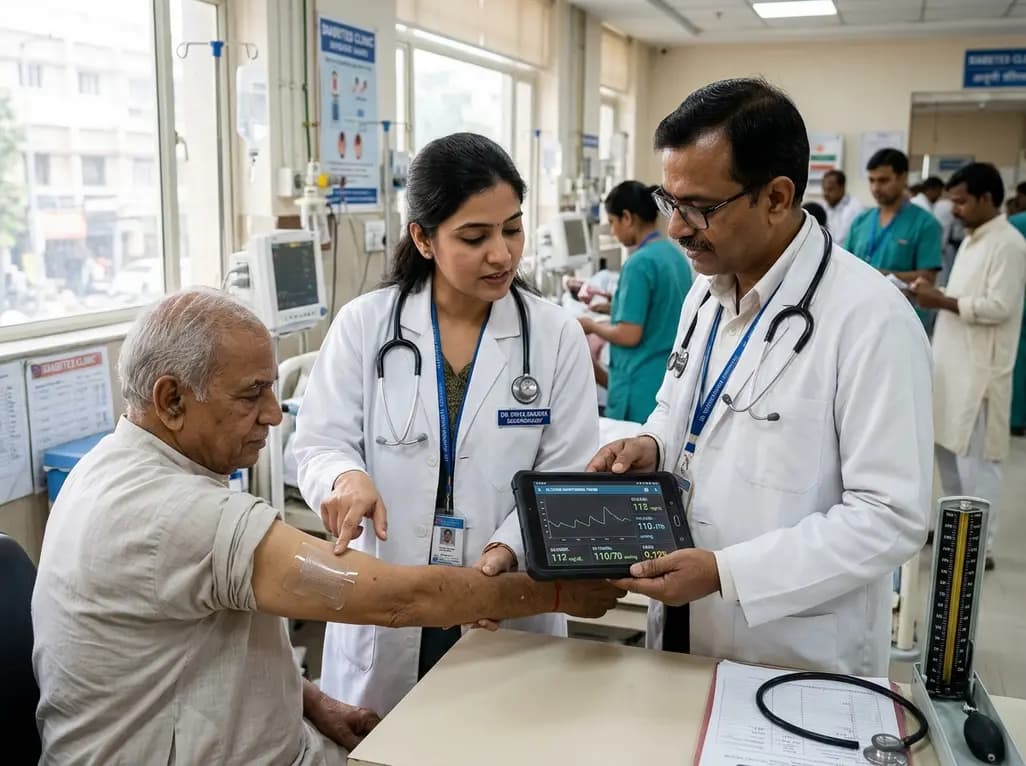
A breakthrough ultrathin multimodal sensor decouples physical hemodynamic monitoring from disposable electrochemical calibration, achieving long-term wearable glucose prediction with 81.36% accuracy and a 9.12% MARD. This offers a robust, drift-free solution for outpatient metabolic surveillance.
Today

A comparative review of tension band wiring and intramedullary screw fixation in thumb metacarpophalangeal arthrodesis, evaluating union rates, hardware complications, and clinical outcomes.
Today

Following regulatory scrutiny from FSSAI regarding promotional representations and lean muscle preservation claims, Dr. Reddy's Laboratories and Nestlé Health Science are currently reviewing the branding and marketing strategy for their joint nutritional supplement Celevida GLP+.
Today
