.webp&w=384&q=75)

Loading, please wait...
Loading, please wait...

Supination-external rotation (SER) stage 4 injuries represent a significant portion of lower limb trauma cases. Consequently, the development of the All-Inside Deltoid Repair technique provides a valuable tool for managing these bimalleolar-equivalent fractures. While surgeons often debate the necessity of medial-side surgical intervention, achieving anatomical stability is vital for long-term joint health. This approach aims to restore ligamentous integrity without the morbidity associated with larger open incisions.
Recent evidence highlights the effectiveness of this minimally invasive method. A prospective study involving 12 patients demonstrated favorable short-term results. Specifically, the participants reported a mean Visual Analog Scale (VAS) score of 1.5 at the six-month follow-up. Additionally, the mean AOFAS score reached 87, reflecting strong functional recovery. Importantly, no complications occurred during the study period, suggesting a high safety profile for the procedure.
Radiographic stability remains a primary concern for orthopedic surgeons. Furthermore, the All-Inside Deltoid Repair technique successfully maintained joint alignment under various conditions. The medial clear space (MCS) showed no significant widening during weight-bearing or stress radiographs. Similarly, the talar tilt (TT) remained consistent across all measurements. Therefore, these findings confirm that the repair effectively preserves joint integrity and prevents undesirable displacement.
In bimalleolar-equivalent injuries, the lateral malleolus is fractured and the deltoid ligament is torn. However, this combination often creates significant instability that mimics a traditional two-bone fracture. Traditional management sometimes overlooks the medial ligamentous injury, focusing only on the fibular fixation. Consequently, patients may experience persistent medial-sided pain if the deltoid is not addressed. By utilizing the All-Inside Deltoid Repair, surgeons can secure both sides of the joint more effectively.
The use of arthroscopic techniques in trauma care continues to evolve. In SER IV bimalleolar-equivalent ankle fractures, this repair method maintains radiographic reduction and yields excellent functional outcomes. Moreover, it offers a reliable solution for surgeons seeking to optimize joint mechanics while minimizing surgical trauma.
This injury involves a fibular fracture combined with a complete rupture of the medial deltoid ligament. It is termed "equivalent" because the resulting instability is similar to having both the medial and lateral malleoli fractured.
The All-Inside Deltoid Repair uses arthroscopic assistance to fix the ligament with minimal tissue disruption. This technique allows for stable joint alignment and early mobilization, which often leads to better functional scores and lower pain levels.
Disclaimer: This content is for informational and educational purposes only. It does not constitute medical advice or establish a doctor-patient relationship. Always seek the advice of a qualified healthcare provider for any questions regarding a medical condition or treatment. Refer to the latest local and national guidelines for clinical practice.
References
Baumfeld TS et al. Deltoid All-Inside Repair in SER IV Bimalleolar-Equivalent Ankle Fractures. Foot Ankle Spec. 2026 Apr 12. doi: 10.1177/19386400261427776. PMID: 41966839.
Orthobullets. Ankle Fractures - Trauma. Accessed April 13, 2026. Available at: https://www.orthobullets.com/trauma/1047/ankle-fractures
Del Balso C, et al. Early radiographic outcomes following deltoid ligament repair in bimalleolar equivalent ankle fractures. J Foot Ankle Surg. 2022;28(6):851-855. doi:10.1016/j.fas.2021.08.007

Read summarized clinical updates, watch expert medical content, and earn CME certifications right from your smartphone.
Open your smartphone camera to scan and install.





This study evaluates the clinical effectiveness of the arthroscopic all-inside deltoid repair technique in maintaining stability for SER IV ankle fractures....
6 months ago

Following regulatory scrutiny from FSSAI regarding promotional representations and lean muscle preservation claims, Dr. Reddy's Laboratories and Nestlé Health Science are currently reviewing the branding and marketing strategy for their joint nutritional supplement Celevida GLP+.
Today
A comprehensive scoping review synthesises evidence linking prenatal maternal mental health to long-term offspring neurodevelopment, evaluating neuroendocrine, inflammatory, and epigenetic pathways while highlighting clinical screening and future research priorities.
Today
The Directorate General of Health Services directs Indian states to halt the hazardous reuse and reprocessing of single-use medical devices. Discover regulatory implications under the Drugs and Cosmetics Act, critical infection risks, legal liabilities, and operational changes required across clinical specialties.
Today
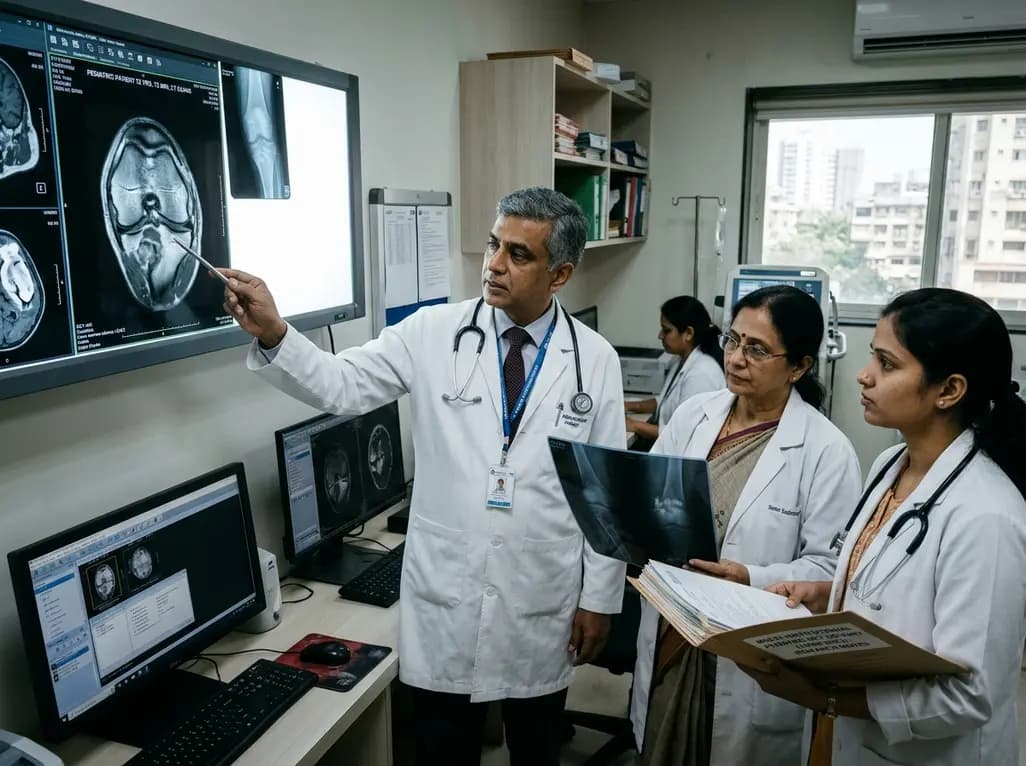
A 25-year multi-institutional cohort reveals high recurrence rates in pediatric giant cell tumor of bone, particularly in patients with open physes and bone marrow edema on preoperative MRI. Early surveillance and careful balance between growth plate preservation and tumor clearance are essential.
Today

India is advancing preventive healthcare by integrating genomics, artificial intelligence, and quantum technologies. With the SANGAM programme sequencing one million Indian genomes, clinicians can unlock personalized therapies, detect cardiometabolic risks early, and curb the burden of diabetes and heart disease.
Today
