.webp&w=384&q=75)

Loading, please wait...
Loading, please wait...
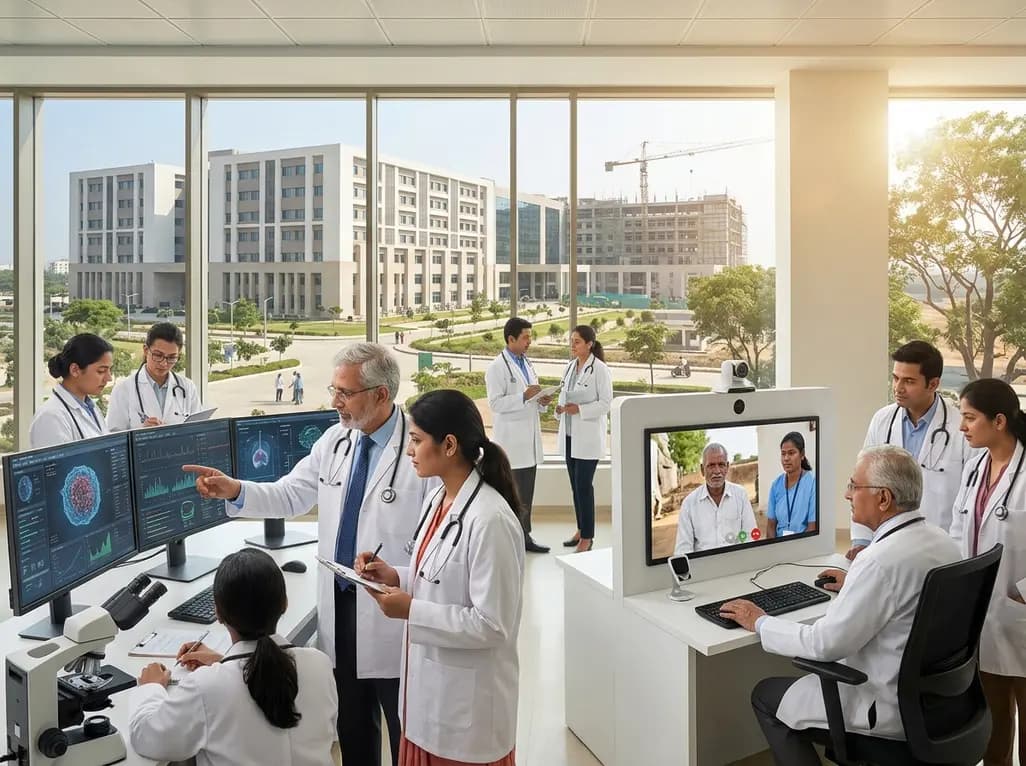
During his Telangana visit, Union Health Minister J.P. Nadda reviewed premier medical institutions. Specifically, the rapid AIIMS Bibinagar development stands out as a major milestone. Sanctioned under the PMSSY, the institute has quickly transitioned into a functional hub for clinical care and research. Consequently, it represents a substantial leap in strengthening South India's medical network. Furthermore, eighteen of the country's twenty-three AIIMS campuses are currently operational. AIIMS Bibinagar will achieve complete operational capability very soon.
The physical expansion of this vital healthcare asset has progressed at an outstanding pace. The Union Minister revealed that construction work has officially reached eighty-seven percent completion. Therefore, the ministry expects the physical infrastructure to finish construction by December this year. The project officially commenced in June 2022 with an approved capital outlay of over eleven hundred crore rupees. Surprisingly, the facility began clinical operations in a remarkably short span. To support this rapid expansion, administrators successfully recruited one hundred and thirty-two qualified faculty members. In addition, there are currently one hundred and thirty-three senior resident doctors active on campus. This workforce ensures that patients receive round-the-clock specialized clinical attention. Consequently, regional reliance on distant healthcare facilities has declined significantly. Moreover, the facility integrates modern construction standards designed for eco-friendly sustainability. This deliberate infrastructure design ensures long-term operational resilience. Indeed, the central government remains firmly committed to upgrading tertiary medical care in underserved regions. This strategic development successfully bridges the gap between rural populations and super-specialty medical interventions.
The institution has achieved substantial milestones in training the next generation of medical specialists. Currently, AIIMS Bibinagar offers comprehensive undergraduate, postgraduate, and advanced super-specialty programs. Specifically, the academic division runs twenty-four postgraduate medical disciplines along with five distinct super-specialty courses. Two full batches of undergraduate medical students have already graduated from this prestigious campus. Furthermore, the newly launched nursing program has further diversified the educational ecosystem since its introduction. This ensures a steady pipeline of skilled healthcare providers. To maintain academic excellence, the faculty utilizes modern training methods and interactive learning technologies. Consequently, students receive a highly practical education that mirrors international standards. Additionally, the academic block features state-of-the-art classrooms and well-equipped laboratories. Faculty members also engage in continuous professional development to keep their knowledge updated. As a result, the learning environment remains highly stimulating for young medical minds. The Union Health Minister commended these efforts, emphasizing strong academic roots. This educational framework will certainly help address the regional shortage of medical professionals.
The hospital division has vastly expanded its clinical reach to benefit the regional population. Daily operations currently accommodate approximately eighteen hundred outpatient department patients seeking specialized care. In addition, the introduction of inpatient wards and emergency care has enhanced local critical care capacity. Patients can now access advanced diagnostic tools like computed tomography and magnetic resonance imaging. Consequently, local residents no longer need to travel to far-off cities for essential diagnostics. Moreover, the digital healthcare front has experienced remarkable growth through telemedicine. Specifically, the eSanjeevani platform has successfully served more than one hundred and fifty-six thousand patients. This virtual consultation service successfully bridges geographical gaps for remote patients. Additionally, the institute fully supports the Ayushman Bharat Digital Mission to streamline medical records. This digital integration facilitates efficient, transparent, and seamless clinical workflows across all departments. Patients also benefit from centralized medicine distribution and localized care desks. Therefore, the hospital has established a patient-centric environment that prioritizes affordability and high-quality outcomes.
A robust research ecosystem defines the academic identity of this premier medical center. Crucially, the institute has successfully secured nearly sixty-four crore rupees in competitive research grants. Currently, faculty members are leading one hundred and twenty-nine ongoing research projects. These studies cover diverse topics ranging from basic medical sciences to advanced clinical trials. Furthermore, the academic staff has published over eleven hundred research papers in peer-reviewed journals. This extensive publication record establishes the institute as a leading hub of medical research. Additionally, the university collaborates actively with national scientific organizations like the Defence Research and Development Organisation. Together, they are developing innovative medical devices, such as the carbon-impregnated prosthetic leg. This collaboration directly benefits amputees by providing lightweight, affordable mobility solutions. Consequently, their scientific research translates directly into tangible clinical benefits for society. Faculty members also encourage postgraduate students to participate in these scientific investigations. Therefore, the institution is nurturing a new generation of physician-scientists who value empirical evidence.
The institution's dedication to societal welfare extends far beyond the physical hospital walls. Specifically, the department of community medicine has adopted six neighboring rural villages. Through this program, specialists provide consistent, preventive care directly to underserved families. Additionally, the medical team has successfully conducted five hundred and forty-seven mobile health camps. These camps have offered free medical checkups, essential medicines, and lifestyle counseling to the public. As a result, more than sixty-six thousand rural residents have directly benefited from these outreach drives. Furthermore, the institute has launched the country's first AIIMS-run community radio station. This innovative platform broadcasts essential health tips, maternal care advice, and disease prevention strategies daily. Consequently, the local population gains access to vital, scientifically accurate health literacy in their native language. To expand this social reach, student volunteers participate actively in public health awareness programs. Therefore, the hospital builds a stronger, healthier, and more informed community in the region.
Q1: What medical programs are currently available at the institute?
Currently, AIIMS Bibinagar offers comprehensive medical education across multiple educational levels. This includes undergraduate MBBS courses, postgraduate programs in twenty-four MD disciplines, and super-specialty training in five DM/MCh courses. Furthermore, they launched a specialized B.Sc. Nursing program to train clinical support staff. These academic structures successfully ensure that all students receive cutting-edge clinical training and robust research exposure.
Q2: How has the hospital expanded its local healthcare access?
The institute serves approximately eighteen hundred outpatients daily through its modern outpatient department facility. Additionally, it offers comprehensive inpatient admissions, dedicated emergency care, and advanced diagnostic services including high-resolution MRI and CT scans. Moreover, the eSanjeevani telemedicine platform has successfully provided remote clinical consultations to more than one lakh fifty-six thousand patients, drastically improving clinical access for distant rural populations.
Q3: What community outreach initiatives has the institute introduced?
Specifically, the public health department has adopted six rural villages and successfully organized over five hundred and forty-seven mobile medical camps. These outreach efforts have already delivered quality clinical care to more than sixty-six thousand local villagers. Furthermore, they launched the first AIIMS-led community radio station to broadcast critical healthcare awareness, maternal hygiene tips, and preventive medicine strategies directly to the surrounding communities.
Disclaimer: This content is for informational and educational purposes only. It does not constitute medical advice or replace professional judgment. Refer to the latest local and national guidelines for clinical practice.
References

Read summarized clinical updates, watch expert medical content, and earn CME certifications right from your smartphone.
Open your smartphone camera to scan and install.





AIIMS Bibinagar achieves a major milestone under Union Health Minister JP Nadda's review, securing Rs 64 crore in research grants and reaching 87% physical construction completion. Discover how the institution is transforming South India's medical education, patient care, and telemedicine services.
3 months ago

Review how tailored exercise programs benefit frail older patients with heart failure. Explore pathophysiological mechanisms, individualized training prescriptions, and strategies to overcome adherence barriers in clinical practice.
Today

Leucine Rich Bio has introduced South Asia's first comprehensive vaginal microbiome test, BugSpeaks. By profiling microbial dysbiosis, pathogens, and antimicrobial resistance, this next-generation diagnostic platform provides clinicians with deeper insights into recurrent infections, fertility, and reproductive health.
Today

In high-risk pulmonary embolism complicated by severe anemia and active uterine bleeding, systemic thrombolysis is contraindicated. Large-bore aspiration thrombectomy provides rapid hemodynamic rescue without fibrinolysis, supported by inferior vena cava filter placement and multidisciplinary critical care.
Today

This comparative study evaluates posterior labral tears with and without glenohumeral instability, highlighting distinct demographic patterns, MRI underestimation in stable shoulders, and successful arthroscopic repair outcomes.
Today

A clinical study demonstrates that early intervention with tocilizumab, either as monotherapy or bridged with corticosteroids, achieves significant proptosis reduction and resolves active inflammation in treatment-naive thyroid eye disease.
Today
