.webp&w=384&q=75)

Loading, please wait...
Loading, please wait...

The integration of artificial intelligence into medical curricula is rapidly reshaping how students learn complex biological processes. A recent study introduces a human-AI collaborative model specifically designed to enhance AI in physiology education. This framework addresses the ethical and pedagogical challenges of laboratory instruction. Consequently, it offers a structured path for modernizing undergraduate medical training while maintaining teacher leadership.
Using a modified Delphi method, researchers consulted 15 interdisciplinary experts to validate a four-module precision teaching model. Specifically, these modules include precision learning analysis, objective setting, implementation, and evaluation. Furthermore, the experts reached a high level of consensus regarding the model's scientific validity. This collaborative approach ensures that technological tools support rather than replace the educator's professional judgment.
The study highlights several practical pathways for successful integration into the laboratory setting. Key recommendations include developing a comprehensive Knowledge Graph and providing targeted training for faculty members. Moreover, the model emphasizes a phased technological implementation and strict ethical safeguards. Because of these measures, institutions can protect student data while fostering a more personalized learning environment. Additionally, this strategy helps preserve pedagogical integrity across diverse student cohorts.
In conclusion, the human-AI collaborative model provides a theoretical roadmap for institutions seeking to evolve. By balancing innovation with teacher agency, medical schools can offer equitable and effective support to every student. Therefore, this framework represents a significant step toward the future of precision medical education.
The goal is to use data-driven insights and AI tools to tailor laboratory instruction to the unique learning needs of each student, ensuring better mastery of physiological concepts.
The model includes dedicated modules for ethical safeguards and strengthens teacher leadership. This ensures that AI serves as a support tool under human oversight rather than an autonomous instructor.
A Knowledge Graph maps complex physiological relationships. Consequently, it allows the AI to provide accurate, context-aware support and feedback to students during laboratory experiments.
Disclaimer: This content is for informational and educational purposes only. It does not constitute medical advice or formal academic instruction. Refer to the latest local and national guidelines for clinical practice.
References
Wu H et al. Designing a human-AI collaborative model for precision teaching in undergraduate physiology laboratory education: A modified Delphi study. Adv Physiol Educ. 2026 May 08. doi: 10.1152/advan.00026.2026. PMID: 42102392.
Elsevier. Clinician of the Future 2025: AI in Healthcare Report. 2025.
Mondal et al. Impact of generative AI in medical education in India: a systematic review. Front Artif Intell. 2025;8:1704785.

Read summarized clinical updates, watch expert medical content, and earn CME certifications right from your smartphone.
Open your smartphone camera to scan and install.





A new modified Delphi study outlines a 4-module human-AI collaborative model for precision teaching in undergraduate physiology laboratory education....
5 months ago
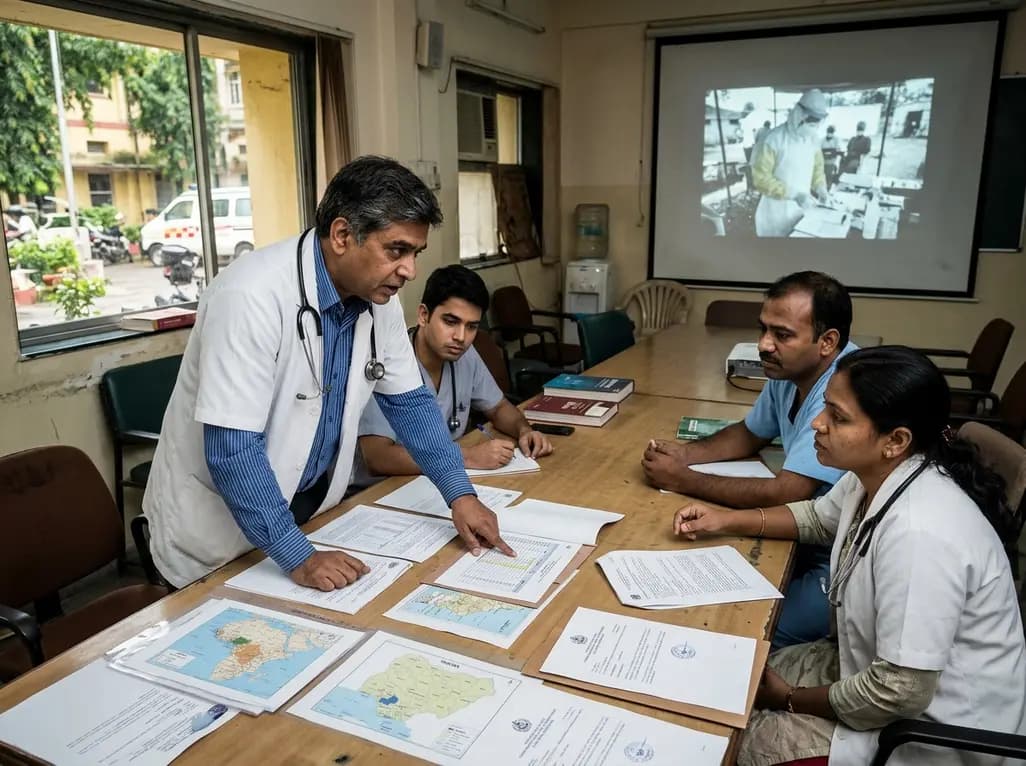
Following Nigeria's first recorded Ebola case linked to regional travel, the Africa CDC has convened an emergency ministerial summit. This alert underscores critical clinical priorities for healthcare professionals, including differentiating early viral infection from malaria, implementing barrier nursing, and triage.
Today

Leucine Rich Bio has introduced South Asia's first comprehensive vaginal microbiome test, BugSpeaks. By profiling microbial dysbiosis, pathogens, and antimicrobial resistance, this next-generation diagnostic platform provides clinicians with deeper insights into recurrent infections, fertility, and reproductive health.
Today

Review how tailored exercise programs benefit frail older patients with heart failure. Explore pathophysiological mechanisms, individualized training prescriptions, and strategies to overcome adherence barriers in clinical practice.
Today

This comparative study evaluates posterior labral tears with and without glenohumeral instability, highlighting distinct demographic patterns, MRI underestimation in stable shoulders, and successful arthroscopic repair outcomes.
Today

A clinical study demonstrates that early intervention with tocilizumab, either as monotherapy or bridged with corticosteroids, achieves significant proptosis reduction and resolves active inflammation in treatment-naive thyroid eye disease.
Today
