.webp&w=384&q=75)

Loading, please wait...
Loading, please wait...
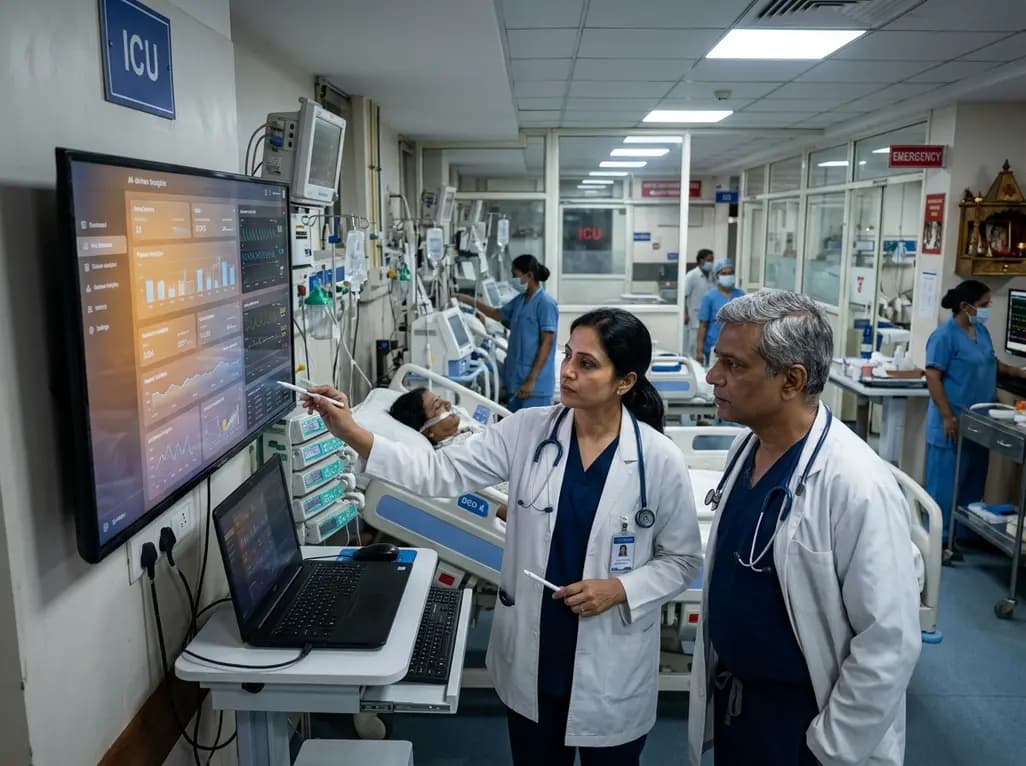
The integration of AI in Indian healthcare is entering an unprecedented era of clinical transformation. Modern medical centers are steadily moving beyond simple exploratory pilots toward tangible enterprise solutions. Consequently, clinicians encounter innovative digital tools designed to optimize patient workflows and enhance bedside judgment. A recent collaborative report from Bain & Company and HealthQuad underlines this vital shift across tertiary hospitals and regional clinics. Furthermore, advanced reasoning algorithms now tackle systemic shortages by expanding physician capacity and mitigating routine administrative burdens. Healthcare administrators recognize that intelligent digital systems provide indispensable clinical leverage. Therefore, this fundamental evolution promises to reshape clinical care delivery throughout India.
Healthcare facilities across India face intense operational pressures due to high patient volumes and clinical workforce constraints. However, the emergence of multi-step agentic artificial intelligence systems offers profound relief for overburdened medical teams. Therefore, modern hospitals are rapidly transitioning from basic administrative automations toward complex clinical decision support frameworks. Autonomous computational capabilities have doubled every six to nine months since 2023, accelerating diagnostic precision. Meanwhile, the baseline infrastructure expenditure required to deploy frontier reasoning models has dropped by approximately ninety-two percent. This dramatic cost reduction allows mid-tier institutions to integrate intelligent workflow support into routine medical operations. Consequently, forward-looking hospitals gain decisive performance advantages over traditional medical centers that delay technological upgrades. In addition, these intelligent systems process multimodal health information far more swiftly than conventional manual methods permit. Physicians can now interpret diagnostic trends, lab panels, and longitudinal health histories with exceptional speed. Furthermore, specialized predictive models synthesize bedside observations without experiencing cognitive fatigue or administrative distraction. As a result, healthcare teams reclaim valuable consultation hours previously lost to cumbersome clerical tasks. Ultimately, this technological revolution strengthens clinical workflows while expanding overall care access nationwide.
Intensive care units represent the most resource-intensive environments within Indian hospitals today. Therefore, optimizing critical care pathways through algorithmic precision provides substantial clinical value to intensivists and nurses. Predictive platforms now analyze continuous telemetry data, arterial blood gas trends, and mechanical ventilation parameters in real time. Consequently, algorithms identify subtle physiological deterioration hours before overt clinical decompensation appears. For example, early warning algorithms accurately detect septic shock trajectories, fluid overload, and impending respiratory failure. Furthermore, these predictive tools prioritize actionable bedside alarms, which directly reduces alarm fatigue among bedside staff. Intensivists can subsequently tailor vasopressor titration, antimicrobial administration, and weaning protocols with heightened confidence. In addition, centralized digital command hubs allow a single intensivist team to oversee multiple rural satellite facilities simultaneously. This tele-ICU architecture effectively bridges the severe shortage of board-certified critical care specialists across secondary tier locations. As a result, peripheral centers maintain academic-level clinical standards without transferring fragile patients over perilous distances. Moreover, intelligent scheduling modules streamline operating theatre handovers into critical care beds, preventing costly bottlenecks. Thus, advanced algorithmic oversight fundamentally safeguards critically ill patients throughout their intensive hospital stay.
Hospital discharge often represents a vulnerable transition point for patients suffering from complex chronic illnesses. However, connected remote monitoring platforms bridge the perilous gap between acute inpatient discharge and home recovery. Wearable biosensors continuously transmit essential physiological metrics, including heart rate, continuous glucose patterns, and oxygen saturation levels. Consequently, smart analytics platforms detect irregular biometric fluctuations before they escalate into acute life-threatening emergencies. For instance, cardiologists receive prompt alerts when congestive heart failure patients experience subtle nocturnal weight gain or dyspnea. Similarly, automated systems alert endocrinologists whenever brittle diabetic patients develop recurrent asymptomatic hypoglycemia episodes. Patients no longer need frequent travels across long distances simply for routine checkups and metric logging. In addition, mobile companion applications provide targeted dietary guidance, exercise modifications, and medication adherence reminders. Therefore, proactive digital touchpoints substantially minimize preventable readmissions and emergency room overcrowding across major metropolitan hospitals. Clinicians also gather richer longitudinal datasets that reflect authentic outpatient physiology rather than intermittent clinic snapshots. Furthermore, this decentralized monitoring framework empowers chronically ill patients to actively participate in personal disease management. Additionally, continuous biometric surveillance offers peace of mind to vulnerable convalescent patients. Ultimately, continuous virtual vigilance transforms reactive symptom treatment into proactive preventive healthcare.
While the therapeutic promise of computational systems appears immense, significant structural hurdles impede widespread adoption across India. Specifically, the Bain and HealthQuad report reveals that electronic medical record adoption hovers at merely thirty-five percent. Many secondary healthcare facilities and nursing homes still rely almost entirely on unstructured physical paper documentation. Consequently, predictive models lack the standardized, interoperable clinical datasets required to generate dependable clinical insights. Furthermore, fragmented data architectures impede seamless communication across different hospital departments, diagnostic laboratories, and pharmacy registries. Healthcare leaders must therefore invest heavily in digital infrastructure to capture clean, structured, and compliant clinical data. Government initiatives like the Ayushman Bharat Digital Mission provide a standardized blueprint for nationwide health information exchange. Moreover, modern ambient listening solutions can automatically transcribe doctor-patient conversations into structured electronic charts in real time. This automated documentation removes the data-entry burden from practicing doctors, thereby encouraging universal EMR compliance. When hospitals establish robust digital baselines, predictive algorithms operate with significantly greater clinical fidelity. In addition, standardized data governance protects patient confidentiality while fostering inter-institutional scientific research. Ultimately, conquering the EMR bottleneck unlocks the true transformative potential of clinical artificial intelligence.
Technological capability alone cannot guarantee successful clinical implementation without robust trust from healthcare providers. Therefore, developers must design transparent decision-support tools that clearly explain the clinical reasoning behind every recommendation. Clinicians rightly reject opaque black-box models that fail to reveal underlying risk calculations or diagnostic logic. However, when software transparently cites medical literature and physiological markers, practitioner confidence increases markedly. In addition, healthcare organizations must implement structured change management programs to train medical staff on digital collaboration. Additionally, comprehensive institutional training programs prepare junior doctors for seamless technological adoption. Startups and health systems should co-create solutions directly within hospital wards rather than in isolated technical laboratories. Furthermore, institutions need clear medicolegal guidelines outlining accountability during AI-assisted diagnostic or therapeutic interventions. As computational tools evolve into proactive clinical partners, they function primarily as capacity multipliers rather than replacements. For example, automated platforms handle routine triage and clinical documentation, allowing doctors to focus on nuanced communication. Consequently, physicians dedicate their specialized expertise to complex diagnoses, invasive procedures, and empathetic patient engagement. Ultimately, successful adoption requires uniting clinical efficacy, user-friendly deployment, and professional trust into a cohesive operating model.
Q1: How does artificial intelligence optimize intensive care workflows?
Artificial intelligence optimizes critical care by processing continuous streams of telemetry, ventilator metrics, and laboratory findings. Consequently, predictive algorithms identify subtle physiological deterioration, such as early sepsis or respiratory decompensation, hours before visible collapse occurs. Furthermore, these systems filter non-critical notifications, substantially reducing bedside alarm fatigue for nurses. As a result, intensivists initiate timely therapeutic interventions, thereby improving survival rates and clinical outcomes.
Q2: Why does low electronic record adoption limit clinical AI?
Clinical algorithms require clean, structured, and longitudinal health records to deliver dependable predictive guidance. However, India exhibits an electronic medical record adoption rate of roughly thirty-five percent across healthcare institutions. Consequently, algorithmic tools lack the comprehensive patient information necessary to evaluate complex medical trajectories accurately. Therefore, establishing robust digital documentation through national health initiatives remains critical to unlocking the diagnostic potential of modern clinical software.
Q3: How does remote monitoring improve chronic illness management?
Remote patient monitoring links individuals with clinical teams through wearable biosensors and automated tracking tools. Consequently, these platforms continuously record physiological metrics, including glucose levels, blood pressure, and oxygen saturation. Furthermore, intelligent analytics alert attending physicians immediately when patient metrics deviate from stable baselines. As a result, medical teams adjust outpatient treatments proactively, successfully preventing acute disease flare-ups and decreasing avoidable emergency hospital admissions.
Disclaimer: This content is for informational and educational purposes only. It does not constitute medical advice or replace professional judgment. Refer to the latest local and national guidelines for clinical practice.
References

Read summarized clinical updates, watch expert medical content, and earn CME certifications right from your smartphone.
Open your smartphone camera to scan and install.





A joint report by Bain & Company and HealthQuad reveals a transformative shift in clinical medicine. As foundation models mature and infrastructure develops, Indian healthcare providers are deploying automated tools across intensive care units, post-discharge chronic pathways, and connected clinical networks.
last month

As monsoon seasons elevate arboviral disease threats, Tamil Nadu has initiated an ICMR-monitored evaluation of the tetravalent dengue vaccine in Tenkasi district. Clinicians emphasize clinical monitoring, public prevention, and high-quality early pediatric care to reduce disease morbidity across endemic regions.
Today

A comparative cohort study evaluates vNOTES vs TLH hysterectomy for benign conditions, demonstrating shorter operative duration, faster return to daily activities, and equivalent female sexual function scores without increased dyspareunia.
Today

Review how tailored exercise programs benefit frail older patients with heart failure. Explore pathophysiological mechanisms, individualized training prescriptions, and strategies to overcome adherence barriers in clinical practice.
Today

This comparative study evaluates posterior labral tears with and without glenohumeral instability, highlighting distinct demographic patterns, MRI underestimation in stable shoulders, and successful arthroscopic repair outcomes.
Today

A clinical study demonstrates that early intervention with tocilizumab, either as monotherapy or bridged with corticosteroids, achieves significant proptosis reduction and resolves active inflammation in treatment-naive thyroid eye disease.
Today
