.webp&w=384&q=75)

Loading, please wait...
Loading, please wait...
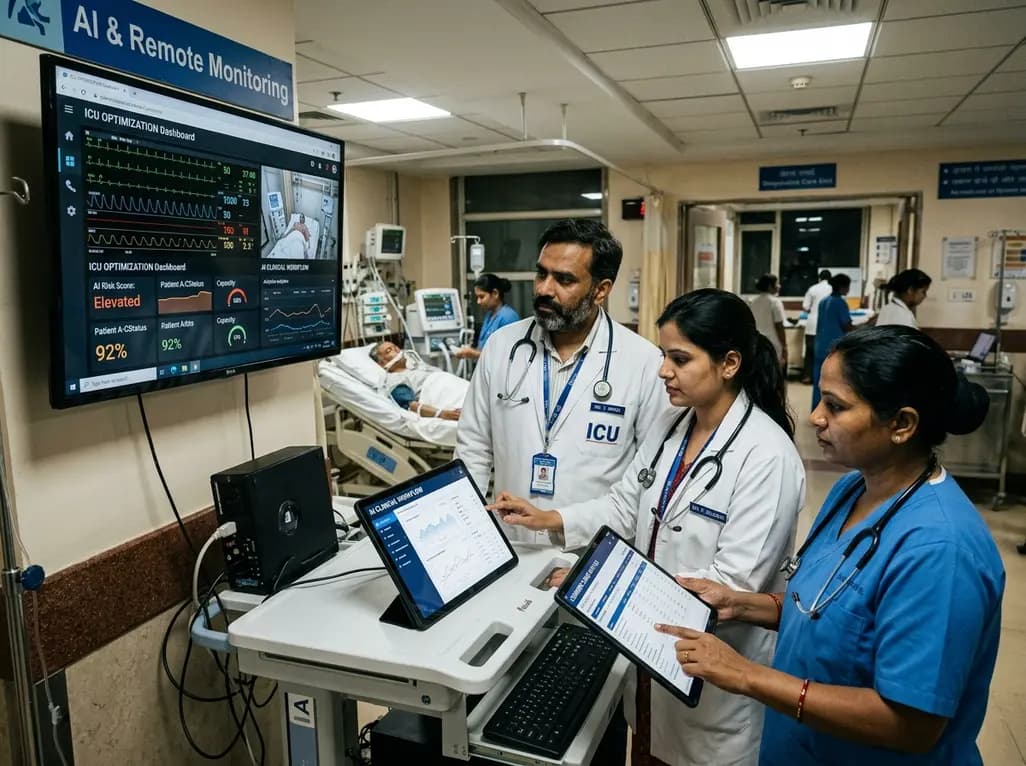
Recent technological breakthroughs are reshaping clinical workflows and inpatient management paradigms across the subcontinent. Consequently, AI in healthcare is rapidly transitioning from experimental pilot studies to high-impact clinical interventions. A joint industry report by Bain & Company and HealthQuad highlights that remote patient monitoring, intensive care unit optimization, and post-discharge chronic disease care represent the next primary growth frontiers. Furthermore, these emerging technologies are helping hospital networks bridge severe human resource shortages. Indian healthcare providers now deploy intelligent systems to support clinical judgment, eliminate administrative bottlenecks, and enhance diagnostic accuracy. Therefore, clinicians must understand how these expanding digital capabilities reshape everyday practice.
The delivery of healthcare in India faces unique systemic pressures, including substantial patient loads and uneven specialist distribution. Fortunately, recent advances in foundation models and reasoning systems have altered this landscape dramatically. According to recent industry analyses, the volume of expert-level clinical work that autonomous systems can manage has doubled every six to nine months. Simultaneously, the computational cost of operating frontier artificial intelligence models has dropped by approximately 92 percent since 2023. As a result, intelligent tools are becoming far more accessible to community nursing homes and tertiary medical centers alike.
Initially, hospital administrators utilized automated algorithms strictly for operational efficiency, such as scheduling appointments and triaging billing claims. Today, however, healthcare institutions are expanding these tools into direct clinical pathways. Digital platforms now assist bedside nurses with ambient documentation and clinical summarization. In addition, these systems help multi-specialty teams synthesize laboratory trends, radiology findings, and bedside telemetry in real time. Because these platforms process unstructured clinical data seamlessly, they reduce cognitive fatigue among physicians. Ultimately, these technological innovations allow clinicians to spend significantly more time engaging directly with vulnerable patients.
Intensive care units and operating theaters represent two of the most resource-intensive environments within modern hospitals. In these high-stakes settings, timely clinical intervention frequently dictates patient survival. Consequently, advanced predictive algorithms provide immense value by forecasting acute decompensation before overt physical deterioration manifests. AI systems continuously analyze vital signs, arterial blood gases, and fluid balance trends. For instance, predictive models can detect early signatures of septic shock or respiratory failure several hours before traditional clinical scoring systems trigger alerts.
Furthermore, machine learning algorithms optimize operating theater schedules by predicting exact case durations based on surgical complexity and patient comorbidities. This proactive coordination reduces emergency surgery delays and minimizes unutilized theater block time. Within the critical care unit, intelligent platforms can streamline mechanical ventilation weaning protocols by analyzing respiratory mechanics dynamically. Moreover, automated decision support tools alert intensivists to subtle electrolyte derangements and drug interactions across complex polypharmacy regimens. Therefore, critical care teams can intervene earlier, prevent avoidable morbidity, and shorten total intensive care length of stay. By serving as an active digital co-pilot, artificial intelligence mitigates provider burnout during arduous night shifts.
Non-communicable diseases, including diabetes, hypertension, and chronic obstructive pulmonary disease, impose a massive burden on outpatient clinics across India. Managing these chronic illnesses requires consistent surveillance, lifestyle modification, and strict medication adherence. However, traditional outpatient review models rely on periodic clinic visits, which fail to capture day-to-day physiological fluctuations. Remote patient monitoring bridges this critical clinical gap by connecting patients directly to their care teams from home.
Wearable sensors and home diagnostic devices collect physiological metrics such as continuous glucose levels, blood pressure readings, and ambulatory oxygen saturation. Subsequently, machine learning algorithms filter through continuous data streams to identify clinically actionable anomalies while discarding benign background fluctuations. For example, an automated system can flag progressive fluid retention in a heart failure patient before acute pulmonary edema develops. Consequently, clinicians can adjust diuretic dosages promptly, preventing costly emergency room admissions and decompensation. In addition, intelligent conversational agents provide personalized dietary guidance, lifestyle advice, and medication reminders to patients between scheduled appointments. Ultimately, continuous digital monitoring transforms chronic disease management from episodic crisis intervention into proactive, personalized care delivery.
Despite the transformative potential of clinical algorithms, digital adoption in India encounters significant structural headwinds. Currently, nationwide electronic medical record adoption remains at approximately 35 percent. Many secondary hospitals and standalone clinics continue to rely heavily on fragmented paper documentation. Without structured digital clinical data, advanced reasoning algorithms cannot generate accurate predictive insights. Therefore, expanding electronic medical record penetration represents an indispensable prerequisite for widespread clinical automation.
Fortunately, the rapid implementation of the Ayushman Bharat Digital Mission is establishing uniform data interoperability across the country. Government initiatives and digital health standards are encouraging private and public healthcare providers to transition away from physical registries. Moreover, modern ambient voice transcription tools allow physicians to generate structured digital notes naturally during patient consultations. These speech-to-text tools eliminate cumbersome manual keyboard entry, which historically fueled physician resistance toward digital charting. As digital record adoption accelerates, clinical datasets will become richer, cleaner, and more representative of diverse local demographics. Consequently, predictive algorithms will achieve greater precision, paving the way for seamless, connected clinical workflows across urban and rural health centers.
Deploying artificial intelligence safely within patient care environments requires more than raw algorithmic capability. Medical leadership must demand clear evidence of deployability, diagnostic transparency, and tangible clinical value across daily workflows. Clinician trust remains the paramount cornerstone of successful hospital adoption. If predictive software functions as a closed black box without explaining its underlying clinical reasoning, healthcare practitioners will rightfully hesitate to act on its recommendations. Therefore, developers must incorporate explainable decision pathways and transparent risk scores that doctors can readily validate during clinical rounds.
Additionally, healthcare providers must evaluate whether emerging software integrates smoothly into existing hospital information architectures. Complex digital solutions that disrupt established nursing routines or add administrative clicks will inevitably face institutional abandonment. Furthermore, institutional leaders must establish robust clinical governance committees to audit algorithmic recommendations and monitor for potential demographic biases. Data privacy and patient confidentiality must also comply rigorously with national digital protection regulations. When hospitals combine transparent algorithms with strong clinical oversight, artificial intelligence becomes a formidable capacity multiplier. Consequently, healthcare institutions can scale superior clinical standards across broader patient populations without compromising safety or professional integrity.
Q1: How does artificial intelligence optimize intensive care unit management in Indian hospitals?
Artificial intelligence optimizes intensive care operations by continuously analyzing high-frequency telemetry, arterial blood gases, and laboratory results. Consequently, predictive algorithms detect subtle indicators of clinical decompensation, such as septic shock or impending respiratory failure, several hours before overt symptoms manifest. Furthermore, these platforms assist intensivists with ventilator weaning timelines, track fluid balances, and flag potential drug-drug interactions. By automating routine data synthesis, AI tools alleviate cognitive overload and enable timely, lifesaving clinical interventions.
Q2: Why is the current electronic medical record adoption rate a barrier to clinical AI?
India's current electronic medical record adoption rate of roughly 35 percent limits the data pipeline required by clinical algorithms. Artificial intelligence models require continuous streams of structured digital data to synthesize longitudinal trends and predict clinical outcomes. Because many facilities still utilize paper charts, critical diagnostic information remains inaccessible to automated systems. Therefore, expanding standardized electronic health records under frameworks like the Ayushman Bharat Digital Mission is essential to unlocking comprehensive, connected clinical artificial intelligence.
Q3: How does remote patient monitoring improve outcomes for chronic disease management?
Remote patient monitoring connects patients directly with clinical teams through wearable sensors and connected home diagnostic devices. Consequently, algorithmic systems track blood pressure, glucose curves, and pulse oximetry trends in real time. When physiological parameters deviate from safe baselines, the platform immediately alerts attending doctors. Thus, clinicians can adjust outpatient therapies proactively, preventing acute disease flare-ups and avoiding hospital readmissions. Additionally, intelligent interactive modules reinforce therapeutic compliance, dietary discipline, and healthy lifestyle habits between consultations.
Disclaimer: This content is for informational and educational purposes only. It does not constitute medical advice or replace professional judgment. Refer to the latest local and national guidelines for clinical practice.
References

Read summarized clinical updates, watch expert medical content, and earn CME certifications right from your smartphone.
Open your smartphone camera to scan and install.





A joint report highlights how artificial intelligence is shifting from administrative automation to connected clinical workflows in India. From ICU optimization to remote patient monitoring and chronic disease care, digital tools are expanding clinical capacity and improving long-term patient outcomes across hospitals.
last month

As monsoon seasons elevate arboviral disease threats, Tamil Nadu has initiated an ICMR-monitored evaluation of the tetravalent dengue vaccine in Tenkasi district. Clinicians emphasize clinical monitoring, public prevention, and high-quality early pediatric care to reduce disease morbidity across endemic regions.
Today

Leucine Rich Bio has introduced South Asia's first comprehensive vaginal microbiome test, BugSpeaks. By profiling microbial dysbiosis, pathogens, and antimicrobial resistance, this next-generation diagnostic platform provides clinicians with deeper insights into recurrent infections, fertility, and reproductive health.
Today

Review how tailored exercise programs benefit frail older patients with heart failure. Explore pathophysiological mechanisms, individualized training prescriptions, and strategies to overcome adherence barriers in clinical practice.
Today

This comparative study evaluates posterior labral tears with and without glenohumeral instability, highlighting distinct demographic patterns, MRI underestimation in stable shoulders, and successful arthroscopic repair outcomes.
Today

A clinical study demonstrates that early intervention with tocilizumab, either as monotherapy or bridged with corticosteroids, achieves significant proptosis reduction and resolves active inflammation in treatment-naive thyroid eye disease.
Today
