.webp&w=384&q=75)

Loading, please wait...
Loading, please wait...

Female mosquitoes demonstrate sophisticated sensory behaviors when reproducing in domestic environments. Specifically, successful Aedes aegypti egg laying requires gravid females to assess external conditions with remarkable precision. These insect vectors undergo aquatic larval and pupal stages before emerging as terrestrial adults. Consequently, maternal oviposition choices directly determine offspring survival and reproductive fitness. Female yellow fever mosquitoes typically deposit individual eggs along the moist inner perimeter of natural cavities and domestic water containers. Furthermore, these desiccated eggs remain viable for months until seasonal floods submerge and hatch them. Recent experimental investigations reveal that physical contact cues govern these reproductive choices alongside chemical attractants. Gravid females actively inspect substrates using their sensitive tarsi and proboscis. Therefore, maternal preference does not depend purely on passive physical encounters. Instead, the female mosquito executes deliberate behavioral evaluations before committing her valuable egg clutch to a particular microhabitat. Understanding this tactile discrimination provides valuable insights into vector bionomics, helping medical professionals and entomologists understand urban disease transmission dynamics.
Researchers have discovered that surface texture serves as a primary mechanical driver of maternal site choice. In controlled behavioral assays, female mosquitoes exhibited an overwhelming preference for rough substrates over smooth surfaces. When presented with choice chambers containing variable grit textures, mosquitoes consistently deposited their eggs on surfaces with larger particle diameters. In contrast, females avoided polished, ultra-smooth materials when rough alternatives existed. Furthermore, this tactile preference operates at micro-topographical scales. Females readily distinguish subtle surface irregularities beneath their tarsi during initial exploration. Rough surfaces offer superior structural adherence for the sticky chorionic pad of each egg, preventing accidental displacement. Additionally, microscopic crevices shield delicate embryos from ambient mechanical disturbances, intense rainfall, and predatory attacks. When forced onto smooth surfaces, females often deposit eggs in abnormal clusters, which may impair subsequent hatching rates. Consequently, physical roughness provides immediate mechanical security and developmental advantages for offspring. By identifying surface texture as an independent behavioral determinant, researchers have fundamentally updated previous models that assumed oviposition relies entirely on olfactory cues.
Gravid mosquitoes do not make reproductive decisions based on isolated sensory inputs. Instead, female vectors integrate competing sensory signals to gauge overall habitat quality. The researchers examined this multisensory processing by pairing favorable physical textures with adverse chemical environments, specifically elevated water salinity. Previous physiological studies confirm that Aedes aegypti larvae lack osmoregulatory adaptations for high salinity, which proves fatal to offspring. Remarkably, when investigators exposed female mosquitoes to rough substrates paired with salty water, the insects weighed the conflicting cues. While high salinity acts as a potent negative deterrent, an attractive rough texture significantly mitigated this chemical aversion. In fact, females accepted modest salinity levels if the egg-laying surface offered optimal tactile grip and texture. However, when salinity reached toxic thresholds, chemical avoidance circuits overrode physical preferences, prompting females to withhold oviposition. This complex behavioral computation illustrates that insect neural circuits perform sophisticated cost-benefit analyses before egg deposition. Therefore, tactile feedback directly modulates gustatory and osmotic evaluations in gravid females.
To understand how tactile stimuli guide oviposition, researchers tracked mosquito locomotion using high-resolution video systems. The observations revealed that surface texture directly modulates local search behaviors and locomotion velocity. When traversing smooth agar plates, female mosquitoes maintained rapid, continuous movement patterns. They showed little tendency to pause or inspect the substrate. In sharp contrast, encountering a rough surface triggered an immediate behavioral shift characterized by reduced traversal speed and prolonged stationary pauses. During these slow locomotion phases, females repeatedly touched the substrate with their tarsi, sweeping their abdomen in characteristic searching arcs. Furthermore, this deliberate deceleration allows the mosquito to assess local moisture gradients and surface stability before depositing an egg. Similarly, the physical resistance provided by micro-grooves stabilizes the insect during abdominal flexion. Consequently, rough substrates act as behavioral arrestants that encourage localized exploration rather than rapid departure. When mosquitoes locate suitable micro-topography, they terminate their search and deposit their eggs methodically.
In India, arboviral diseases like dengue and chikungunya place recurring seasonal pressure on inpatient wards and intensive care units. Traditional vector management focuses primarily on larviciding and eliminating stagnant water collections. However, unsealed cement tanks, earthenware jars, and discarded rubber tires provide abundant rough breeding sites in domestic environments. Understanding female texture preferences creates powerful opportunities for innovative public health engineering. Specifically, municipal programs can equip monitoring ovitraps with rough collection substrates to increase trap sensitivity and achieve earlier epidemic warnings. Furthermore, civic authorities can apply smooth hydrophobic coatings to water storage tanks and stormwater drains, establishing physical barriers that deter mosquito oviposition without chemical insecticides. Clinicians can translate these behavioral insights into effective community preventative guidance during clinical consultations. By advising patients to scrub rough-walled storage pots and replace worn earthenware with smooth containers, practitioners address root vector sources. Ultimately, integrating behavioral entomology into clinical preventive medicine strengthens nationwide vector control initiatives and reduces seasonal transmission risks.
Rough surface textures provide physical micro-crevices that shield mosquito eggs from environmental stress and mechanical dislodgement. When female mosquitoes deposit eggs onto rough substrates, the eggs adhere firmly via their sticky chorionic pads. In contrast, eggs laid on smooth surfaces frequently clump together irregularly or detach prematurely. Consequently, substrate roughness directly promotes long-term embryonic survival and guarantees successful larval hatching once rainwaters submerge the oviposition site.
Female mosquitoes evaluate multiple sensory cues simultaneously to ensure offspring viability in dynamic natural environments. Elevated water salinity poses lethal osmotic hazards to developing larvae, which lack marine adaptations. However, an optimal rough surface provides strong tactile incentives that can partially offset mild chemical deterrents. Therefore, the maternal nervous system integrates physical touch with gustatory chemosensory feedback, balancing structural egg adhesion against potential osmotic toxicity to identify the safest available nursery.
Public health programs can exploit mosquito surface preferences through targeted surveillance and container modifications. Routine monitoring programs can equip ovitraps with rough collection strips, dramatically boosting capture sensitivity for early outbreak warnings. Furthermore, sanitation agencies can coat open water sumps and municipal drainage channels with ultra-smooth, anti-adhesive polymers. This structural intervention deters gravid females from laying eggs without requiring chemical pesticides, creating sustainable, non-toxic barriers against persistent urban vector proliferation.
Disclaimer: This content is for informational and educational purposes only... Refer to the latest local and national guidelines for clinical practice.
References

Read summarized clinical updates, watch expert medical content, and earn CME certifications right from your smartphone.
Open your smartphone camera to scan and install.





A landmark study reveals that surface texture strongly influences Aedes aegypti egg laying decisions. Gravid mosquitoes favor rough substrates and balance physical texture against water salinity, offering novel mechanistic targets for source reduction and dengue vector management across India.
Today

The Indian Government has approved the Biovigilance Programme of India, empowering the IPC to track adverse events in organ and tissue transplant procedures. This nationwide initiative unifies donor and recipient surveillance with established drug and medical device safety mechanisms to elevate clinical standards.
Today
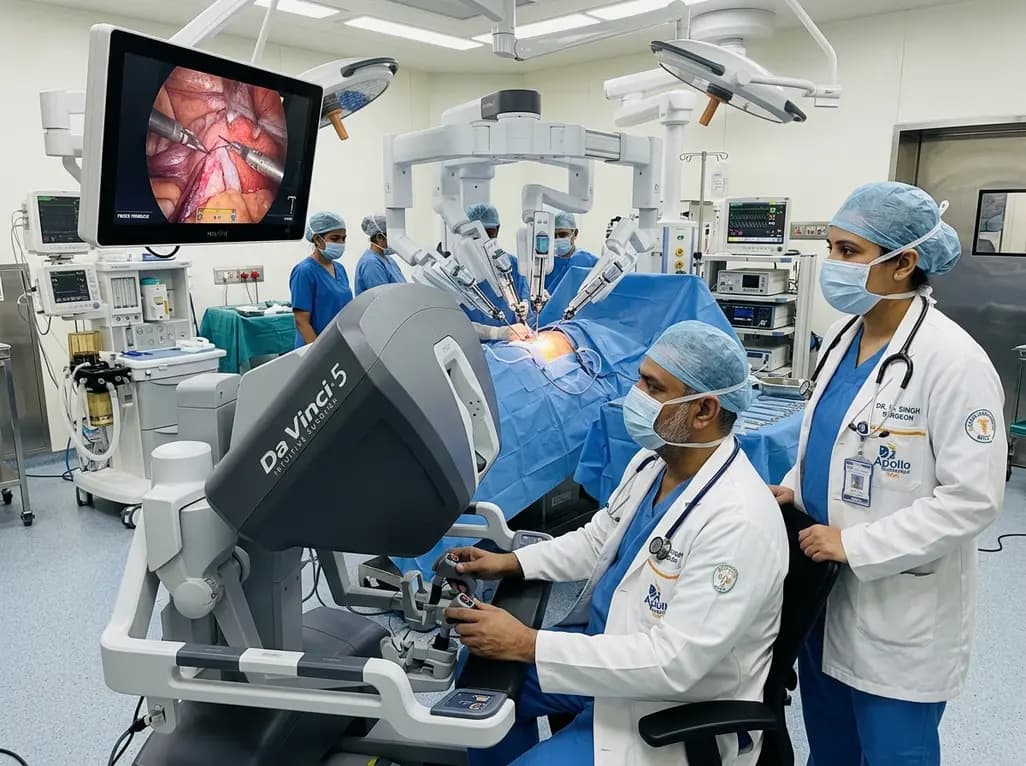
India expands its minimally invasive surgical landscape as Intuitive unveils its fifth-generation robotic platform. Equipped with real-time force feedback and immense computing performance, this innovation assists clinical specialists across urology, gynecology, and general surgery in optimizing operative care.
Today

Large-scale biobank research demonstrates that low-grade systemic inflammation quietly remodels ventricular architecture years before cardiovascular symptoms appear. Learn how emerging biomarkers like GlycA and targeted anti-inflammatory pathways could reshape preventive cardiovascular screening and clinical risk evaluation.
Today

Systematic review comparing labral repair and reconstruction in primary hip arthroscopy shows comparable short- to mid-term patient-reported outcomes, with lower THA conversion after repair but superior outcomes for reconstruction in patients aged 40 and older.
Today
Diabetic peripheral neuropathy involves chronic neuroinflammation and blood-nerve barrier dysfunction. This review discusses advanced nanomedicine formulations, including nanoparticles and hydrogels, designed to overcome pharmacokinetic barriers and modulate the peripheral neuroimmune axis.
Today
