.webp&w=384&q=75)

Loading, please wait...
Loading, please wait...
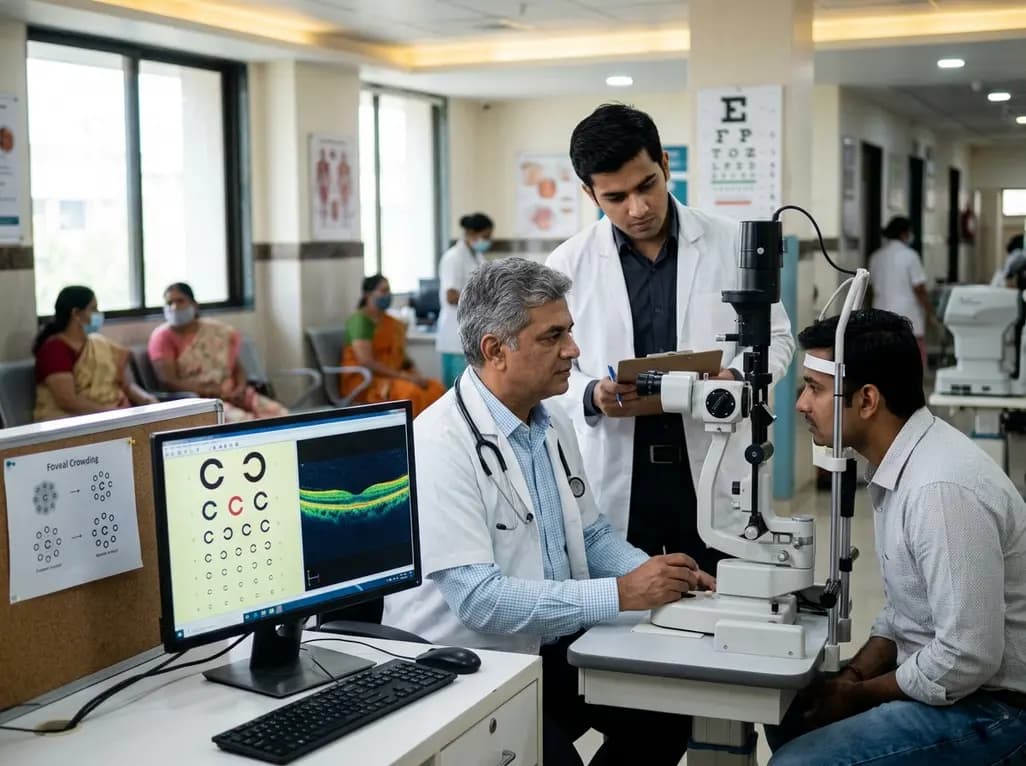
Recent research highlights a significant link between foveal crowding in ADHD and impaired visual identification. Moreover, adults with Attention-Deficit/Hyperactivity Disorder (ADHD) often experience difficulties filtering irrelevant information. Specifically, while many studies focus on peripheral vision, new evidence examines how this phenomenon affects central, or foveal, vision. A study involving 45 participants compared adults with ADHD to neurotypical controls. Consequently, researchers found that those with ADHD struggle more when targets are surrounded by distracting elements.
Furthermore, the study utilized a computerized task where participants identified the direction of a central letter. Results indicated that individuals with ADHD exhibited much stronger crowding effects than their neurotypical counterparts. Consequently, they experienced slower response times across varying stimulus durations. This heightened interference suggests an increased integration field in the visual cortex. Essentially, the brain of an adult with ADHD may merge the target and distractors into a single, confusing signal due to reduced filtering capacity.
Interestingly, researchers found that salient visual cues can mitigate these effects effectively. For example, when the target letter appeared in red while distractors remained black, performance improved significantly for both groups. Therefore, enhancing target distinctiveness could be a key strategy for managing complex visual tasks. Additionally, these findings explain why dense environments, like heavy traffic or cluttered text, pose unique challenges. Thus, segmentation helps the brain isolate the target from the background noise more efficiently.
The inability to filter visual \"noise\" has real-world consequences for everyday behaviors. For instance, reading becomes more taxing when letters appear crowded together. Similarly, driving in complex urban environments requires the rapid filtering of distracting signals. However, if the integration field is too large, a driver might struggle to identify critical signs amidst roadside clutter. Therefore, understanding these perceptual alterations provides a more holistic view of ADHD symptoms. Ultimately, this research suggests that ADHD impacts basic sensory processing, not just high-level behavior.
Foveal crowding refers to the difficulty of identifying a central target when it is surrounded by nearby distracting objects. In adults with ADHD, this effect is more pronounced, leading to slower and less accurate visual recognition.
Using a distinct color for a target (segmentation) makes it stand out from surrounding distractors. This salient cue helps the brain isolate the target, effectively reducing the interference caused by nearby objects.
While ADHD is associated with functional vision problems like crowding and tracking, it does not typically involve structural damage to the eye. Instead, the issues stem from how the brain processes and filters visual information.
Disclaimer: This content is for informational and educational purposes only. It does not constitute medical advice, diagnosis, or treatment. Always seek the advice of your physician or other qualified health provider with any questions you may have regarding a medical condition. Refer to the latest local and national guidelines for clinical practice.
References
Ifrah-Tsruya H et al. Foveal crowding and segmentation effects in adults with ADHD. Vision Res. 2026 Jun 17. doi: undefined. PMID: 42308563.
Panis S, Schmidt T. Increased Sensitivity to Perceptual Interference in Adults with Attention Deficit Hyperactivity Disorder. Front Psychol. 2021;12:656354.
Rappeport N, Lev M, Polat U. Foveal crowding increases with age under limited viewing conditions. Sci Rep. 2025;15:26451.
"
Read summarized clinical updates, watch expert medical content, and earn CME certifications right from your smartphone.
Open your smartphone camera to scan and install.





Adults with ADHD exhibit significantly stronger foveal crowding and slower response times than neurotypical controls. This reflects a reduced ability to filter irrelevant visual information and an increased integration field in central vision, though salient cues like color can mitigate these effects.
4 months ago

Review how tailored exercise programs benefit frail older patients with heart failure. Explore pathophysiological mechanisms, individualized training prescriptions, and strategies to overcome adherence barriers in clinical practice.
Today

Leucine Rich Bio has introduced South Asia's first comprehensive vaginal microbiome test, BugSpeaks. By profiling microbial dysbiosis, pathogens, and antimicrobial resistance, this next-generation diagnostic platform provides clinicians with deeper insights into recurrent infections, fertility, and reproductive health.
Today

In high-risk pulmonary embolism complicated by severe anemia and active uterine bleeding, systemic thrombolysis is contraindicated. Large-bore aspiration thrombectomy provides rapid hemodynamic rescue without fibrinolysis, supported by inferior vena cava filter placement and multidisciplinary critical care.
Today

This comparative study evaluates posterior labral tears with and without glenohumeral instability, highlighting distinct demographic patterns, MRI underestimation in stable shoulders, and successful arthroscopic repair outcomes.
Today

A clinical study demonstrates that early intervention with tocilizumab, either as monotherapy or bridged with corticosteroids, achieves significant proptosis reduction and resolves active inflammation in treatment-naive thyroid eye disease.
Today
