.webp&w=384&q=75)

Loading, please wait...
Loading, please wait...
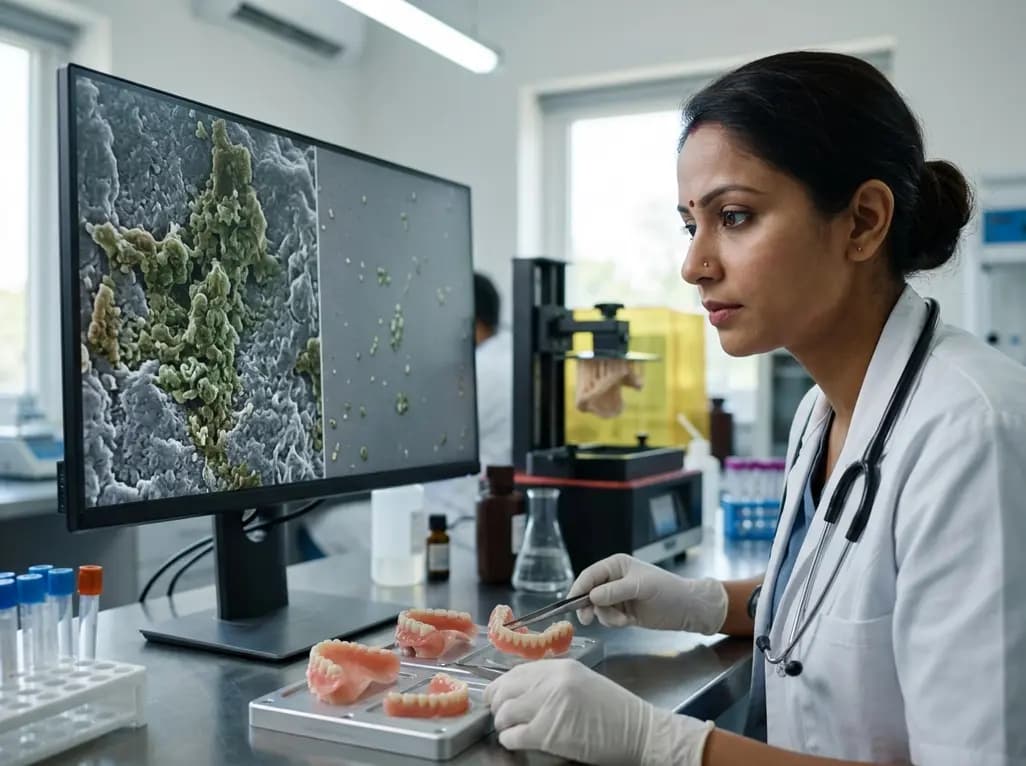
Digital advancements have transformed the fabrication of dental prostheses. Specifically, 3D printing offers speed and accuracy for denture bases. However, practitioners must understand that 3D printing orientation alters the surface topography of the final product. Recent evidence suggests that the angle of layer deposition directly affects how easily bacteria and fungi can colonize the material.
The study evaluated FotoDent® resin at three printing angles: 0°, 45°, and 90°. Interestingly, the results showed that microbial counts for Candida albicans, Porphyromonas gingivalis, and Streptococcus mutans decreased as the print angle increased. Specifically, the 90-degree angle demonstrated the lowest microbial adhesion across all species. In contrast, the 0-degree orientation produced the highest surface roughness. Furthermore, these 3D-printed specimens generally outperformed conventional cold-cured resins in resisting microbial colonization.
Using a 90-degree 3D printing orientation provides a smoother surface finish compared to horizontal printing. This smoother texture minimizes the niches available for microbial entrapment. Consequently, dentures printed at this angle may lower the risk of denture stomatitis and periodontal issues. Therefore, clinicians should specify optimal printing parameters when ordering digitally fabricated prostheses. Additionally, this choice helps maintain long-term oral health by simplifying the cleaning process for the patient.
While 3D printing is efficient, the technical settings dictate the biological response of the oral tissues. Practitioners should favor orientations that reduce areal surface roughness. Moreover, the study indicates that surface free energy components change with the printing angle. This variation impacts how the material interacts with saliva and oral microbes. Ultimately, selecting the 90-degree orientation offers a superior balance of surface smoothness and reduced microbial load.
A 90-degree printing orientation is superior because it produces the smoothest surface and significantly reduces microbial adhesion compared to 0-degree and 45-degree angles.
The 0-degree printing orientation typically yields the highest surface roughness. As the angle increases toward 90 degrees, the surface becomes smoother, which limits biofilm formation.
Yes, the study found that FotoDent® 3D-printed resin generally exhibited lower microbial counts than conventional cold-cured ProBase® resins, suggesting better biological performance.
Disclaimer: This content is for informational and educational purposes only. It does not constitute medical advice or a professional endorsement. Clinicians should use their professional judgment and consider individual patient factors when making treatment decisions. Refer to the latest local and national guidelines for clinical practice.
References
Akbar JH et al. Impact of Printing Orientation on the Surface Properties and Microbial Biofilm Formation of 3D-Printed Denture Resins. Int J Prosthodont. 2026 Jun 02. doi: 10.11607/ijp.9754. PMID: 42234481.
Al-Haj Husain N et al. Effect of printing orientation on the surface and mechanical properties of 3D-printed denture base resins: A systematic review. J Prosthet Dent. 2023.

Read summarized clinical updates, watch expert medical content, and earn CME certifications right from your smartphone.
Open your smartphone camera to scan and install.





This study evaluates the impact of 3D printing angles on surface roughness and microbial biofilm formation in photopolymer resins used for dentures....
4 months ago

As monsoon seasons elevate arboviral disease threats, Tamil Nadu has initiated an ICMR-monitored evaluation of the tetravalent dengue vaccine in Tenkasi district. Clinicians emphasize clinical monitoring, public prevention, and high-quality early pediatric care to reduce disease morbidity across endemic regions.
Today

Leucine Rich Bio has introduced South Asia's first comprehensive vaginal microbiome test, BugSpeaks. By profiling microbial dysbiosis, pathogens, and antimicrobial resistance, this next-generation diagnostic platform provides clinicians with deeper insights into recurrent infections, fertility, and reproductive health.
Today

Review how tailored exercise programs benefit frail older patients with heart failure. Explore pathophysiological mechanisms, individualized training prescriptions, and strategies to overcome adherence barriers in clinical practice.
Today

This comparative study evaluates posterior labral tears with and without glenohumeral instability, highlighting distinct demographic patterns, MRI underestimation in stable shoulders, and successful arthroscopic repair outcomes.
Today

A clinical study demonstrates that early intervention with tocilizumab, either as monotherapy or bridged with corticosteroids, achieves significant proptosis reduction and resolves active inflammation in treatment-naive thyroid eye disease.
Today
