.webp&w=384&q=75)

Loading, please wait...
Loading, please wait...

The Yamuna Expressway Industrial Development Authority (YEIDA) recently entered a strategic medical devices collaboration with Medical Excellence Japan (MEJ). This partnership aims to strengthen the local healthcare ecosystem by leveraging international technical expertise. Furthermore, the agreement focuses on enhancing infrastructure and fostering economic growth within Uttar Pradesh.
The Memorandum of Understanding (MoU) establishes a structured framework for long-term cooperation. Specifically, both organizations intend to promote innovation, investment, and technology exchange in the medical industry. Additionally, the collaboration seeks to improve patient outcomes through advanced equipment and localized manufacturing. Both parties will also explore financial commitments, including joint funding and grants, to support sector growth.
YEIDA will provide essential infrastructure and regulatory facilitation at its dedicated Medical Device Park in Sector 28. Consequently, investors will receive land allocation, utility support, and policy incentives to streamline their operations. Meanwhile, MEJ will assist Japanese medical technology firms in participating in research collaborations and knowledge transfer initiatives. Moreover, the project near Jewar Airport will position the region as a global manufacturing hub for high-tech medical equipment.
Q1: What is the primary goal of the YEIDA and MEJ agreement?
The agreement aims to establish a framework for innovation, investment, and technology exchange in the medical devices sector to improve healthcare delivery and patient outcomes.
Q2: What incentives does YEIDA provide for investors in the Medical Device Park?
YEIDA offers land allocation, utility infrastructure, regulatory facilitation, and specific policy incentives to support companies setting up manufacturing units.
Q3: How will Medical Excellence Japan (MEJ) contribute to this partnership?
MEJ will bring technical expertise, encourage participation from Japanese medical technology firms, and support research collaborations and capacity-building initiatives.
Disclaimer: This content is for informational and educational purposes only. It does not constitute medical advice or replace professional judgment. Refer to the latest local and national guidelines for clinical practice.
References

Read summarized clinical updates, watch expert medical content, and earn CME certifications right from your smartphone.
Open your smartphone camera to scan and install.





YEIDA and Medical Excellence Japan (MEJ) signed a landmark MoU to boost innovation and infrastructure at the Sector 28 Medical Device Park near Jewar Airpor...
5 months ago
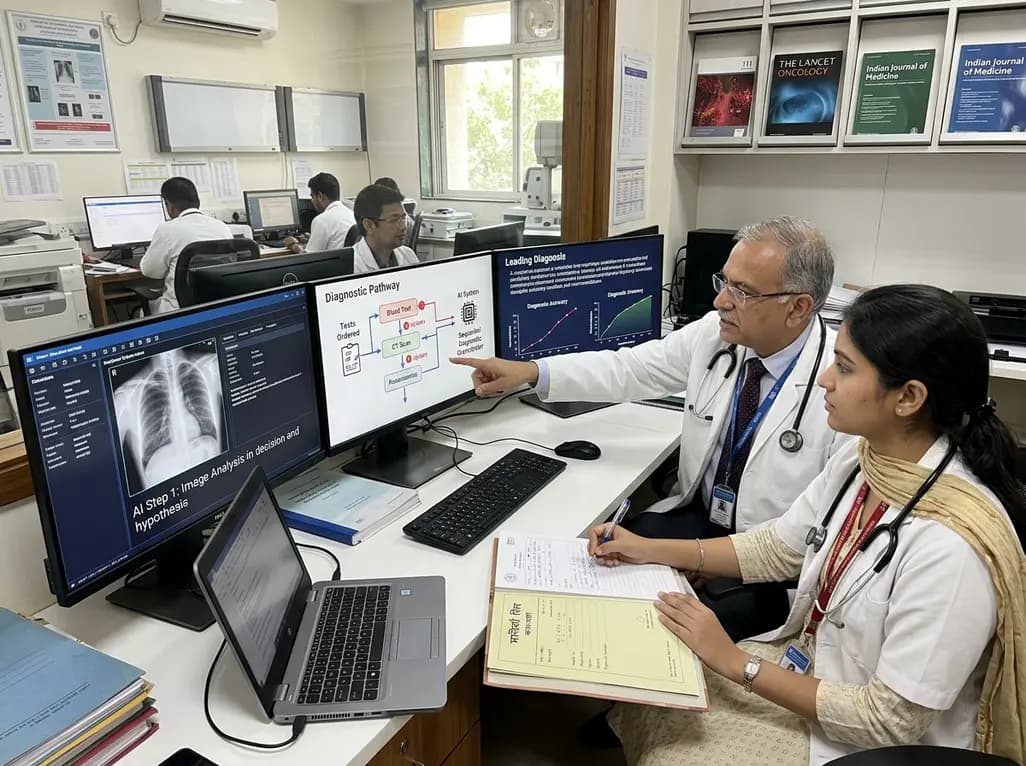
A breakthrough peer-reviewed study demonstrates that a sequential AI diagnosis system can mirror real-world clinical reasoning. By ordering stepwise tests and updating hypotheses dynamically, this multi-agent orchestrator achieved superior diagnostic accuracy while reducing investigative costs.
Today

A prenatal case highlights severe glutaric acidemia type II presenting as bilateral hyperechoic cystic kidneys at 18 weeks. Whole-exome sequencing revealed a novel homozygous ETFDH frameshift variant, demonstrating the power of rapid genetic testing in fetal renal anomalies.
Today

Review how tailored exercise programs benefit frail older patients with heart failure. Explore pathophysiological mechanisms, individualized training prescriptions, and strategies to overcome adherence barriers in clinical practice.
Yesterday

This comparative study evaluates posterior labral tears with and without glenohumeral instability, highlighting distinct demographic patterns, MRI underestimation in stable shoulders, and successful arthroscopic repair outcomes.
Yesterday

A clinical study demonstrates that early intervention with tocilizumab, either as monotherapy or bridged with corticosteroids, achieves significant proptosis reduction and resolves active inflammation in treatment-naive thyroid eye disease.
Yesterday
