

Loading, please wait...
Loading, please wait...
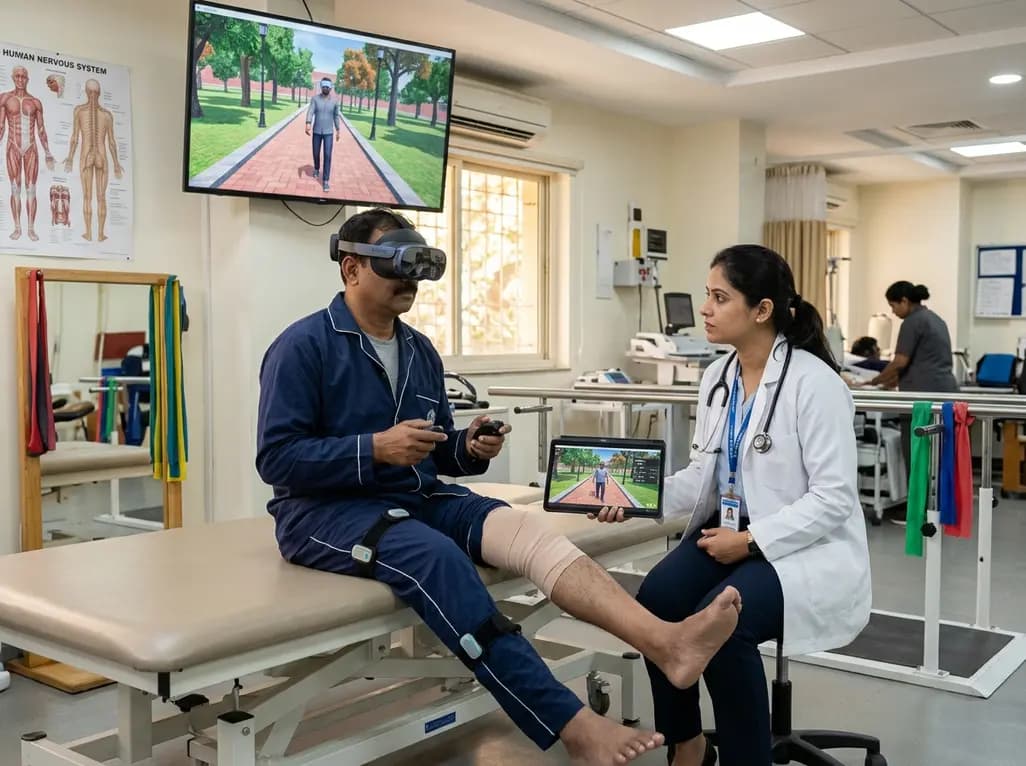
Limb amputation represents a life-altering event that disrupts structural anatomy, somatosensory pathways, and bodily self-representation. Following surgical amputation, up to eighty percent of patients develop debilitating neuropathic sensations. Historically, clinicians have relied heavily on systemic pharmacotherapy, local anesthetic blocks, and classic mirror therapy to address this post-surgical distress. However, conventional treatment regimens frequently fail to yield lasting relief or promote functional autonomy. Emerging digital health technologies are now bridging this therapeutic divide. In particular, XR serious games have emerged as transformative modalities in neurorehabilitation. By synthesizing extended reality environments with targeted gaming dynamics, these platforms engage residual neuromuscular networks. Consequently, patients experience meaningful relief while concurrently rebuilding motor commands essential for daily life.
To appreciate how immersive interventions function, clinicians must first examine the central mechanisms underlying neuropathic post-amputation pain. Amputation abruptly removes peripheral sensory afference from the primary somatosensory and motor cortices. As a direct consequence, adjacent cortical representations rapidly expand into the denervated anatomical territory. This maladaptive cortical reorganization directly correlates with the frequency and intensity of distressing phantom sensations. Furthermore, motor execution commands directed toward the missing extremity generate persistent sensorimotor incongruence. Because the central nervous system anticipates visual and proprioceptive confirmation that never arrives, central pain processing pathways remain pathologically sensitized. Traditional interventions often struggle to resolve this central conflict because they lack dynamic feedback. In contrast, interactive digital systems restore coherent closed-loop sensorimotor signaling, thereby dampening aberrant nociceptive loops.
Recent systematic evidence demonstrates that XR serious games deliver consistent and clinically meaningful reductions in phantom discomfort. Specifically, augmented reality systems utilizing phantom motor execution report striking effect sizes, with Cohen's d values ranging between 0.9 and 1.3. During these sessions, surface electromyography sensors capture subtle muscle activation patterns from the residual limb stump. Sophisticated machine-learning algorithms subsequently decode these intentional motor signals in real time. The digital interface renders an anatomically precise virtual limb that executes the patient's intended movements within an engaging game. Consequently, patients actively fire preserved motor pathways rather than relying on passive observation. Functional imaging and neurophysiological tracking reveal that this focused motor execution promotes cortical remapping. Therefore, the brain systematically reclaims its original somatotopic boundaries and resolves maladaptive reorganization.
Beyond upper extremity pain management, immersive serious gaming demonstrates profound utility in lower limb post-amputation rehabilitation. Lower extremity amputees frequently endure asymmetrical weight-bearing patterns, postural instability, and a pervasive fear of falling. Randomized controlled trials evaluating virtual reality exergames reveal quantifiable improvements in functional gait kinematics and static balance control. These game environments introduce dynamic challenges, such as navigating complex obstacles, weight shifting on force platforms, and interactive target acquisition. Consequently, patients execute corrective postural adjustments within protected simulated environments. Moreover, the multisensory nature of immersive gaming diverts conscious attention away from kinesiophobia. Because real-time kinematic feedback continually informs the user, patients rapidly refine their center-of-mass trajectory. Accordingly, users develop symmetric limb loading patterns that significantly reduce the long-term risk of falls.
A primary challenge within post-amputation medicine remains the abandonment of advanced myoelectric prostheses due to device complexity and user frustration. Immersive extended reality environments serve as intuitive training grounds that bridge the gap between stump conditioning and prosthetic mastery. By coupling virtual reality environments with pattern recognition algorithms, patients learn to coordinate isolated muscle contractions to manipulate digital objects. Consequently, users achieve shorter task completion times and demonstrate refined grip modulation before ever donning physical hardware. Furthermore, synchronous visual and proprioceptive stimuli foster a deep sense of embodiment, encouraging the brain to perceive the artificial limb as an authentic bodily extension. As a direct result, patients exhibit greater confidence and report far higher long-term prosthetic adoption rates during community reintegration.
Although evidence supporting virtual rehabilitation platforms is highly encouraging, several translational hurdles warrant clinical scrutiny. Current research indicates that while user satisfaction and compliance remain remarkably favorable, evidence certainty across diverse functional domains remains exploratory. High-quality randomized trials with extended follow-up intervals are necessary to confirm lasting neuroplastic benefits. Furthermore, technological barriers, including equipment acquisition costs, technical calibration demands, and cyber-sickness, can impede routine clinical deployment. Clinicians must also adapt training modules to accommodate diverse patient demographics and variable digital literacy levels. However, as lightweight standalone headsets and cloud-enabled processing continue to advance, decentralized home-based therapy becomes increasingly viable. Ultimately, integrating gamified reality into standard amputee rehabilitation pathways promises to democratize specialized multidisciplinary care worldwide.
Conventional mirror therapy relies entirely on passive reflection of the intact extremity, which restricts bilateral movement and lacks interactive sensory challenge. Conversely, extended reality serious games decode actual residual stump myoelectric signals, allowing direct motor control of a digital limb. This dynamic phantom motor execution generates synchronized sensorimotor feedback, effectively reversing maladaptive cortical reorganization and reducing pain far more robustly than classic reflective techniques.
Yes, clinicians safely deploy virtual reality balance and gait protocols when following standard fall-prevention measures. Therapists typically position patients within safety harnesses or stable parallel bars while using virtual reality balance platforms. By engaging individuals in gamified weight-shifting and obstacle-avoidance tasks, these interventions enhance postural equilibrium, improve gait symmetry, and alleviate kinesiophobia without elevating baseline physical risks.
Rejection of myoelectric prostheses frequently results from steep learning curves and muscle fatigue during early device training. Immersive serious gaming permits patients to practice intuitive electromyographic pattern separation in interactive virtual environments prior to receiving physical devices. This pre-prosthetic training refines fine motor control, reduces execution errors, and fosters psychological embodiment, thereby promoting enduring real-world prosthetic success.
Disclaimer: This content is for informational and educational purposes only... Refer to the latest local and national guidelines for clinical practice.
References
Farhan M et al. XR serious games for phantom limb pain, neurofunctional recovery, and prosthetic adoption: a systematic review. J Rehabil Med. 2026 Nov 11. doi: 10.2340/jrm.v58.46784. PMID: 43010871.
Ortiz-Catalan M et al. Phantom motor execution facilitated by machine learning and augmented reality as treatment for phantom limb pain: a single group, clinical trial in patients with chronic intractable phantom limb pain. Lancet. 2016;388(10062):2885-2894.
Rothgangel A et al. Traditional and augmented reality mirror therapy for phantom limb pain and lower limb amputees: a randomized controlled trial. Clin Rehabil. 2018;32(11):1491-1502.

Read summarized clinical updates, watch expert medical content, and earn CME certifications right from your smartphone.
Open your smartphone camera to scan and install.





Discover how extended reality (XR) serious games transform post-amputation rehabilitation. This review highlights significant phantom limb pain reduction, motor cortex restoration, enhanced gait and balance, and superior myoelectric prosthetic adoption through immersive, sensorimotor training.
Today
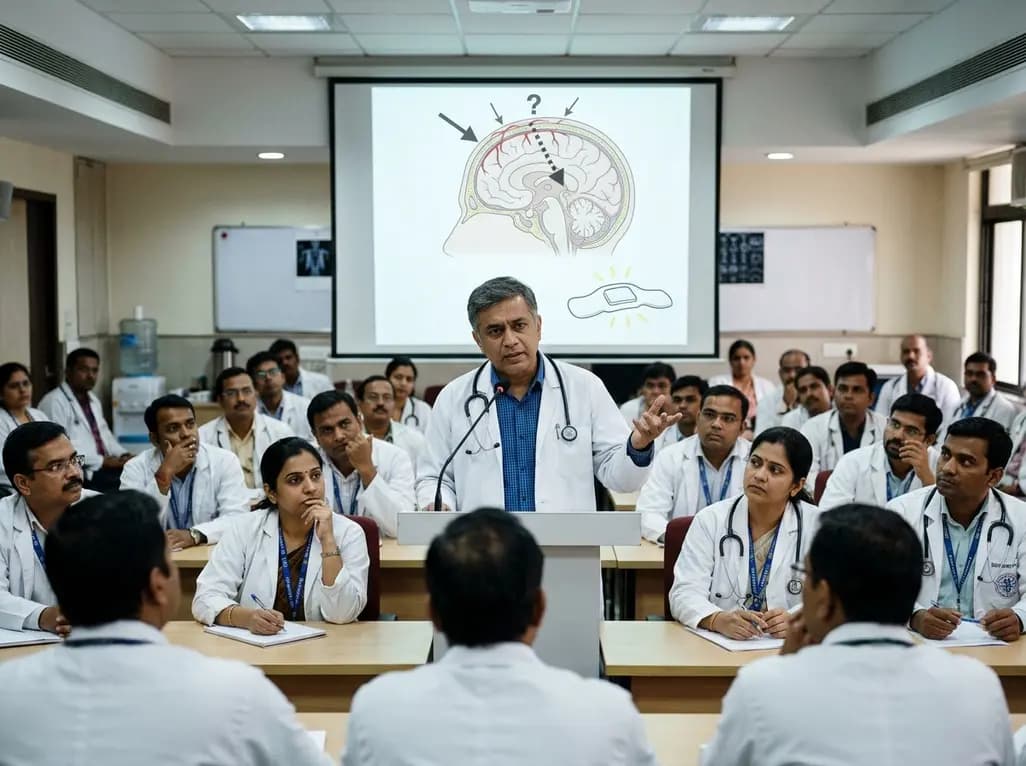
The $900 Temple wearable launched by Deepinder Goyal promises real-time tracking of cerebral blood flow and metabolic entropy. However, prominent clinicians warn that optical scalp sensors merely reflect superficial arterial circulation rather than intracranial hemodynamics, raising major regulatory concerns.
Today

A new comparative study demonstrates that intraoperative imprint cytology achieves 96.6% diagnostic accuracy in ovarian tumours, outperforming frozen section in sensitivity for borderline lesions and offering an accessible, rapid alternative for resource-constrained surgical centres.
Today

A study reveals that extracellular vesicle-derived miR-144-5p is a highly predictive diagnostic biomarker for carotid artery plaques (AUC 0.907). Correlating with IL-1β and TNF-α, it opens new avenues for liquid biopsy-based stroke risk assessment and vascular monitoring.
Today

A systematic review evaluates psychological interventions for smoking cessation in diabetes, showing short-term success but highlighting challenges in long-term abstinence.
Yesterday
