.webp&w=384&q=75)

Loading, please wait...
Loading, please wait...

The clinical management of epilepsy relies fundamentally on accurate seizure frequency documentation. However, traditional full-montage electroencephalography imposes substantial physical constraints on patients during extended diagnostic evaluations. Standard hospital systems require extensive head wrappings, messy conductive pastes, and bulky recording boxes. Consequently, outpatient evaluations often suffer from low patient adherence and premature study termination. Many individuals cannot maintain standard montages during employment, schooling, or vigorous daily routines. Furthermore, clinicians recognize that patient-maintained seizure diaries remain notoriously inaccurate, missing up to half of all ictal occurrences. Automated wearable EEG seizure detection addresses this diagnostic shortfall by capturing objective neurophysiological data continuously. Miniature wireless sensors attach discreetly across the scalp, recording cerebral activity across multiday periods without lifestyle restriction.
Nevertheless, extended multiday recording sessions generate massive electrographic data volumes that overwhelm manual review capacities. Neurologists cannot feasibly inspect hundreds of hours of raw ambulatory traces for individual patients during standard clinic hours. Automated computational algorithms resolve this clinical bottleneck by screening continuous recordings independently. By flagging suspicious electrographic events for targeted physician verification, software maintains rigorous diagnostic standards while accelerating workflow efficiency. This objective surveillance bridges the critical gap between inpatient precision and naturalistic home monitoring.
Recent investigations evaluated a discrete electrographic seizure detection algorithm developed for the Epitel reduced-channel wearable platform. Researchers conducted a rigorous clinical validation trial enrolling fifty diverse participants to determine diagnostic reliability. Among these individuals, thirty-one patients experienced confirmed electrographic seizures during the evaluation period. The study cohort incorporated both pediatric subjects aged six to twenty-one years and mature adults aged twenty-two and older. Additionally, investigators collected continuous electroencephalographic traces across two distinct clinical monitoring settings. These environments included controlled epilepsy monitoring units and real-world ambulatory domiciliary settings.
Historically, automated detection algorithms functioned exclusively on conventional full-montage recordings featuring nineteen or more scalp electrodes. Applying automated analytics to reduced-channel montages presents distinct technical hurdles because fewer sensors capture localized electrical discharges. To overcome this limitation, engineers trained machine learning architectures to recognize spatial-temporal spectral evolutions indicative of paroxysmal seizures. The analytical pipeline processes raw microvolt inputs, suppresses background artifacts, and flags suspicious discrete electrographic events automatically. Reviewers subsequently compared the algorithmic outputs against consensus visual interpretations from board-certified clinical epileptologists. Consequently, the study established an objective baseline for reduced-channel diagnostic accuracy.
The validation trial revealed strong overall performance across complex neurological presentations. Specifically, the automated algorithm demonstrated an event-level sensitivity of 86.2 percent with a 95 percent confidence interval spanning 79.5 to 93.2 percent. Moreover, diagnostic sensitivity varied substantially according to underlying electrographic seizure semiology. Focal seizures that evolved into bilateral generalized convulsive episodes achieved the highest detection sensitivity at 91.4 percent. Similarly, primary generalized seizures exhibited robust algorithmic recognition, reaching an 86.7 percent sensitivity rate.
However, isolated focal seizures proved somewhat more challenging for the reduced-channel configuration, yielding a 77.3 percent sensitivity rate. This disparity occurs naturally because focal discharges often remain confined to localized brain regions distant from sensor placement. Conversely, generalized propagation generates widespread cortical field potentials that reduced montages detect readily. In addition, the algorithm demonstrated consistent diagnostic accuracy across disparate age categories. Pediatric participants aged six to twenty-one years achieved an 83 percent sensitivity mark. Meanwhile, adult patients aged twenty-two years and older demonstrated a 90 percent sensitivity rate. Therefore, the detection system functions dependably across broad demographic spectrums encountered in routine hospital consultations.
False positive detection rates represent a critical operational parameter for clinical neurophysiology software. Across all cohorts, the algorithm produced an overall false detection rate of 0.162 events per hour. This figure aligns closely with the operational performance of conventional software designed for inpatient full-montage systems. Furthermore, detection efficacy remained stable across diverse clinical testing environments. Inpatient epilepsy monitoring units exhibited an 87.5 percent sensitivity rate alongside a low false positive rate of 0.136 events hourly.
Conversely, naturalistic ambulatory recordings demonstrated an 80 percent sensitivity rate. However, the false detection rate reached 0.290 events per hour in ambulatory settings. Notably, all ambulatory monitoring participants represented active pediatric patients living unconstrained lives. Childhood play, mastication, cranial muscle contraction, and mechanical lead displacement introduce electrical artifacts into ambulatory traces. Consequently, automated software occasionally misinterprets rhythmic physiological noise as paroxysmal seizure activity. Although this elevated false discovery rate requires targeted refinement, the current baseline remains clinically acceptable for screening purposes. Clinicians can filter out artifactual triggers rapidly, while retaining crucial captures of previously unrecorded daytime and nocturnal events. Thus, ambulatory recordings still yield meaningful diagnostic gains.
Clinicians frequently express skepticism toward automated artificial intelligence tools due to opaque decision-making processes. To address this apprehension directly, developers integrated a proprietary statistical Confidence metric into the analytical software. This algorithmic index evaluates the morphological probability that an identified electrographic pattern reflects genuine cerebral seizure activity. During validation trials, the calculated Confidence score correlated strongly with real-world positive predictive value. Thus, high-confidence flags reliably corresponded to true electrographic events confirmed by reviewing specialists. In contrast, low-confidence detections frequently captured transient electromyographic spikes or ambient motion artifacts.
As a result, neurophysiologists can sort through multiday recording catalogs by confidence tiers rather than reviewing chronologically. For example, a specialist can review high-confidence detections first to establish an immediate diagnosis. Subsequently, the physician can screen intermediate clusters to evaluate subtle subclinical patterns. This graded triage mechanism dramatically minimizes physician fatigue and accelerates report turnaround times. Ultimately, incorporating transparent confidence metrics fosters vital clinical trust in automated diagnostic support systems. In resource-constrained settings, where dedicated epilepsy monitoring beds remain scarce, wearable reduced-channel systems expand specialized neurological access. By transforming unwieldy multiday recordings into digestible summaries, automated analytics empower clinical teams to optimize medical therapy promptly.
The novel algorithm demonstrated an event-level sensitivity of 86.2 percent alongside a false detection rate of 0.162 events per hour. Consequently, these metrics match the operational performance of conventional full-montage clinical software. Furthermore, the automated tool significantly reduces manual review times for extended electrographic recordings without sacrificing diagnostic reliability.
Ambulatory monitoring yielded 0.290 false detections per hour compared to 0.136 in the epilepsy monitoring unit. Crucially, all ambulatory subjects were pediatric patients engaged in unrestricted daily activities. Physiological muscle artifacts, chewing, movement, and electrode friction elevate signal noise in home settings. Therefore, developers must refine artifact rejection algorithms for real-world environments.
The supplemental Confidence metric quantifies the statistical likelihood that a detected electrographic discharge represents a genuine seizure. In validation testing, this score correlated strongly with detection precision. Thus, reviewing physicians can prioritize high-probability seizure alerts during trace interpretation. Consequently, this triage feature streamlines review workflows and fosters clinician trust in automated outputs.
Disclaimer: This content is for informational and educational purposes only and does not constitute medical advice, diagnosis, or treatment. Healthcare professionals should exercise their independent clinical judgment when managing patients. Refer to the latest local and national guidelines for clinical practice.
References
Newton TJ et al. Validation of a discrete electrographic seizure detection algorithm for extended-duration, reduced-channel wearable EEG. Epilepsia. 2025 Jul. doi: 10.1111/epi.18365. PMID: 40108974.
Muvvala VK, Kazen AB, Newton TJ, et al. Comparative analysis of signal quality and usability for a novel wireless, wearable EEG sensor. Clin Neurophysiol Pract. 2025;10:292-300. doi: 10.1016/j.cnp.2025.06.002.
Tosi Z, Muvvala VK, Newton TJ, et al. Assessing a Reduced-Channel Algorithm for End-to-End Seizure Detection on Multiday EEG Using Inter-Rater Agreement With Epileptologists. Sci Rep. 2026;16(1):22964. doi: 10.1038/s41598-026-58120-x.

Read summarized clinical updates, watch expert medical content, and earn CME certifications right from your smartphone.
Open your smartphone camera to scan and install.





A clinical validation study in Epilepsia demonstrates that an automated algorithm for reduced-channel wearable EEG achieves 86.2% sensitivity and low false-positive rates, offering viable long-term outpatient electrographic seizure monitoring for pediatric and adult patients.
Today

A study evaluating drone transport of blood samples across winter and summer found 31 of 32 routine biochemical analytes remained stable compared to ground transport. While plasma LDH showed minor increases, separation gel caused greater preanalytical alterations, showing aviation rules are the main barrier.
Today

A recent case highlights favorable maternal and neonatal survival in a patient presenting at 34 weeks with probable Eisenmenger physiology and suspected double outlet right ventricle (DORV). Here is a critical review of hemodynamic challenges, delivery strategies, and peripartum management in complex cardiac disease.
Today
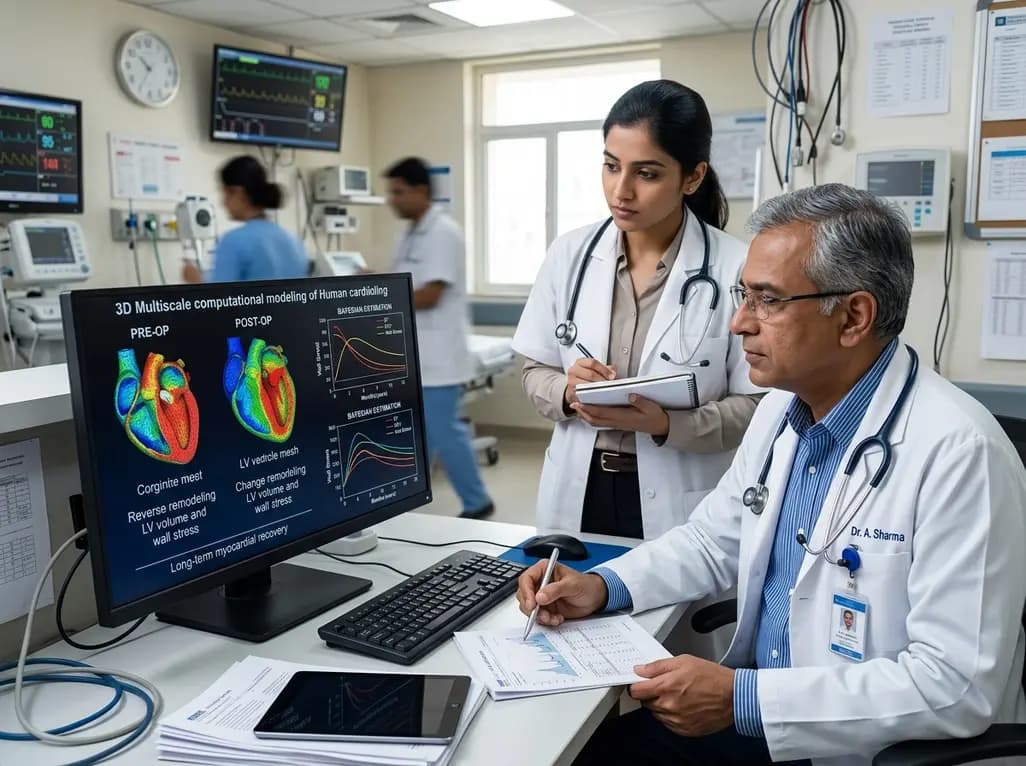
A novel multiscale computational model calibrated with Bayesian algorithms demonstrates that full reverse remodeling after mitral valve regurgitation demands both mechanical correction of volume overload and neurohormonal restoration, shedding light on persistent postoperative left ventricular dysfunction.
Today

Systematic review comparing labral repair and reconstruction in primary hip arthroscopy shows comparable short- to mid-term patient-reported outcomes, with lower THA conversion after repair but superior outcomes for reconstruction in patients aged 40 and older.
Today

A preclinical study reveals that alpinetin significantly alters glimepiride pharmacokinetics by inhibiting CYP2C9. This drug-herb interaction enhances hypoglycemic potency and underscores critical safety concerns regarding severe hypoglycemia in diabetic management.
Today
