.webp&w=384&q=75)

Loading, please wait...
Loading, please wait...
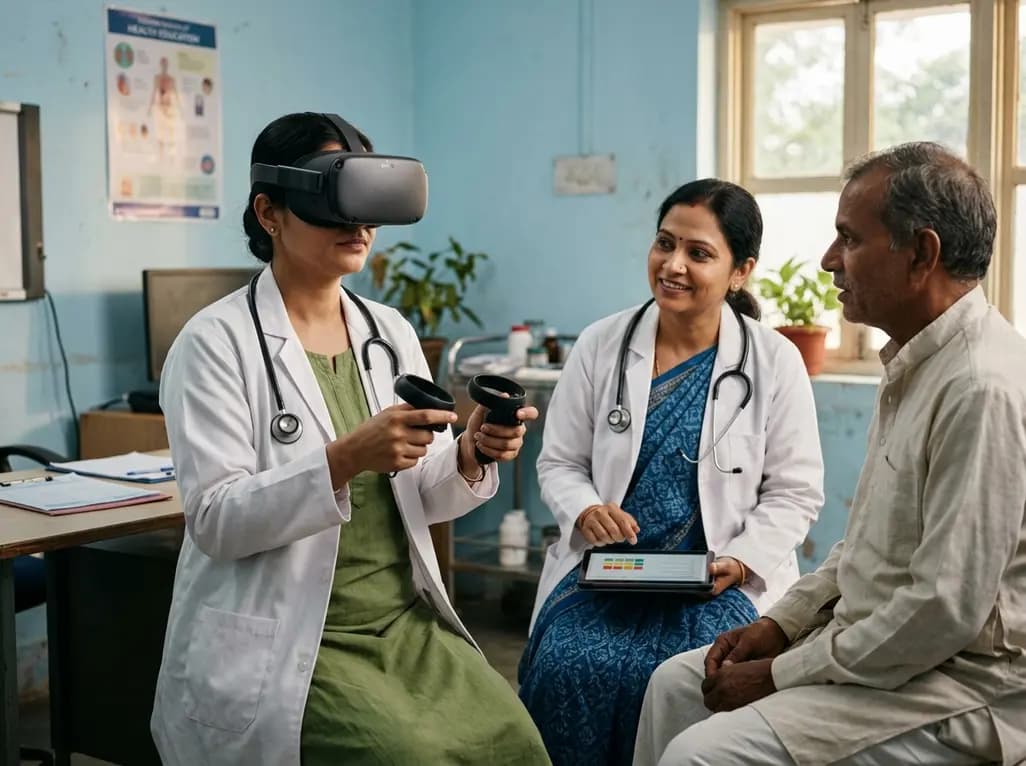
Rural communities worldwide often face substantial gaps in mental healthcare infrastructure, leaving vulnerable individuals without timely psychiatric intervention. To bridge this critical divide, medical educators increasingly turn to immersive simulation technologies that replicate complex, real-world clinical encounters. A pioneering mixed-methods study recently investigated the feasibility of a novel VR suicide prevention training system designed for healthcare workers, trainees, and rural community members. Suicide remains an urgent global public health priority that demands proactive screening and empathetic communication skills from every frontline clinician. By immersing learners in realistic domestic settings, virtual reality platforms cultivate situational awareness, enhance observational precision, and demystify sensitive clinical conversations. Consequently, immersive education offers a scalable, highly standardized method to prepare medical teams for complex community-based home evaluations.
Geographic isolation, specialist shortages, and social stigma frequently prevent rural veterans and underserved individuals from accessing timely psychiatric care. Under these challenging circumstances, general practitioners, community nurses, and allied health professionals serve as the principal line of defense during acute psychological crises. However, traditional didactic lectures and static video presentations rarely prepare clinicians for the dynamic, unpredictable nature of home evaluations. Virtual reality provides an experiential bridge by placing trainees directly inside authentic living spaces. Within these virtual environments, learners can identify safety risks, observe nonverbal behavioral cues, and practice conversational de-escalation in a controlled setting. Furthermore, digital simulations can be deployed across remote healthcare clinics, medical colleges, and regional training centers without requiring expensive logistical resources. As a result, frontline health workers gain substantial confidence and clinical readiness before interacting with high-risk individuals in domestic environments. Therefore, expanding immersive educational platforms represents a vital strategy for reducing disparities in rural mental healthcare delivery.
Developing an effective clinical simulation requires a structured instructional design methodology that guarantees both educational validity and technological usability. The researchers utilized the ADDIE framework, which encompasses five systematic phases: Analysis, Design, Development, Implementation, and Evaluation. During the initial analysis and design phases, educational technologists collaborated closely with psychiatric specialists, military social workers, and rural community members to pinpoint essential competencies. Subsequently, developers built the prototype simulation to depict an authentic home visit with a veteran experiencing acute distress. During the implementation phase, thirty participants—including practicing clinicians, social work students, and community representatives—navigated the scenario using commercial virtual reality headsets. Researchers evaluated presence, ecological validity, and usability using standardized psychometric instruments alongside qualitative feedback. Adhering to this structured instructional framework ensured that every visual asset, interactive dialogue choice, and environmental clue directly aligned with evidence-based suicide intervention goals. Consequently, this development process provides an adaptable blueprint for creating specialized clinical simulation modules across diverse medical disciplines.
A fundamental objective of home-based crisis intervention is the rapid identification of hazard indicators paired with lethal means counseling. In the simulated home visit, participants explored domestic rooms to detect both obvious and subtle signs of self-harm risk. Notably, participants exhibited exceptional recall for prominent physical objects, correctly identifying unsecured firearms in over ninety-three percent of evaluations and alcohol containers in eighty-three percent. Conversely, subtler contextual indicators, such as unopened mail, social isolation cues, and medication mismanagement, were noted less frequently. This critical discrepancy demonstrates why immersive training is uniquely valuable: it exposes specific observational blind spots that standard written examinations fail to uncover. Furthermore, lethal means safety counseling emphasizes respectful, collaborative conversations that establish time and distance between an individual in crisis and lethal tools. By practicing empathetic negotiation strategies repeatedly within virtual simulations, clinicians learn how to discuss firearm safety and medication security without triggering defensiveness. Consequently, healthcare providers develop the practical communication skills needed to save lives during acute domestic interventions.
For any virtual reality medical curriculum to succeed, the technology must deliver high psychological fidelity while preventing unwanted physical side effects. Participants in the feasibility evaluation reported strong spatial presence and high ecological validity, noting that the virtual environment felt remarkably genuine and compelling. Crucially, adverse simulator effects—such as nausea, visual fatigue, disorientation, or dizziness—remained exceptionally low across all participant demographics. Trainees praised the authentic dialogue, naturalistic audio design, and realistic emotional presentation of the virtual patient. However, qualitative user feedback highlighted key areas for software refinement, including smoother avatar locomotion, refined physical object manipulation, and clearer interactive navigational prompts. Developers must carefully fine-tune these technical elements before conducting large-scale clinical efficacy trials. When educational software successfully minimizes cybersickness while maximizing sensory engagement, learners experience deep cognitive absorption. Consequently, virtual reality emerges as a well-tolerated, safe, and highly engaging modality for intensive psychiatric and crisis intervention training.
The successful pilot testing of this virtual simulation offers valuable insights for primary care physicians, emergency room staff, and community health networks. Frontline doctors and nurses frequently encounter patients suffering from undiagnosed mood disorders, substance misuse, or acute suicidal ideation. Integrating virtual reality simulations into undergraduate medical curricula, residency rotations, and continuing professional development establishes consistent, high-quality clinical standards across regional healthcare systems. Moreover, the diverse participant cohort demonstrated that non-specialist community members and healthcare students can master complex risk assessment concepts through immersive experiential learning. As telemedicine and mobile outreach services expand into remote territories, equipping rural healthcare teams with advanced de-escalation and safety counseling skills becomes increasingly paramount. Embracing scalable digital simulations empowers multidisciplinary care teams to identify crisis indicators earlier, deliver timely lethal means interventions, and foster resilient community safety networks. Ultimately, adopting cutting-edge educational technology will help prevent avoidable tragedies and enhance the quality of community-based psychiatric care.
Lethal means safety counseling is an evidence-based clinical intervention that helps healthcare providers collaboratively reduce a patient's access to lethal methods, such as unsecured firearms and prescription medications, during acute crises. By creating physical time and distance between suicidal intent and lethal tools, this intervention significantly reduces immediate suicide mortality.
Virtual reality provides immersive, realistic domestic scenarios where clinicians practice identifying environmental hazard cues and conducting challenging risk conversations. This interactive experiential approach enhances observational recall, builds professional confidence, and reinforces empathetic communication skills more effectively than passive didactic lectures or traditional written clinical case studies.
The ADDIE model is a systematic instructional design framework consisting of five sequential phases: Analysis, Design, Development, Implementation, and Evaluation. Medical educators utilize this structured framework to design, refine, and validate highly effective simulation modules that satisfy rigorous clinical learning objectives and maintain high technological usability.
Disclaimer: This content is for informational and educational purposes only. It is not intended to be a substitute for professional medical advice, diagnosis, or treatment. Always seek the advice of your physician or other qualified health provider with any questions you may have regarding a medical condition. Refer to the latest local and national guidelines for clinical practice.
References

Read summarized clinical updates, watch expert medical content, and earn CME certifications right from your smartphone.
Open your smartphone camera to scan and install.





A pilot study evaluated the VET-SAVR virtual reality simulation for suicide prevention in rural veterans. The platform proved feasible and acceptable, demonstrating high user engagement, low simulator sickness, and strong recall for lethal means cues like firearms and alcohol.
last month

Pancreatic cancer cachexia affects over 80% of patients, driving severe muscle wasting, systemic inflammation, and treatment intolerance. This review highlights key pathophysiological drivers, exocrine insufficiency, objective CT imaging, and emerging therapies like GDF-15 inhibitors to improve clinical outcomes.
Today

A scoping review reveals how pregnancy affects phonation through laryngeal edema and reduced phonation time rather than major acoustic pitch alterations. Learn how to identify, evaluate, and manage vocal symptoms in expectant mothers.
Today
According to WHO data, average lifespan reached 73.3 years in 2023, recovering from pandemic lows. However, healthy life expectancy lags at 62.8 years due to surging noncommunicable conditions like cardiovascular disease and dementia, demanding proactive primary screening and sustained chronic care.
Today
Researchers have engineered an artificial sensory-pain integrated receptor using a multi-threshold organic synaptic transistor. The system distinguishes benign touch from noxious stimuli, enabling safer, more responsive prosthetic limbs with built-in memory and simplified hardware architecture.
Today
Medical robotics is transitioning beyond operative suites into diagnostics, cardiology, and endocrinology. Explore how innovations in tele-robotics, AI integration, and nanomedicine are overcoming geographical barriers and transforming precision healthcare delivery across India's evolving disease landscape.
Today
