.webp&w=384&q=75)

Loading, please wait...
Loading, please wait...

Hyperfunctional voice disorders present frequent diagnostic and rehabilitative dilemmas for otolaryngologists, laryngologists, and speech-language pathologists worldwide. In professional voice users, including classical singers, educators, and public speakers, excessive laryngeal muscle activation frequently leads to chronic vocal fatigue and tissue injury. Therefore, clinicians must identify pathological vocal strain early to prevent irreversible vocal fold remodeling, such as nodules, polyps, or fibrous contact lesions. Traditionally, auditory-perceptual assessment represents the clinical gold standard for grading strained phonatory qualities in outpatient voice clinics. However, subjective perceptual ratings suffer from considerable inter-rater variability, personal bias, and clinician fatigue during prolonged consultations. Consequently, voice specialists often find it difficult to establish dependable, reproducible baselines for longitudinal patient monitoring. Reliable vocal strain prediction demands objective diagnostic instruments that can quantify subtle alterations within glottic vibration and acoustic output. Furthermore, conventional acoustic metrics frequently fail to isolate true glottal hyperadduction from harmless supraglottic resonance shaping. As a result, research groups are actively developing automated computational tools to standardize voice assessment. By combining noninvasive physiological sensing with modern machine learning algorithms, clinicians can obtain consistent, objective evaluations of phonatory effort. This technological transition marks a significant advancement in laryngological practice.
To overcome the limitations of isolated acoustic analysis, investigators have implemented multimodal diagnostic architectures. Specifically, combining radiated acoustic signals with electroglottography provides a direct physiological window into vocal fold contact behavior. Electroglottography measures electrical impedance across the thyroid cartilage via surface neck electrodes, tracking glottal opening and closure without disturbing natural articulation. In addition, high-fidelity acoustic microphones capture essential psychoacoustic features and spectral timbre produced along the vocal tract. In a recent rigorous study, investigators assembled paired acoustic and electroglottographic recordings from singers performing diverse musical exercises. Moreover, they partitioned the data into mutually exclusive training-validation and independent testing cohorts to ensure genuine singer-independent generalization. This methodological partition prevents models from memorizing unique singer timbres, thereby guaranteeing broad clinical applicability across unfamiliar patients. Furthermore, investigators incorporated singer metadata, including biological sex and singing experience, to enrich algorithmic classification. By integrating contact mechanics with airborne acoustics, the researchers constructed a comprehensive digital representation of phonatory function. Consequently, this multimodal design resolves ambiguities that typically hinder single-modality assessments, providing superior sensitivity to excessive medial compression during phonation.
Extracting physiologically grounded feature sets represents a vital prerequisite for building accurate clinical models. Therefore, the researchers evaluated comprehensive acoustic representations, including mel-frequency cepstral coefficients, wavelet scattering coefficients, and the extended Geneva minimalistic acoustic parameter set. These standard parameters quantify harmonic noise ratios, spectral tilt, and subtle frequency fluctuations that indicate phonatory strain. Concurrently, the electroglottographic analysis extracted specialized glottal dynamic descriptors, such as the contact quotient and amplitude modulation profiles. Contact quotient measurements directly reflect the relative duration of glottal closure, where elevated values frequently signal hyperfunctional medial compression. In addition, recursive feature elimination systematically identified and retained the most predictive features while discarding redundant variables. Furthermore, feature-level fusion merged these multidimensional data streams into unified predictive vectors. As a result, the regression algorithms received simultaneous, complementary information regarding laryngeal biomechanics and radiating sound characteristics. This careful curation prevented algorithmic overfitting and ensured that the machine learning models remained transparent and interpretable. Ultimately, this robust feature engineering framework highlights the essential physiological indicators of excessive vocal loading.
The experimental findings demonstrated compelling predictive accuracy across several modern machine learning regression models. Specifically, the researchers trained support vector regressors, random forest ensembles, and ridge regression algorithms using leave-one-singer-out cross-validation. During the training and validation phase, the multimodal pipeline achieved an exceptional Spearman correlation coefficient of 0.823 with consensus expert ratings. Furthermore, this combined acoustic and electroglottographic model significantly outperformed unimodal systems, confirming the vital synergy between structural contact data and acoustic radiation. When evaluated on the separate, unseen test cohort, the model retained robust predictive stability across diverse singing tasks. Consequently, these results prove that the system generalizes successfully to unfamiliar vocalists rather than capitalizing on idiosyncratic voice qualities. In addition, incorporating singer metadata provided noticeable improvements when evaluating diverse vocal classifications and pitch ranges. Recursive feature selection confirmed that glottal contact duration and high-frequency spectral energy distribution were the most influential predictors. Thus, the objective computational system successfully mirrored the perceptual judgment of seasoned voice professionals with high fidelity.
These findings introduce valuable clinical capabilities for practicing otolaryngologists, phoniatricians, and speech therapists managing professional voice users. For example, voice clinics can deploy automated screening algorithms to identify subtle hyperfunctional habits before organic vocal fold pathologies develop. Furthermore, objective strain scores provide clinicians with quantifiable metrics to track patient rehabilitation following phonosurgical procedures or targeted voice therapy. Instead of relying purely on subjective auditory impressions, clinicians can track longitudinal progress using standardized numerical ratings. In addition, pairing noninvasive electroglottography with automated analysis offers an objective methodology for differentiating muscle tension dysphonia from adductor spasmodic dysphonia. Vocal performers and pedagogical vocal coaches can also utilize real-time strain feedback during training sessions to eliminate excessive laryngeal tension. Moreover, as outpatient laryngology services adopt telemedicine and digital voice monitoring, automated algorithms can facilitate remote surveillance of vocal health. Therefore, integrating multimodal machine learning into daily clinical practice enhances diagnostic consistency and fosters earlier intervention for high-risk voice users.
Electroglottography directly evaluates vocal fold vibratory dynamics by transmitting a safe, low-voltage electrical current across the thyroid lamina. While conventional acoustic microphones record radiated sound modified by supraglottic vocal tract filtering, electroglottography captures real-time lateral vocal fold contact area without acoustic distortion. Consequently, combining both modalities allows clinicians to distinguish true glottal hyperadduction from benign resonance shifts, delivering far greater diagnostic accuracy during objective voice evaluations.
Automated machine learning models primarily quantify the functional severity of phonatory strain rather than offering definitive tissue diagnoses. However, by measuring abnormal glottal contact kinetics alongside spectral irregularities, these algorithms alert otolaryngologists to underlying muscle tension patterns. When paired with routine video laryngostroboscopy, automated strain prediction helps clinicians determine whether vocal fatigue stems from primary hyperfunction or secondary compensations caused by underlying polyps, nodules, or mucosal stiffness.
Singer-independent cross-validation ensures that predictive algorithms evaluate generalized biomechanical patterns rather than memorizing individual vocal timbres, resonant idiosyncrasies, or singer identities. By testing models exclusively on unfamiliar vocalists who were never included in the training cohort, researchers verify that the system remains objective and robust. Therefore, clinicians can confidently deploy these automated scoring tools across diverse patient populations without experiencing performance drops across unfamiliar voice profiles.
Disclaimer: This content is for informational and educational purposes only... Refer to the latest local and national guidelines for clinical practice.
References
Liu Y et al. Automatic Prediction of Vocal Strain Scores in Singing Voice Using Audio and Electroglottographic Modalities. J Speech Lang Hear Res. 2026 Sep 22. doi: 10.1044/2026_JSLHR-25-01016. PMID: 42771827.
Herbst CT. Electroglottography-an update. J Voice. 2020;34(4):503-526.
Roy N, Merrill RM, Gray SD, Smith EM. Voice disorders in the general population: prevalence, risk factors, and occupational impact. Laryngoscope. 2005;115(11):1988-1995.
Eyben F, Scherer KR, Schuller BW, et al. The Geneva Minimalistic Acoustic Parameter Set (GeMAPS) for Voice Research and Affective Computing. IEEE Trans Affect Comput. 2016;7(2):190-202.

Read summarized clinical updates, watch expert medical content, and earn CME certifications right from your smartphone.
Open your smartphone camera to scan and install.





A groundbreaking study demonstrates that multimodal machine learning combining audio and electroglottographic data predicts vocal strain scores with high accuracy. This objective approach advances laryngology and voice rehabilitation for professional singers and voice users.
Today
Non-invasive biospecimen sampling offers exciting opportunities for stress medicine. This article examines a pioneering protocol comparing cortisol, inflammatory cytokines, and metabolic markers across blood plasma, whole saliva, and oral mucosal transudate during baseline and acute stress states.
Today
A school-based intervention using the Health Action Process Approach (HAPA) significantly enhanced adolescents' perceived benefits of consulting healthcare providers and promoted proactive menstrual health behaviors, offering key clinical insights for managing adolescent dysmenorrhea and endometriosis.
Today

A multicenter propensity-matched study evaluated DOAC plus single versus dual antiplatelet therapy after carotid artery stenting. Findings revealed comparable intracranial hemorrhage and ischemic stroke rates, supporting DOAC plus SAPT as a viable antithrombotic strategy in high-risk patients.
Today

A cross-sectional study reveals that sarcopenic obesity independently increases functional impairment and severe disc degeneration in patients with degenerative lumbar spinal stenosis, highlighting the need for body composition assessment.
Today
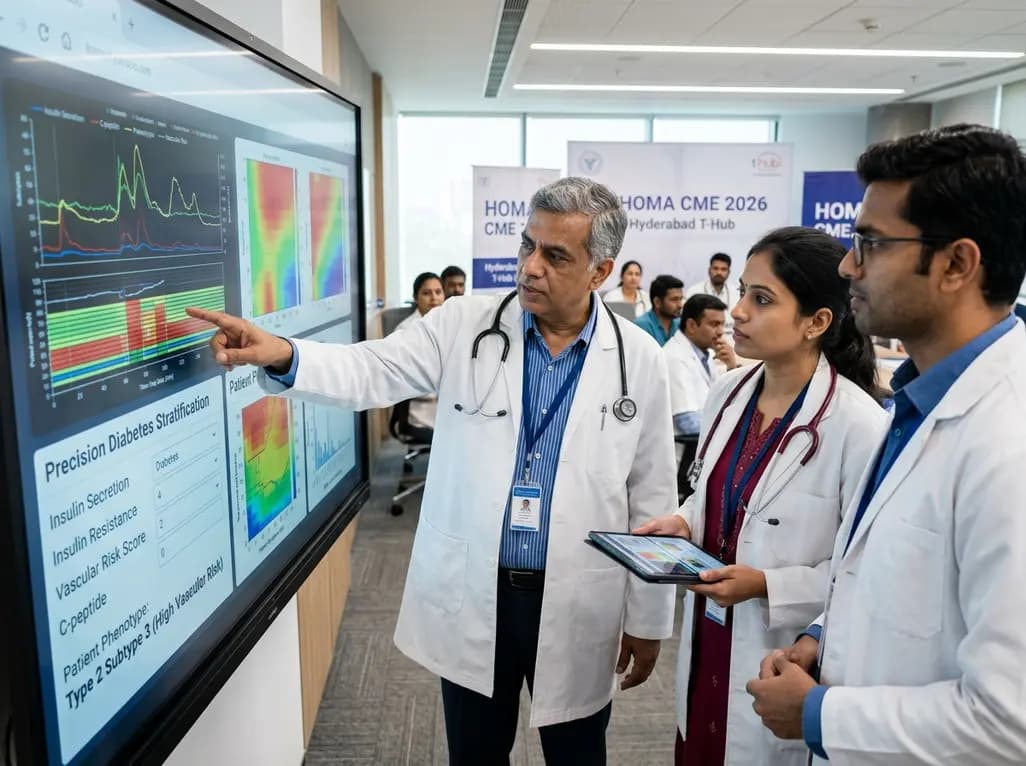
At Homa CME 2026 at Hyderabad's T-Hub, healthcare leaders emphasized moving beyond routine metrics through digital calculators and precision stratification. Discover why characterizing individual insulin secretion, resistance patterns, and vascular risks transforms chronic metabolic care in India.
Yesterday
