.webp&w=384&q=75)

Loading, please wait...
Loading, please wait...

In India, more than 70 million people suffer from vertigo and related balance disorders. Although nearly 74% of these cases are benign, the high patient volume burdens the healthcare system. Specifically, older adults face a higher risk of hospitalisation due to untreated vestibular issues. Moreover, recent observations suggest an increasing association between vertigo and post-viral conditions. This adds a new layer of complexity to patient care. Therefore, improving diagnostic precision at the first point of care is essential. Such precision enhances patient outcomes and improves their overall quality of life.
A primary challenge in vertigo management in India is the lack of structured clinical evaluation. Frequently, patients undergo repeated and expensive imaging like MRIs that may be unnecessary. Instead, specialists recommend focused bedside examinations of the vestibular and ocular motor systems. Additionally, frontline physicians benefit from hands-on training to build confidence in assessing balance disorders. Consequently, bridging these diagnostic gaps can prevent prolonged patient discomfort. It also reduces unnecessary medical expenditure and improves clinic efficiency.
Accurate diagnosis requires clinicians to distinguish between peripheral, central, and functional vertigo. While conditions like Benign Paroxysmal Positional Vertigo (BPPV) are common, identifying \"red flags\" is critical. For instance, a multidisciplinary approach involving neurologists and ENT specialists ensures clinicians do not overlook serious causes. Notably, advances in vestibular medicine have made most conditions highly treatable. Thus, adopting a systematic history-taking process remains the most effective tool for successful clinical outcomes. This approach ensures patients receive the right treatment at the right time.
Q1: Why is vertigo frequently misdiagnosed in India?
Vertigo is often dismissed as a minor ailment due to limited awareness and a lack of structured clinical evaluation at the primary care level.
Q2: What are the risks of leaving vertigo untreated?
Untreated vertigo significantly increases the risk of falls and serious injuries. It may also mask underlying neurological conditions like stroke or inner ear disorders.
Q3: How can physicians improve diagnostic accuracy for vertigo?
Clinicians can improve accuracy by using structured patient history-taking and bedside examinations of the vestibular and ocular motor systems instead of relying solely on imaging.
Disclaimer: This content is for informational and educational purposes only. It does not constitute medical advice or replace professional judgment. Refer to the latest local and national guidelines for clinical practice.
References

Read summarized clinical updates, watch expert medical content, and earn CME certifications right from your smartphone.
Open your smartphone camera to scan and install.





Experts address the high misdiagnosis rate of vertigo in India, stressing the need for structured bedside evaluations and dedicated clinics for better outco...
6 months ago
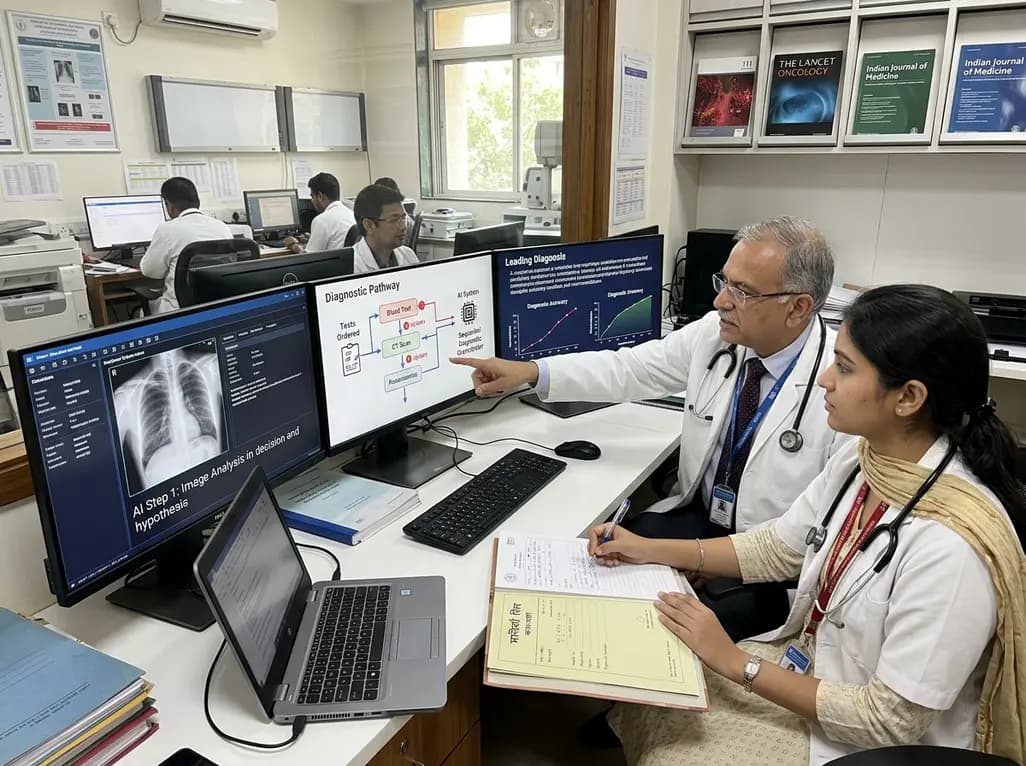
A breakthrough peer-reviewed study demonstrates that a sequential AI diagnosis system can mirror real-world clinical reasoning. By ordering stepwise tests and updating hypotheses dynamically, this multi-agent orchestrator achieved superior diagnostic accuracy while reducing investigative costs.
Today

A prenatal case highlights severe glutaric acidemia type II presenting as bilateral hyperechoic cystic kidneys at 18 weeks. Whole-exome sequencing revealed a novel homozygous ETFDH frameshift variant, demonstrating the power of rapid genetic testing in fetal renal anomalies.
Today

Review how tailored exercise programs benefit frail older patients with heart failure. Explore pathophysiological mechanisms, individualized training prescriptions, and strategies to overcome adherence barriers in clinical practice.
Yesterday

This comparative study evaluates posterior labral tears with and without glenohumeral instability, highlighting distinct demographic patterns, MRI underestimation in stable shoulders, and successful arthroscopic repair outcomes.
Yesterday

A clinical study demonstrates that early intervention with tocilizumab, either as monotherapy or bridged with corticosteroids, achieves significant proptosis reduction and resolves active inflammation in treatment-naive thyroid eye disease.
Yesterday
