.webp&w=384&q=75)

Loading, please wait...
Loading, please wait...
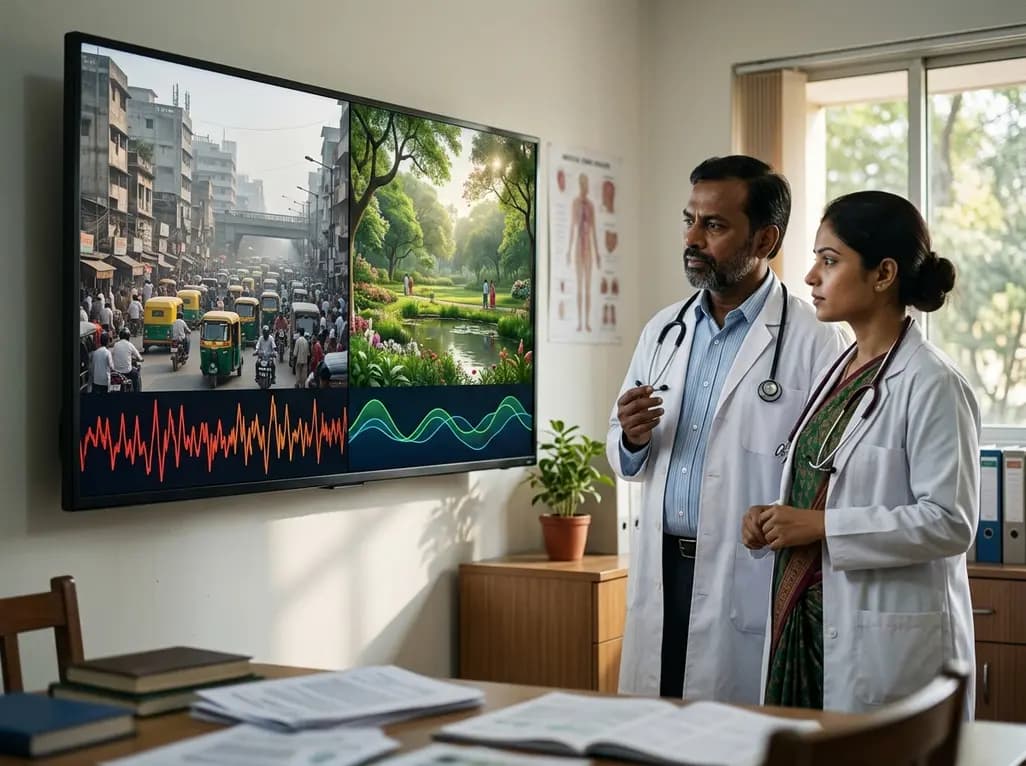
Recent empirical data highlights the vital role of urban landscape mental health in promoting psychological well-being. As cities expand, clinicians and planners must understand how different environments impact the human nervous system. Notably, a new study introduces a synchronized cross-modal framework to evaluate the restorative potential of various landscapes. Furthermore, this research provides a quantitative, systems-level approach to sustainable urban design.
Researchers conducted a laboratory experiment with 42 healthy undergraduate students to analyze multi-scale data streams. They synchronously recorded brain activity (EEG), visual attention, and peripheral autonomic signals. To integrate these findings, the team developed the Cross-Modal Restorative Index (CMRI). Consequently, the results show a distinct hierarchy of environmental restoration across nine landscape typologies.
Pristine natural environments, such as mountainous areas and fields, elicited \"complete integrated restoration.\" These settings triggered significant systemic convergence. For instance, participants experienced central cognitive relaxation via posterior alpha power activation. Moreover, the data revealed robust parasympathetic upregulation and a profound drop in subjective tension and fatigue. Specifically, the field landscape showed a significant alpha power increase compared to artificial scenes.
Conversely, built landscapes demonstrated what researchers call \"fragmented restoration.\" Road scenes exhibited a localized dissociation where physiological calming did not match psychological domains. Although researchers observed some posterior alpha wave increases, over 74% of visual attention remained locked on artificial elements. As a result, subjective fatigue actually increased in these urban settings. This decoupling suggests that mere physical presence in a city environment does not guarantee mental recovery.
Clinicians should note that ecologically authentic blue-green infrastructure is essential for resilient urban design. This study proves that not all \"green\" spaces provide equal benefits. Additionally, integrating diverse natural elements helps synchronize physiological and psychological recovery. Therefore, sustainable city planning must prioritize authentic natural landscapes to combat the stressors of rapid urbanization.
The CMRI is a new metric that integrates data from brain activity, eye-tracking, and autonomic signals. It provides a holistic score to measure how effectively an environment restores mental and physiological health.
In built environments, physiological signals might show temporary relaxation, but visual and psychological indicators often remain stressed. This dissociation means the mind does not fully recover despite some physical calming.
Disclaimer: This content is for informational and educational purposes only. It does not constitute professional medical advice, diagnosis, or treatment. Refer to the latest local and national guidelines for clinical practice.
References

Read summarized clinical updates, watch expert medical content, and earn CME certifications right from your smartphone.
Open your smartphone camera to scan and install.





A cross-modal study reveals that natural landscapes offer superior mental health restoration compared to the fragmented effects of built urban environments....
4 months ago

Recent epidemiological data reveals a dramatic surge in summer heat mortality driven by human-induced climate warming. This analysis explores the pathophysiological impacts on cardiac and renal systems, diagnostic dilemmas in death certification, and essential emergency cooling protocols for acute clinical care.
Today

Odisha has established India's first state-level clinical protocol specifically tailored for pregnant women with sickle cell disease. Developed with NHM and UNICEF, the framework provides structured antenatal screening, crisis mitigation, standardized referral pathways, and specialized interdisciplinary care.
Today

India is advancing preventive healthcare by integrating genomics, artificial intelligence, and quantum technologies. With the SANGAM programme sequencing one million Indian genomes, clinicians can unlock personalized therapies, detect cardiometabolic risks early, and curb the burden of diabetes and heart disease.
Today

A randomized controlled trial demonstrates that an eight-week dual-task training intervention significantly improves static and dynamic postural control over standard balance exercises in individuals with chronic ankle instability, addressing critical neurocognitive deficits during athletic and daily activities.
Today

A retrospective cohort study of 7,716 ICU patients from the MIMIC-IV database demonstrates that Gradient Boosting Decision Trees significantly outperform traditional SOFA scores in predicting in-hospital mortality among patients with sepsis and diabetes, with SHAP analysis providing clinical interpretability.
Today
