.webp&w=384&q=75)

Loading, please wait...
Loading, please wait...

Researchers have introduced a hierarchical multi-parameter framework for the predictive design of Type I AIE photosensitizers, specifically targeting the challenges of hypoxic tumor environments. This study demonstrates how acceptor engineering can effectively modulate intramolecular charge transfer (ICT) to enhance photodynamic therapy (PDT) outcomes. By strengthening the electron-withdrawing capacity, scientists can enable a direct charge transfer-mediated intersystem crossing (ISC) pathway, which is essential for high-performance photosensitization.
The development of the photosensitizer DPCMQ highlights the practical application of this framework. Specifically, the design utilizes several key parameters to ensure high ISC efficiency. These include a favorable singlet-triplet gap as a thermodynamic prerequisite and low reorganization energy to drive kinetic performance. Notably, the DPCMQ molecule achieved an exceptionally high S1→T1 intersystem crossing rate of 2.94 × 10⁷ s⁻¹. Consequently, this high efficiency allows the triplet state to populate rapidly, where optimal descriptors facilitate efficient electron transfer even in oxygen-poor environments.
Moreover, the aggregation-induced emission (AIE) characteristics play a crucial role in the therapeutic efficacy of these molecules. In aggregates, restricted molecular motion and a hydration-promoted microenvironment boost the overall performance. This design selectively promotes the generation of hydroxyl radicals (•OH) rather than relying on oxygen-dependent superoxide pathways. Therefore, these Type I AIE photosensitizers remain effective under hypoxic conditions where traditional Type II therapies often fail. Furthermore, the low triplet energy of the framework suppresses unwanted Type II activity, providing a highly specific and predictive blueprint for advanced oncological treatments.
Type I photosensitizers operate through electron transfer to produce reactive species like hydroxyl radicals, which are less dependent on high oxygen levels. In contrast, Type II photosensitizers rely on energy transfer to molecular oxygen to create singlet oxygen, often making them less effective in hypoxic tumor cores.
DPCMQ is significant because it achieves an extremely high intersystem crossing rate and utilizes a specific molecular design that thrives in aggregates. Its ability to generate hydroxyl radicals selectively ensures it remains potent in the low-oxygen environments characteristic of many solid tumors.
Disclaimer: This content is for informational and educational purposes only. It does not constitute professional medical advice, diagnosis, or treatment. Always seek the advice of your physician or other qualified healthcare provider with any questions you may have regarding a medical condition. Refer to the latest local and national guidelines for clinical practice.
References
Cao J et al. Acceptor Engineering-Mediated Charge-Transfer Control: A Hierarchical Framework for Predictive Design of High-Performance Type I AIE Photosensitizers. Small. 2026 May 24. doi: 10.1002/smll.202514808. PMID: 42177831.
Yu Q, et al. Biomarker-activatable photosensitizers with aggregation-induced emission characteristics for photodynamic therapy. Coordination Chemistry Reviews. 2024;518:216056.
Tang BZ, et al. AIE-Active Photosensitizers: Manipulation of Reactive Oxygen Species Generation and Applications in Photodynamic Therapy. MDPI. 2022;14(10):1134.

Read summarized clinical updates, watch expert medical content, and earn CME certifications right from your smartphone.
Open your smartphone camera to scan and install.





A new study presents a predictive design framework for Type I AIE photosensitizers, like DPCMQ, to enhance photodynamic therapy in hypoxic tumor environment...
4 months ago
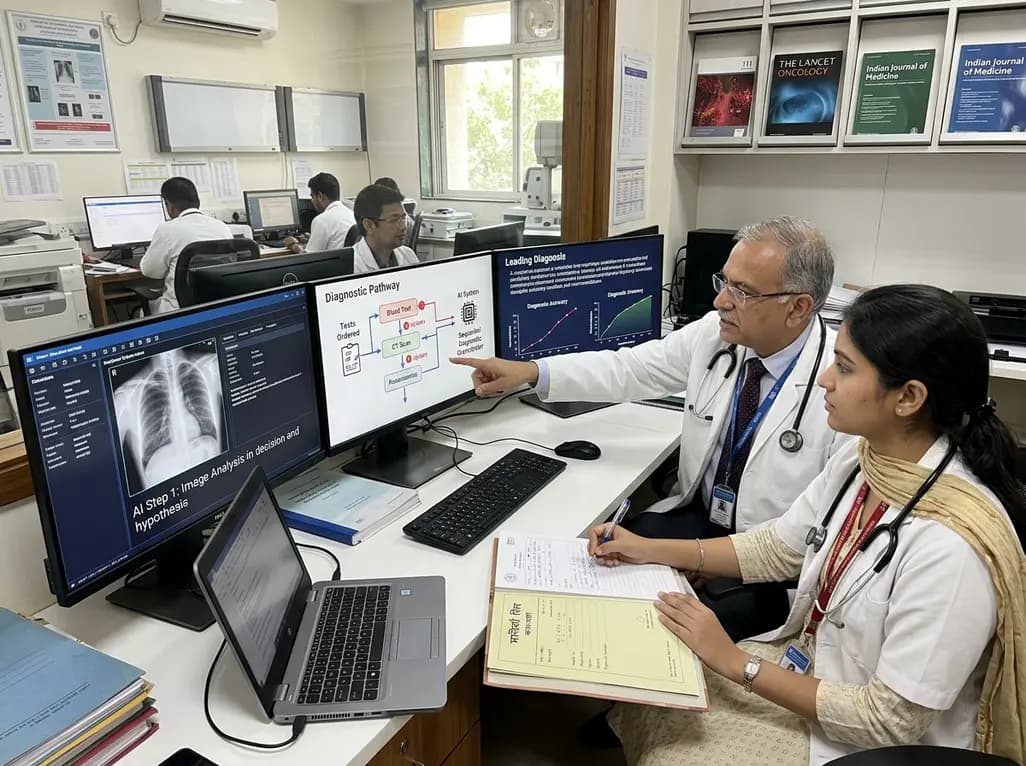
A breakthrough peer-reviewed study demonstrates that a sequential AI diagnosis system can mirror real-world clinical reasoning. By ordering stepwise tests and updating hypotheses dynamically, this multi-agent orchestrator achieved superior diagnostic accuracy while reducing investigative costs.
Today

A prenatal case highlights severe glutaric acidemia type II presenting as bilateral hyperechoic cystic kidneys at 18 weeks. Whole-exome sequencing revealed a novel homozygous ETFDH frameshift variant, demonstrating the power of rapid genetic testing in fetal renal anomalies.
Today

Review how tailored exercise programs benefit frail older patients with heart failure. Explore pathophysiological mechanisms, individualized training prescriptions, and strategies to overcome adherence barriers in clinical practice.
Yesterday

This comparative study evaluates posterior labral tears with and without glenohumeral instability, highlighting distinct demographic patterns, MRI underestimation in stable shoulders, and successful arthroscopic repair outcomes.
Yesterday

A clinical study demonstrates that early intervention with tocilizumab, either as monotherapy or bridged with corticosteroids, achieves significant proptosis reduction and resolves active inflammation in treatment-naive thyroid eye disease.
Yesterday
