

Loading, please wait...
Loading, please wait...

Mechanical thrombectomy represents the definitive standard of care for acute ischemic stroke caused by large vessel occlusion. Traditionally, neurointerventionalists prefer transfemoral access due to established catheter systems and familiar pelvic anatomy. However, transradial access thrombectomy has emerged as a promising alternative route. While interventional cardiology adopted radial puncture decades ago, neurovascular specialists have transitioned more cautiously. An updated meta-analysis and trial sequential analysis evaluated whether radial access matches the safety and efficacy of the femoral approach during urgent cerebral revascularization.
The meta-analysis compiled clinical outcomes across ten comparative studies, including one randomized controlled trial and nine observational studies. Consequently, the pooled dataset encompassed 763 transradial access cases alongside 3,527 transfemoral procedures. Interventionalists frequently explore radial arterial access to minimize catastrophic puncture-site bleeding. In addition, radial puncture facilitates earlier post-procedural ambulation and improves patient comfort. Nevertheless, neurointerventional teams require adequate evidence before adopting new vascular pathways during emergent acute stroke interventions.
Historically, catheter navigability through tortuous aortic arch anatomy created hesitation among operators. Therefore, researchers systematically analyzed procedural metrics to evaluate whether radial access compromises angiographic success. The aggregated data demonstrated that successful recanalization occurred at comparable rates between groups, with an odds ratio of 0.88. Furthermore, rates of complete recanalization showed no significant difference, yielding an odds ratio of 1.15. These findings indicate that technical reperfusion remains achievable regardless of the chosen arterial entry point. Moreover, operators successfully executed clot retrieval maneuvers across varied clinical environments. Thus, the initial procedural comparison demonstrates baseline feasibility for radial neurovascular interventions.
Timely cerebral reperfusion directly dictates neurological salvage in acute ischemic stroke. Therefore, speed remains paramount during every thrombectomy procedure. Skeptics often argue that transradial navigation introduces procedural delay due to complex subclavian tortuosity. However, the meta-analysis revealed no statistically significant disparity in puncture-to-recanalization time between radial and femoral approaches. Specifically, the mean difference was minus 1.67 minutes, confirming that radial access does not inherently delay intracranial revascularization.
Furthermore, first-pass reperfusion serves as an essential predictor of superior functional independence. The analysis demonstrated an odds ratio of 0.83 for first-pass effect, showing comparable performance across cohorts. Similarly, the mean difference in the number of device passes was 0.17, which did not reach statistical significance. Consequently, operators can retrieve intracranial thrombi effectively without excessive device manipulation through the upper extremity. In addition, crossover rates between arterial access routes demonstrated an odds ratio of 1.71. Although radial procedures slightly favored conversion to femoral access, this difference remained statistically nonsignificant. Hence, procedural efficiency appears robust when skilled neurointerventionalists execute radial access protocols.
Access-site hematomas and retroperitoneal hemorrhages represent major hazards during transfemoral interventions. Because systemic thrombolysis and aggressive anticoagulation accompany many stroke cases, bleeding risks escalate substantially. Transradial access fundamentally mitigates these risks because the radial artery rests against the distal radius bone, permitting straightforward manual compression. Consequently, the meta-analysis identified a favorable trend toward fewer access-site complications with radial entry, reporting an odds ratio of 0.70.
Moreover, systemic safety endpoints reinforced the procedural viability of the radial approach. Symptomatic intracranial hemorrhage occurred at similar frequencies between cohorts, with an odds ratio of 0.93. Therefore, changing arterial access does not increase secondary intracranial hemorrhagic transformation. Additionally, hospital length of stay remained comparable, showing a modest mean difference of minus 0.59 days. Long-term functional recovery, measured by favorable outcomes at three months, yielded an odds ratio of 0.85, confirming equivalent functional trajectory. Ultimately, safety profiles reassure interventional teams that radial access does not compromise patient outcomes. As a result, centers can safely consider radial routes for select acute stroke candidates.
Standard meta-analyses sometimes generate false-positive or false-negative conclusions due to repetitive testing on sparse cumulative data. To prevent erroneous conclusions, the investigators applied trial sequential analysis across all primary endpoints. Trial sequential analysis calculates the required information size necessary to achieve definitive statistical power. Notably, the analysis revealed that successful recanalization, puncture-to-recanalization duration, and first-pass effect did not achieve the required information size. Consequently, current clinical evidence regarding these efficacy parameters remains statistically inconclusive.
In contrast, the trial sequential analysis for access-site complications yielded decisive findings. The cumulative Z-curve crossed the futility boundary, indicating a very high probability of clinical similarity between radial and femoral techniques. Therefore, existing literature provides sufficient statistical certainty regarding access-site safety comparability. However, larger randomized clinical trials must recruit additional patients to confirm true procedural noninferiority. Meanwhile, clinicians should interpret efficacy comparisons with appropriate methodological caution. Furthermore, academic centers should support ongoing multicenter randomized trials to eliminate residual statistical uncertainty. Through robust clinical trials, the neurointerventional community will ultimately determine optimal access strategies for diverse stroke populations.
Despite promising clinical data, practical barriers currently hinder widespread radial adoption in neurointervention. First, smaller radial artery diameters restrict sheath caliber, occasionally precluding the deployment of large-bore aspiration catheters. Consequently, manufacturers must design dedicated low-profile, hydrophilic-coated systems tailored for upper extremity neurovascular access. In addition, severe radial artery spasms can disrupt catheter advancement, necessitating prophylactic intra-arterial cocktail infusions containing verapamil and nitroglycerin.
Furthermore, severe bovine arch variations or type III aortic arches present steep technical challenges during left common carotid catheterization. Therefore, operators must develop advanced wire-handling techniques and select specialized curved guiding catheters. When interventionalists encounter severe peripheral vascular disease or hostile femoral anatomy, radial access provides an invaluable alternative. Conversely, unselected usage without proper training may increase procedural times during time-sensitive stroke rescues. Thus, institutional stroke teams must implement structured radial training programs for fellows and junior consultants. By mastering anatomical nuances, operators can minimize vascular trauma and expand rescue access options.
The ongoing evolution of neuroendovascular devices will likely reshape arterial access paradigms over the coming decade. As radial-specific guide catheters, long sheaths, and dedicated closure tools enter routine practice, procedural success rates will steadily climb. Moreover, centers in developing nations and tertiary referral hubs can leverage radial access to shorten post-procedure monitoring demands. Because radial access eliminates prolonged bed rest, patients can ambulate sooner, reducing nursing workload in crowded intensive care units.
Nevertheless, transfemoral access retains its position as the primary default approach for emergency mechanical thrombectomy. Until definitive randomized trial data establish clear superiority or equivalence, clinicians should maintain flexibility between both techniques. Interventionalists should choose radial access selectively, particularly when encountering severe aortoiliac occlusion, morbid obesity, or severe groin hematomas. Ultimately, proficiency in both access techniques empowers stroke teams to deliver rapid, personalized revascularization for every patient.
Transradial access significantly reduces puncture-site bleeding and catastrophic retroperitoneal hematomas compared to transfemoral puncture. Furthermore, it enables immediate post-procedural patient mobilization and reduces required nursing supervision. This approach proves especially advantageous for patients with hostile aortoiliac anatomy, extreme femoral tortuosity, severe pelvic atherosclerotic disease, or severe morbid obesity.
No, the latest meta-analysis demonstrated no statistically significant difference in puncture-to-recanalization time between transradial and transfemoral access. Skilled neurointerventional operators achieve rapid vessel recanalization through the radial route without introducing substantial delay. However, appropriate operator training and catheter familiarity remain vital to prevent anatomical navigation delays.
Trial sequential analysis indicated that the total accumulated patient sample size did not reach the calculated required information size for efficacy metrics like recanalization rates. Consequently, while current outcomes appear clinically comparable, the statistical power remains inadequate to definitively exclude minor differences without further large randomized controlled clinical trials.
Disclaimer: This content is for informational and educational purposes only and does not constitute medical advice, diagnosis, or treatment. Healthcare professionals should exercise their independent clinical judgment when making treatment decisions. Institutional protocols and clinical context should guide procedural choices. Refer to the latest local and national guidelines for clinical practice.
References

Read summarized clinical updates, watch expert medical content, and earn CME certifications right from your smartphone.
Open your smartphone camera to scan and install.





An updated meta-analysis and trial sequential analysis compare transradial and transfemoral access routes for mechanical thrombectomy in acute ischemic stroke. Findings demonstrate comparable recanalization rates and safety profiles, though definitive efficacy data require larger randomized trials.
Today

Review how tailored exercise programs benefit frail older patients with heart failure. Explore pathophysiological mechanisms, individualized training prescriptions, and strategies to overcome adherence barriers in clinical practice.
Today
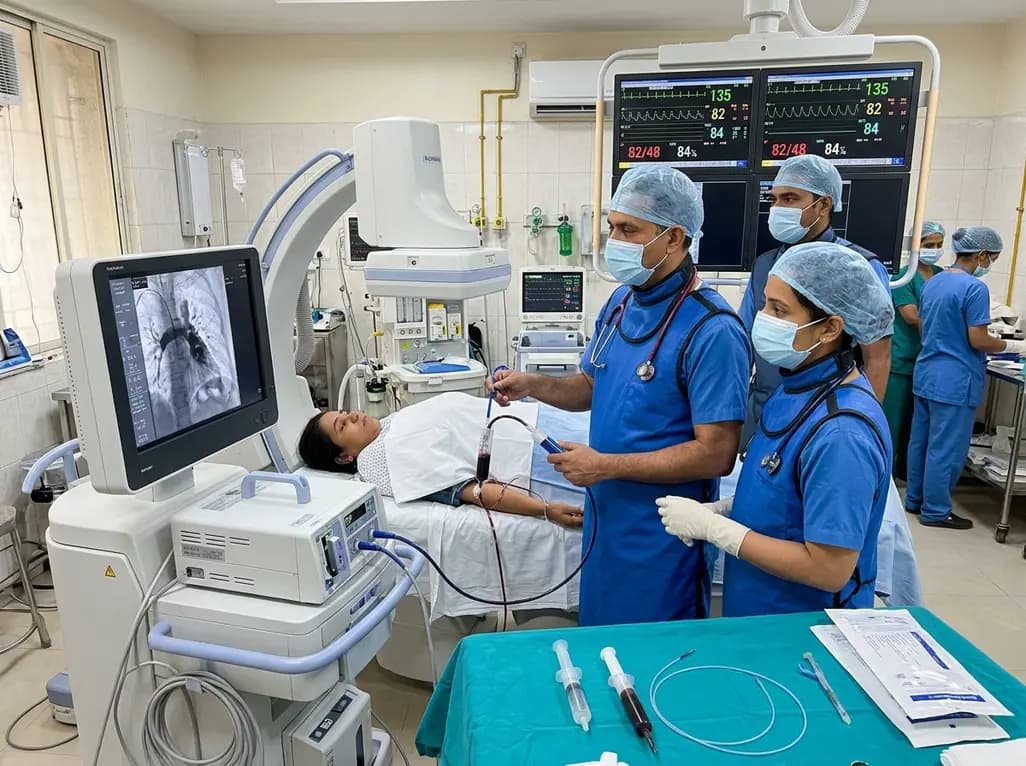
In high-risk pulmonary embolism complicated by severe anemia and active uterine bleeding, systemic thrombolysis is contraindicated. Large-bore aspiration thrombectomy provides rapid hemodynamic rescue without fibrinolysis, supported by inferior vena cava filter placement and multidisciplinary critical care.
Today

A cross-sectional study in Zanzibar reveals that 46.5% of adults with type 2 diabetes experience multidomain autonomic dysfunction on the COMPASS-31 tool, primarily orthostatic intolerance, while 45.9% exhibit cardiovascular autonomic neuropathy, highlighting the urgent need for structured clinical screening.
Today

This comparative study evaluates posterior labral tears with and without glenohumeral instability, highlighting distinct demographic patterns, MRI underestimation in stable shoulders, and successful arthroscopic repair outcomes.
Today

A recent case-control study reveals that urinary clusterin provides superior diagnostic performance for early diabetic kidney disease detection in pediatric type 1 diabetes mellitus, identifying tubular damage before conventional microalbuminuria occurs.
Today
