.webp&w=384&q=75)

Loading, please wait...
Loading, please wait...
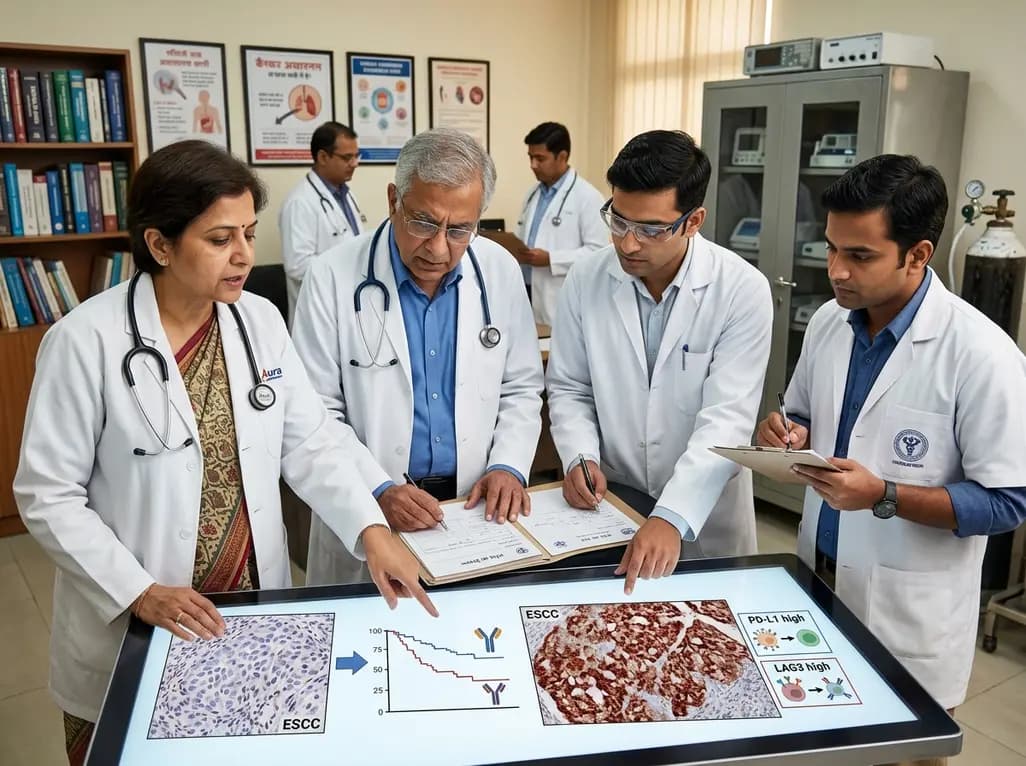
Esophageal squamous cell carcinoma (ESCC) remains a formidable challenge within the Indian oncology landscape, where late-stage diagnosis is frequently the norm rather than the exception. For patients who have already progressed on first-line platinum-based chemotherapy, the search for effective second-line therapeutic interventions is critical. Recent advancements have focused on the potential of bispecific antibodies, which aim to target multiple immune checkpoints simultaneously to overcome resistance mechanisms. The study under review examines the utility of Tobemstomig in Advanced ESCC and lomvastomig compared to the established standard of care, nivolumab. While nivolumab has significantly improved outcomes in this setting, clinicians are eager to identify agents that might provide even greater durability of response. Understanding the nuances of this Phase 2 trial is essential for Indian gastroenterologists and oncologists who manage a high volume of these aggressive malignancies. This article delves into survival data and biomarker signatures defining the future of personalized immunotherapy in esophageal cancer management.
The biological rationale for using bispecific antibodies like tobemstomig and lomvastomig lies in the complexity of the tumor microenvironment. T-cell exhaustion is a hallmark of advanced solid tumors, characterized by the co-expression of several inhibitory receptors beyond just PD-1. While nivolumab effectively blocks the PD-1/PD-L1 axis, it may not address other pathways that contribute to immune evasion. Tobemstomig is designed to simultaneously block PD-1 and LAG-3, a combination that has shown promise in other malignancies like melanoma. By targeting LAG-3, tobemstomig aims to reinvigorate T-cells that have become unresponsive despite PD-1 inhibition. On the other hand, lomvastomig targets the TIM-3 receptor alongside PD-1. The theory suggests that dual blockade could potentially yield superior antitumor activity compared to monotherapy. However, the translation from preclinical synergy to clinical efficacy in ESCC requires rigorous validation to determine if these multi-target agents truly offer a therapeutic advantage over current anti-PD-1 monotherapies in the clinical setting for advanced esophageal cancers.
This Phase 2 study was an active-controlled, multicenter trial that enrolled 190 patients with unresectable advanced or recurrent ESCC. These participants were specifically checkpoint inhibitor (CPI)-naïve and had either become refractory or intolerant to a prior line of chemotherapy. The researchers utilized a 1:1:1 randomization protocol to assign patients into three distinct treatment arms. The first arm received lomvastomig at 2100 mg every two weeks, the second arm was treated with tobemstomig at the same dosage, and the third arm received the control drug, nivolumab, at 240 mg every two weeks. The primary objective of the investigation was to determine overall survival (OS), the gold standard for clinical benefit in oncology. Secondary endpoints included objective response rates, progression-free survival, safety, and pharmacodynamic changes. Notably, the lomvastomig arm was discontinued early in the study, reflecting the importance of continuous efficacy monitoring. This methodological framework provides a solid foundation for interpreting the subsequent survival and biomarker results across the diverse patient cohorts.
The primary results of the trial indicated that neither of the bispecific antibodies managed to surpass the survival benefits provided by nivolumab in the overall population. The median overall survival was highest in the nivolumab arm at 8.1 months, which aligns with historical data for second-line immunotherapy. In contrast, patients in the tobemstomig arm experienced a median OS of 6.7 months, while those in the discontinued lomvastomig arm had a median OS of only 4.8 months. When looking at objective response rates, the figures were relatively similar between tobemstomig at 9.8% and nivolumab at 8.6%, while lomvastomig lagged significantly at 3.7%. These findings suggest that for an unselected patient population, shifting from standard PD-1 blockade to these specific bispecific antibodies may not be immediately advantageous. The early termination of the lomvastomig group further underscores that not all checkpoint combinations yield the desired synergistic effect in ESCC. For clinicians, these survival statistics reinforce nivolumab’s status as a robust second-line option for general populations.
A critical takeaway emerged during the exploratory biomarker analysis, particularly regarding the efficacy of Tobemstomig in Advanced ESCC subgroups. While the overall population did not show improved survival, patients with high PD-L1 expression, defined as a Combined Positive Score (CPS) of 10 or greater, showed a more favorable response. Furthermore, those who exhibited both high PD-L1 and high LAG-3 expression appeared to benefit most significantly from the dual blockade. In these specific cohorts, tobemstomig was associated with prolonged survival compared to the broader group, suggesting that target receptor expression is a prerequisite for the drug's efficacy. This finding is paramount for the evolving landscape of precision medicine in India, where biomarker testing is becoming integrated into oncology workflows. It suggests that a PD-L1-guided treatment selection could allow certain ESCC patients to achieve better outcomes with tobemstomig. Identifying these responder profiles is essential for refining the use of bispecific antibodies and ensuring that patients receive the most appropriate immunotherapy.
Safety remains a concern when targeting multiple immune pathways, but the study found that the adverse event profiles for both lomvastomig and tobemstomig were manageable and consistent with known immune-mediated side effects. There were no unexpected safety signals that would preclude their use, provided patients are monitored via standard protocols. In conclusion, while the trial did not achieve superiority over nivolumab in the general ESCC population, it provided invaluable data on LAG-3 and PD-L1 as predictive biomarkers. For the Indian medical community, this reinforces the necessity of molecular profiling before deciding on second-line therapies. While nivolumab remains a foundational treatment, tobemstomig may emerge as a viable alternative for a subset of patients with high checkpoint expression. Future research will likely focus on refining selection criteria and exploring these bispecific antibodies in combination with chemotherapy to enhance survival. This progress represents an important step toward more nuanced and effective management of advanced esophageal squamous cell carcinoma in daily clinical practice.
The LAG-3 pathway represents a key mechanism of T-cell exhaustion that often works alongside PD-1 to suppress the immune response against tumors. In esophageal squamous cell carcinoma, co-expression of LAG-3 and PD-1 on tumor-infiltrating lymphocytes suggests a state of deep immune suppression. Targeting both pathways with a bispecific antibody like tobemstomig aims to reverse this exhaustion more effectively than monotherapy, particularly in patients where LAG-3 expression is prominently high.
PD-L1 Combined Positive Score (CPS) testing is vital because the Phase 2 study demonstrated that tobemstomig’s survival benefits were largely confined to patients with a CPS of 10 or greater. In the overall, unselected population, the drug did not outperform nivolumab. However, for those with high PD-L1 expression, the dual blockade of PD-1 and LAG-3 showed promise. This underscores the necessity of biomarker-guided treatment to ensure patient selection is optimized.
Based on the study results, the safety profiles of the bispecific antibodies lomvastomig and tobemstomig remained consistent with the established safety records of existing immune checkpoint inhibitors like nivolumab. The adverse events observed were generally manageable and related to immune-mediated mechanisms common in this drug class. While targeting two pathways could theoretically increase toxicity, the trial did not find unmanageable or new safety risks, suggesting these bispecific agents are relatively safe for clinical use.
Disclaimer: This content is for informational and educational purposes only and does not constitute medical advice or a professional relationship. Always seek the advice of a physician or other qualified health provider with any questions regarding a medical condition. Refer to the latest local and national guidelines for clinical practice.
References
Wyrwicz L et al. A Randomized, Nivolumab-controlled, Phase 2 and Biomarker Study of Lomvastomig and Tobemstomig in Advanced or Metastatic Squamous Cell Carcinoma of the Esophagus. Clin Cancer Res. 2026 Jul 13. doi: 10.1158/1078-0432.CCR-26-0851. PMID: 42440370.
Kato K et al. Nivolumab versus chemotherapy in patients with advanced oesophageal squamous cell carcinoma refractory or intolerant to previous chemotherapy (ATTRACTION-3): a multicentre, randomised, open-label, phase 3 trial. Lancet Oncol. 2019;20(11):1506-1517.
Doki Y et al. Nivolumab Combination Therapy in Advanced Esophageal Squamous-Cell Carcinoma. N Engl J Med. 2022;386(5):449-462.

Read summarized clinical updates, watch expert medical content, and earn CME certifications right from your smartphone.
Open your smartphone camera to scan and install.





This Phase 2 study compared bispecific antibodies tobemstomig and lomvastomig with nivolumab in advanced ESCC. While overall results did not favor the bispecifics, tobemstomig showed significant survival benefits in the PD-L1-high and LAG3-high patient subgroups, highlighting a biomarker-driven approach.
3 months ago

As monsoon seasons elevate arboviral disease threats, Tamil Nadu has initiated an ICMR-monitored evaluation of the tetravalent dengue vaccine in Tenkasi district. Clinicians emphasize clinical monitoring, public prevention, and high-quality early pediatric care to reduce disease morbidity across endemic regions.
Today

Leucine Rich Bio has introduced South Asia's first comprehensive vaginal microbiome test, BugSpeaks. By profiling microbial dysbiosis, pathogens, and antimicrobial resistance, this next-generation diagnostic platform provides clinicians with deeper insights into recurrent infections, fertility, and reproductive health.
Today

Review how tailored exercise programs benefit frail older patients with heart failure. Explore pathophysiological mechanisms, individualized training prescriptions, and strategies to overcome adherence barriers in clinical practice.
Today

This comparative study evaluates posterior labral tears with and without glenohumeral instability, highlighting distinct demographic patterns, MRI underestimation in stable shoulders, and successful arthroscopic repair outcomes.
Today

A clinical study demonstrates that early intervention with tocilizumab, either as monotherapy or bridged with corticosteroids, achieves significant proptosis reduction and resolves active inflammation in treatment-naive thyroid eye disease.
Today
