.webp&w=384&q=75)

Loading, please wait...
Loading, please wait...

Cognitive impairment represents one of the most debilitating comorbidities in individuals living with temporal lobe epilepsy. Although clinicians frequently link memory decline to hippocampal sclerosis, sleep alterations also play an indispensable role. Sleep serves as a vital restorative window for neural consolidation. Specifically, non-rapid eye movement sleep allows the brain to stabilize freshly encoded daytime information. During healthy sleep cycles, distinct oscillatory rhythms interact across the cortex to facilitate long-term memory formation. However, chronic epileptic activity significantly alters these coordinated electrophysiological patterns. Consequently, many patients report severe forgetfulness and learning difficulties despite achieving satisfactory seizure control. Researchers now recognize that localized seizures can induce widespread functional disturbances throughout distant brain networks. Therefore, studying microstructural sleep oscillations offers critical insights into epilepsy-related cognitive decline. Ultimately, addressing sleep disruption may uncover novel diagnostic and therapeutic avenues for comprehensive patient care.
Memory consolidation during non-rapid eye movement sleep depends entirely on precise temporal coupling between neural oscillations. Neocortical slow waves represent synchronized fluctuations between hyperpolarized down-states and depolarized up-states. Concurrently, the thalamic reticular nucleus generates sleep spindles, which manifest as transient bursts between 10 and 16 Hz. Under physiological conditions, spindles nest directly into the excitable peaks of slow-wave up-states. Furthermore, this fine alignment coordinates hippocampal sharp-wave ripples with cortical networks, transferring temporary memories into long-term neocortical storage. When this microstructural coordination breaks down, synaptic plasticity diminishes dramatically. As a result, newly acquired declarative memories fail to undergo proper stabilization. In addition, temporal desynchronization hampers the brain's capacity to prune unnecessary synapses. Thus, intact spindle-slow wave coupling remains a fundamental prerequisite for daytime cognitive efficacy. Without this precise nocturnal interplay, cortical circuits cannot sustain robust information retention. Consequently, neuroscientists consider this oscillatory harmony a cornerstone of human memory processing.
To examine these oscillatory dynamics, clinical investigators conducted a meticulous observational study at a specialized epilepsy center. The cohort comprised 20 adult patients with unilateral drug-resistant temporal lobe epilepsy and 20 age- and sex-matched healthy controls. Notably, ten patients presented with left temporal epileptic generators, whereas ten exhibited right temporal foci. In addition, researchers recorded full-night sleep using combined high-density electroencephalography and standard polysomnography. Subsequently, automated algorithms detected slow waves between 0.5 and 4 Hz alongside sleep spindles between 10 and 16 Hz. Specifically, the team analyzed events across all N2 and N3 epochs with validated computational tools. Furthermore, they defined coupling as direct temporal overlap between individual spindle occurrences and slow-wave cycles. The researchers also differentiated slow spindles from fast spindles to assess frequency-dependent coupling characteristics. Consequently, through this comprehensive methodology, the investigators systematically quantified global and focal neurophysiological patterns across the entire cerebrum.
The investigation yielded striking neurophysiological evidence regarding oscillatory uncoupling in patient cohorts. Specifically, coupled spindle-slow wave rates decreased significantly in patients with temporal lobe epilepsy compared to healthy individuals. Patients exhibited a median rate of 0.18 coupled events per minute, whereas controls demonstrated 0.35 events per minute. Furthermore, this impairment involved both fast spindle and slow spindle subtypes. Interestingly, researchers discovered that this decoupling did not remain confined to the affected temporal lobe. Instead, the contralateral healthy hemisphere showed an identical reduction in coupled oscillatory rates. Moreover, the effect size proved notably stronger during early sleep cycles than late sleep epochs. Consequently, these findings confirm that a unilateral epileptic focus precipitates bilateral, widespread cortical desynchronization during crucial consolidation periods.
These empirical findings reshape our clinical understanding of cognitive dysfunction in chronic epilepsy syndromes. Clinicians historically viewed memory impairment as a localized consequence of unilateral hippocampal damage. However, the presence of widespread oscillatory decoupling reveals a diffuse network pathology. Because spindle-slow wave coupling directly governs synaptic plastic changes, pervasive uncoupling hinders memory consolidation across the entire neocortex. In addition, the marked disruption during early sleep cycles disproportionately affects initial memory stabilization. Patients therefore experience significant difficulty retaining newly learned information throughout their daily lives. As a result, cognitive deficits in temporal lobe epilepsy reflect global circuit failure rather than isolated focal destruction. Clinicians must therefore consider systemic network health when evaluating neurocognitive symptoms in their patients.
Identifying widespread spindle decoupling highlights exciting possibilities for therapeutic innovation in refractory epilepsy management. Conventional antiseizure pharmacotherapies focus exclusively on suppressing hypersynchronous paroxysmal discharges. Unfortunately, some medications disrupt physiological sleep architecture and inadvertently aggravate cognitive complaints. Therefore, future treatment paradigms should incorporate therapies that actively preserve or restore sleep microstructural integrity. For instance, non-invasive closed-loop acoustic stimulation can enhance slow-wave amplitude and phase-locked spindle activity. Similarly, targeted transcranial electrical stimulation presents a promising strategy to synchronize thalamocortical oscillations. Moreover, optimizing sleep hygiene and correcting coexisting sleep apnea may substantially improve oscillatory coupling. In summary, monitoring sleep architecture provides a practical biomarker for tracking cognitive risk. By protecting nocturnal oscillatory synchrony, neurologists can potentially prevent long-term cognitive deterioration in vulnerable epilepsy patients.
Memory impairment stems from hippocampal structural pathology, recurrent seizure activity, and disrupted sleep-dependent neural consolidation. Specifically, desynchronization between cortical slow waves and thalamocortical sleep spindles prevents effective information transfer from the hippocampus to neocortical storage sites, thereby eroding synaptic plasticity and memory stabilization.
Early non-rapid eye movement sleep exhibits the highest homeostatic slow-wave pressure, reflecting intense synaptic consolidation demands. Consequently, physiological coupling between thalamocortical spindles and cortical slow oscillations peaks during these initial cycles. In epilepsy, pathological network disruption hits this critical window hardest, leading to pronounced early decoupling.
Emerging neurostimulation techniques, such as phase-locked auditory stimulation and transcranial electrical stimulation, actively enhance spindle-slow wave synchrony. While currently investigational, these non-invasive neuromodulatory therapies show promise in re-establishing physiological electrophysiological rhythms. Therefore, they may eventually improve memory retention alongside optimized antiseizure medication regimens in refractory patients.
Disclaimer: This content is for informational and educational purposes only and is not intended to serve as medical advice, diagnosis, or treatment. Healthcare professionals should exercise their clinical judgment and consult official prescribing information, peer-reviewed literature, and professional guidelines when making clinical decisions. Readers should never disregard professional medical advice or delay seeking it because of something they have read here. Refer to the latest local and national guidelines for clinical practice.
References

Read summarized clinical updates, watch expert medical content, and earn CME certifications right from your smartphone.
Open your smartphone camera to scan and install.





A recent clinical study demonstrates that temporal lobe epilepsy causes widespread decoupling of sleep spindles and slow waves across both cerebral hemispheres. This global disruption during early NREM sleep provides a compelling neurophysiological mechanism for chronic memory deficits in affected patients.
Today

A North Texas pilot study reveals that combining virtual physician consultations with in-person house calls safely manages adult pneumonia. By utilizing CRB-65 severity scores, clinicians effectively triaged patients, providing home-based recovery while directing higher-risk individuals to emergency care.
Today

A quasi-experimental study demonstrates that culturally tailored educational interventions significantly boost HPV knowledge and vaccination intentions. These findings provide actionable strategies for healthcare providers in India to overcome vaccine hesitancy and advance cervical cancer prevention.
Today

A comprehensive meta-analysis evaluates the association between Body Mass Index and outcomes following abdominal aortic aneurysm repair. Discover how overweight and obesity correlate with lower mortality while underweight status confers heightened risk, challenging conventional preoperative risk stratification.
Today

The SOLARIO trial shows that a short course (≤7 days) of systemic antibiotic therapy is noninferior to long courses (≥4 weeks) in orthopedic infections treated with local antibiotic carriers, with significantly fewer adverse events.
Today
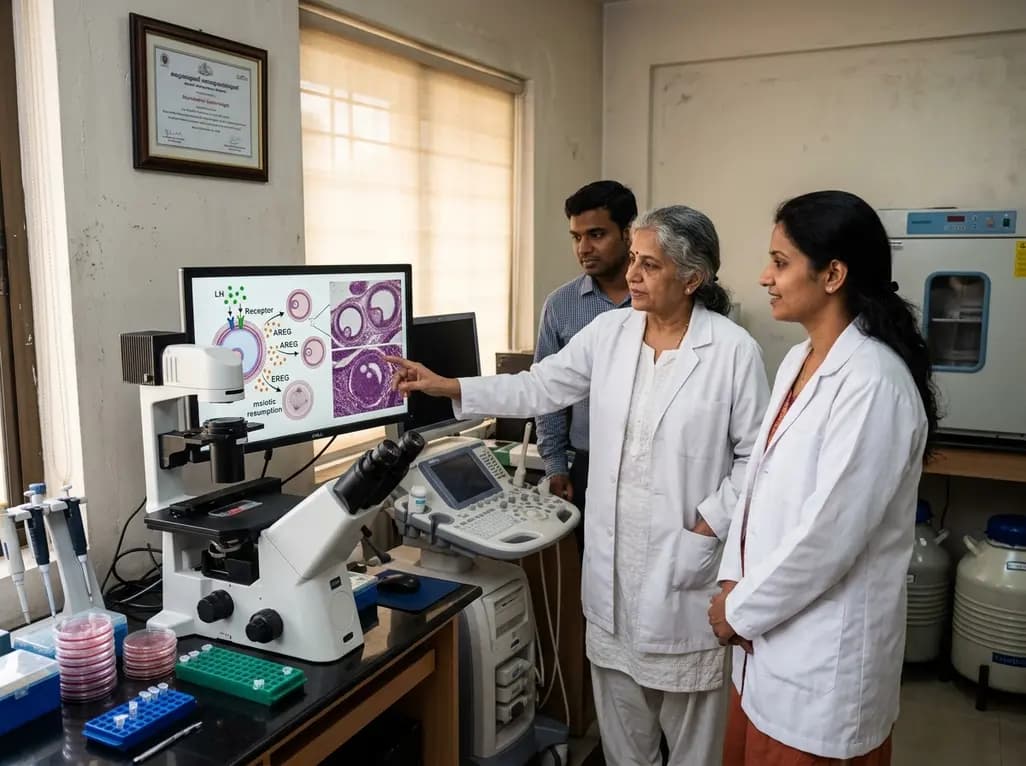
New research reveals that preovulatory follicles communicate via LH-induced paracrine signaling. Diffusible EGF ligands epiregulin and amphiregulin coordinate oocyte meiotic resumption across neighboring follicles, challenging traditional concepts of follicular autonomy.
Today
