.webp&w=384&q=75)

Loading, please wait...
Loading, please wait...
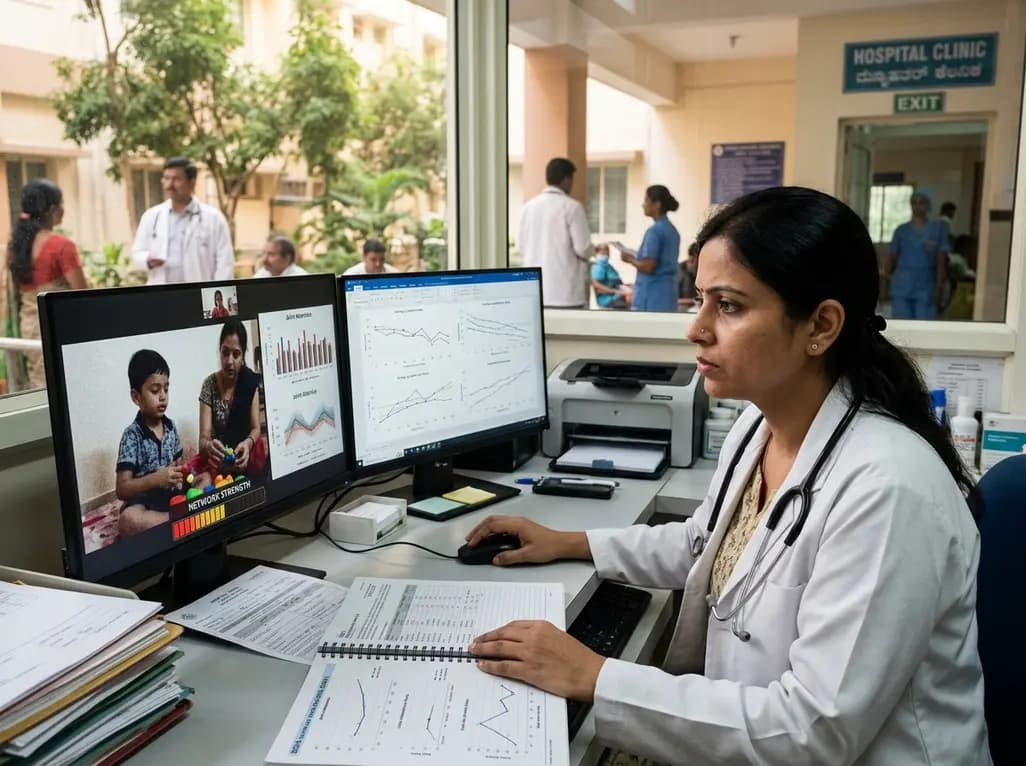
Modern pediatric practice increasingly relies on remote digital assessments to bridge geographic gaps and reduce diagnostic waitlists. Performing a comprehensive telehealth autism evaluation allows developmental specialists to observe social interactions within a child's natural home environment. However, real-world telecommunication links introduce unexpected signal interruptions, packet loss, and video freezing that can compromise clinical observations.
Teleconsultation platforms deliver high-definition video feeds under ideal conditions, but home broadband and mobile cellular networks fluctuate constantly. To systematically investigate these issues, researchers constructed an optical-fiber testbed capable of simulating realistic digital impairments. Specifically, the investigators introduced controlled packet loss and wireless radio attenuation to recreate connection problems that clinicians encounter in everyday practice.
Through this setup, the research team derived four discrete freeze patterns. These patterns featured one-second video pauses occurring at intervals of every 16.7, 11.1, 8.3, or 5.0 seconds. The researchers subsequently applied these precise video degradations to recorded Brief Observation of Symptoms of Autism sessions across ten pediatric subjects. Consequently, four blinded clinical psychologists reviewed forty standardized video clips to evaluate scoring integrity under compromised transmission speeds.
Statistical analyses integrated Fisher exact tests with Benjamini-Hochberg false discovery corrections, Spearman rank correlations, and logistic regression with Bonferroni adjustments. Furthermore, these rigorous tests determined how frame freezes affect clinician certainty during complex behavioural observations. Understanding these specific technical thresholds enables pediatricians and child psychiatrists to differentiate authentic developmental symptoms from video-induced transmission artifacts during remote encounters.
Clinicians often assume that streaming video fails abruptly during poor connectivity. In contrast, experimental observations revealed that diagnostic feed quality degraded in a predictable, dose-dependent manner rather than suffering immediate total collapse. Network engineers monitored Received Signal Strength Indicator values alongside real-time data loss to identify the exact tipping points for streaming failure.
Specifically, connection stability dropped sharply when signal attenuation pushed wireless strength below -70 dBm. Similarly, when transmission dropped above approximately 0.04% of total data packets, the video feed experienced severe visual stuttering. Under these compromised parameters, screen freezes escalated dramatically from mild pauses every 16.7 seconds to severe disruptions every 5.0 seconds. Therefore, subtle shifts in Wi-Fi signal quality exert disproportionately large effects on video fluidity.
In addition, the severity of stream disruption directly correlated with the proportion of clinical items that observers could not score reliably. The researchers identified a strong negative correlation between stream quality and unscored items, with a Spearman coefficient approaching -0.58. Consequently, healthcare providers must understand that crossing these technical boundaries directly degrades observational clarity, requiring active monitoring before diagnostic sessions begin.
Not all developmental diagnostic markers suffer equally when video transmission lags. Specifically, brief and rapid nonverbal cues showed the highest sensitivity to screen freezing. Clinicians evaluating the degraded recordings reported substantial hurdles when assessing subtle eye movements, vocal intonation, and fleeting facial reactions that require uninterrupted visual synchrony.
Most notably, four specific behavioral metrics were four to nine times more likely to be coded as unscorable during degraded streams. These sensitive metrics included Spontaneous Joint Attention, Integration of Gaze and Other Behaviors, Immediate Echolalia, and Stereotyped or Idiosyncratic Language. Because joint attention involves swift coordinated transitions between objects and communicative partners, a single-second video freeze easily obscures the entire interaction.
Similarly, evaluating verbal repetitions requires pristine audio and video alignment to distinguish genuine echolalia from transmission echoes or robotic playback delays. When packets dropped frequently, evaluators marked these behaviors as uninterpretable rather than risking erroneous clinical judgements. In contrast, prolonged and broad motor behaviors, such as whole-body pacing or repetitive hand flapping, remained identifiable even during periodic stream stuttering. Therefore, doctors must exercise extreme caution when interpreting micro-behaviors under unstable visual streams.
Despite the vulnerability of rapid micro-behaviors, the Brief Observation of Symptoms of Autism demonstrated remarkable diagnostic durability. Although individual time-sensitive items frequently became unscorable under severe disruption, the overall diagnostic impression across complete modules remained remarkably steady. Importantly, no single behavioral item reached statistically significant scoring deviation after applying rigorous multiple-comparison corrections.
Furthermore, evaluators maintained substantial inter-rater consistency throughout mild to moderate signal degradation. The study demonstrated an intraclass correlation coefficient of 0.93 across blinded scorers, alongside an impressive Cohen's kappa coefficient of 0.76. These metrics confirm that experienced practitioners reliably reach shared clinical impressions despite encountering occasional visual stutters. Hence, moderate packet degradation does not automatically invalidate standardized developmental assessments.
Consequently, the Brief Observation of Symptoms of Autism remains a robust first-line screening and diagnostic instrument for remote evaluations. Clinicians aggregate behavioral observations across varied social activities throughout the clinical protocol, mitigating the loss of fleeting cues during brief visual freezes. In addition, standard diagnostic algorithms rely on broad symptom patterns rather than isolated moments. Thus, the instrument provides sufficient diagnostic redundancy, protecting clinical conclusions against moderate broadband instability in real-world pediatric care.
Healthcare providers conducting remote developmental assessments must implement practical pre-session technical protocols to protect diagnostic precision. First, practitioners should actively verify that patient families maintain an internet connection superior to the -70 dBm threshold and packet loss below 0.04%. When possible, advising families to use hardwired Ethernet connections or position themselves close to the home router drastically improves stability.
In addition, clinical teams should consider hybrid or recorded submission models when live connections remain inherently unstable. For example, asking caregivers to upload high-definition video recordings of unstructured home play provides pristine footage for delicate social communication metrics. Clinicians can then review rapid joint attention and gaze shifts asynchronously while using live teleconsultation for parent interviews and history gathering.
Moreover, clinicians must remain vigilant regarding item-level vulnerabilities during live teleconsultation. If network drops occur during sensitive communicative presses, evaluators should re-administer that specific behavioral probe once the connection stabilizes. Furthermore, documenting stream quality in the clinical record ensures transparent diagnostic governance. Ultimately, proactive technical preparation and heightened clinical awareness safeguard diagnostic confidence, expanding equitable developmental healthcare across underserved and rural populations.
Packet loss creates periodic screen freezes that disrupt real-time behavioral observation. When packet loss exceeds 0.04%, freeze frequency accelerates substantially, causing evaluators to miss brief behavioral cues. While overall clinical scores often remain stable, individual rapid micro-behaviors become difficult or impossible to evaluate accurately.
Time-sensitive items that require precise auditory-visual coordination show the greatest vulnerability. Specifically, Spontaneous Joint Attention, Integration of Gaze and Other Behaviors, Immediate Echolalia, and Stereotyped Language are four to nine times more likely to be coded unscorable because one-second visual interruptions obscure swift, fleeting communicative responses.
Clinicians should ensure connection signal strength stays stronger than -70 dBm and packet loss remains under 0.04%. Utilizing hardwired Ethernet cables or positioning devices near routers avoids signal attenuation. When bandwidth falls below these standards, evaluators should request recorded video uploads to preserve diagnostic integrity.
Disclaimer: This content is for informational and educational purposes only, and should not be taken as professional medical advice. Healthcare professionals should rely on their clinical judgment, institutional protocols, and official prescribing information when making diagnostic and treatment decisions. Refer to the latest local and national guidelines for clinical practice.
References

Read summarized clinical updates, watch expert medical content, and earn CME certifications right from your smartphone.
Open your smartphone camera to scan and install.





Recent clinical data reveal how network degradation affects telehealth autism evaluations using BOSA. While overall diagnostic scoring remains resilient under moderate latency, time-sensitive metrics like joint attention and gaze integration become vulnerable below -70 dBm RSSI and above 0.04% packet loss.
last month

Novel diimide and hydrazone scaffolds, particularly compound #C4, synergistically reactivate latent HIV-1 when combined with JQ1 or PKC activators. Demonstrating donor-matched proviral transcription ex vivo and non-canonical signaling, these findings advance shock and kill strategies toward reservoir eradication.
Today

A cross-sectional study reveals that maternal RSV vaccination coverage reached only 43.7% in Argentina, with maternal vaccine knowledge being the sole independent predictor of uptake. Clinicians play a crucial role in eliminating informational and structural barriers to optimize infant health.
Today

Review how tailored exercise programs benefit frail older patients with heart failure. Explore pathophysiological mechanisms, individualized training prescriptions, and strategies to overcome adherence barriers in clinical practice.
Yesterday

This comparative study evaluates posterior labral tears with and without glenohumeral instability, highlighting distinct demographic patterns, MRI underestimation in stable shoulders, and successful arthroscopic repair outcomes.
Yesterday

A clinical study demonstrates that early intervention with tocilizumab, either as monotherapy or bridged with corticosteroids, achieves significant proptosis reduction and resolves active inflammation in treatment-naive thyroid eye disease.
Yesterday
