.webp&w=384&q=75)

Loading, please wait...
Loading, please wait...
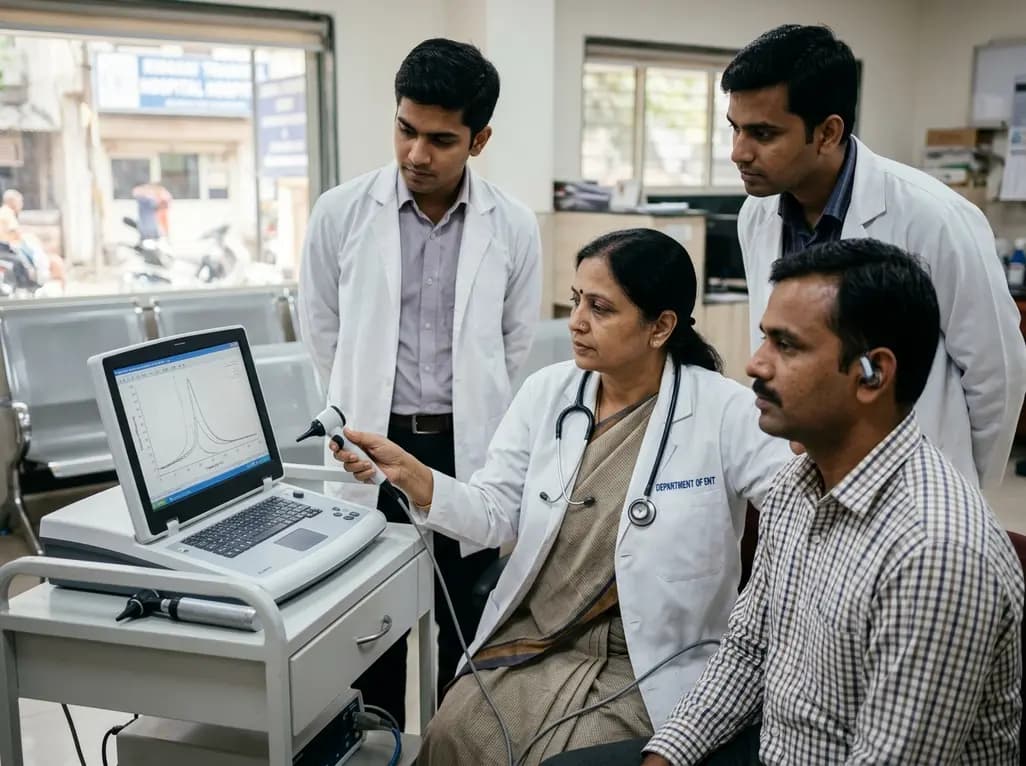
Conductive hearing loss stemming from ossicular pathologies represents a frequent diagnostic puzzle for otolaryngologists. While clinical evaluations typically involve pure-tone audiometry and acoustic immittance, distinguishing stapedial fixation from ossicular discontinuity often proves challenging. A groundbreaking clinical study demonstrates that sweep frequency impedance otosclerosis diagnostic protocols provide unprecedented accuracy in characterizing middle ear stiffness. This non-invasive diagnostic instrument measures dynamic sound pressure modifications across a continuous frequency sweep. Consequently, clinicians can evaluate ossicular chain mechanics before undertaking exploratory tympanotomy or stapes reconstruction.
Accurate identification of stapedial ankylosis remains crucial for surgical planning in otology. Otolaryngologists frequently encounter patients presenting with normal tympanic membranes alongside substantial conductive hearing impairment. Conventional diagnostic batteries incorporate 226-Hz tympanometry, bone-conduction thresholds, and high-resolution computed tomography. However, standard tympanometry frequently yields false-negative normal type A curves in early stapedial fixation. Furthermore, computed tomography scans can miss subtle bony demineralization around the fissula ante fenestram. This diagnostic uncertainty complicates surgical counseling and patient selection. Therefore, investigators at Kanazawa University Hospital evaluated sweep frequency impedance technology to address these longstanding diagnostic limitations. Their retrospective cohort analysis assessed thirty-seven surgically confirmed ears, including twenty-two otosclerosis cases and fifteen ossicular chain discontinuities. Notably, sweep frequency impedance testing achieved an impressive correct diagnosis rate of 0.91. In contrast, the classic Carhart notch attained a diagnostic accuracy of only 0.73. Furthermore, conventional tympanometry and computed tomography demineralization imaging demonstrated an accuracy rate of just 0.459. These results highlight a dramatic diagnostic gap between legacy tests and dynamic impedance sweeps. Consequently, adopting advanced impedance measurements could prevent diagnostic delays and reduce misdirected surgical interventions across clinical centers.
The sweep frequency impedance meter operates on foundational acoustic principles of middle ear biomechanics. Unlike standard single-frequency tympanometry, this system delivers an acoustic probe tone that sweeps smoothly across a wide frequency spectrum. Simultaneously, the system monitors dynamic acoustic impedance and sound pressure level alterations within the external auditory canal. Pathological processes that stiffen the ossicular chain alter the resonant behavior of the middle ear apparatus. Specifically, otosclerosis causes progressive osteodystrophy and hyperostosis of the stapes footplate, dramatically elevating system stiffness. As a result, the natural resonance frequency shifts toward higher spectral values. In addition, the middle ear absorbs less acoustic energy at specific resonance points, leading to measurable changes in sound pressure level. Ossicular discontinuity produces precisely the opposite biomechanical effect by reducing overall chain stiffness and lowering resonance frequency. Sweep frequency impedance meters capture these subtle physical shifts with remarkable sensitivity and rapid recording speed. Moreover, recent signal processing algorithms incorporate adaptive noise reduction to preserve data integrity during clinical testing. Thus, clinicians gain an objective, non-invasive readout of physical stiffness across the tympano-ossicular system.
The Kanazawa University cohort offers compelling evidence comparing legacy otologic diagnostics against dynamic sweep frequency measurements. Pure-tone audiometry has long served as the screening cornerstone, relying heavily on the Carhart notch at 2 kHz. Although the Carhart notch reflects mechanical changes rather than true sensorineural loss, it lacks consistent sensitivity. In this surgical cohort, the notch correctly identified otosclerosis in seventy-three percent of ears. Meanwhile, high-resolution computed tomography and standard 226-Hz tympanometry demonstrated severe limitations, achieving diagnostic correctness in fewer than forty-six percent of patients. In stark contrast, the sweep frequency impedance meter outperformed every comparator with ninety-one percent accuracy. Therefore, dynamic impedance measures offer superior diagnostic yield compared to static pressure evaluations. Furthermore, the test differentiates stapedial fixation from incudostapedial joint separation with outstanding reliability. Misdiagnosing an ossicular discontinuity as stapedial fixation can lead to inappropriate operative approaches and surgical delays. Consequently, incorporating sweep frequency impedance testing into preoperative protocols provides clinicians with indispensable diagnostic clarity. Otolaryngologists can confidently identify otosclerosis even when radiologic findings and conventional tympanograms remain completely indeterminate.
Surgical management of otosclerosis requires nuanced understanding of the physical resistance encountered at the oval window. Surgeons often encounter variable pathology ranging from fibrous stapedial ankylosis to massive obliterative footplate disease. The investigators sought to determine whether preoperative impedance parameters correlated with intraoperative perceived footplate stiffness. Specifically, the team examined resonance frequency, sound pressure level change, and preoperative air-bone gaps. Interestingly, the statistical analysis revealed no significant linear correlations between audiometric data, impedance values, and subjective intraoperative stiffness ratings. However, the observed associations followed the predicted biomechanical trajectory. Greater stapes footplate stiffness corresponded with elevated resonance frequencies, reduced sound pressure modulation, and larger air-bone gaps. The lack of statistical significance likely reflects the small cohort size and the subjective nature of intraoperative tactile scoring. Furthermore, variations in surgeon hand pressure introduce qualitative variance into intraoperative footplate stiffness assessments. Nevertheless, the biomechanical alignment confirms that sweep frequency impedance mirrors actual physical resistance at the oval window. Thus, continued refinement of standardized impedance scoring may eventually allow otologists to grade footplate fixation severity prior to surgical incision.
Implementing dynamic impedance measurement tools holds profound practical implications for contemporary otolaryngology practices. In many clinical settings, conductive hearing loss with intact tympanic membranes prompts expensive imaging or exploratory surgery. In contrast, sweep frequency impedance testing offers an office-based, non-invasive assessment that delivers immediate biomechanical data. Otolaryngologists can optimize preoperative patient counseling by establishing accurate expectations regarding surgical complexity. For example, predicting severe footplate fixation alerts the surgeon to prepare micro-drills or specialized laser stapedotomy instruments. Additionally, junior surgeons can seek experienced mentorship when dynamic impedance indices suggest advanced stapes obliteration. Furthermore, this objective test assists in differentiating ossicular trauma, congenital fixation, and tympanosclerosis without ionizing radiation exposure. From an economic perspective, high diagnostic accuracy reduces unnecessary exploratory tympanotomies and redundant radiological examinations. As medical centers adopt advanced acoustic immittance platforms, sweep frequency impedance will become standard equipment. Consequently, integrating this technology enhances clinical decision-making, protects patient safety, and elevates surgical success rates in middle ear reconstruction.
Sweep frequency impedance testing measures dynamic middle ear mechanics across a wide frequency range. Otosclerosis causes abnormal stapes footplate fixation, which significantly increases structural stiffness and shifts the resonance frequency to higher values. In contrast, ossicular discontinuity uncouples the ossicular chain, reducing middle ear stiffness and lowering resonance frequency. By analyzing shifts in resonance frequency and sound pressure level alterations, the device accurately differentiates fixed ossicles from disconnected chains.
Standard tympanometry uses a single 226-Hz probe tone that assesses overall tympanic membrane compliance rather than deep ossicular stiffness. Consequently, patients with otosclerosis frequently present with deceptively normal type A tympanograms. Similarly, computed tomography scans can fail to visualize minute demineralization plaques in early otospongiosis stages. Therefore, both legacy tests miss early structural pathology, whereas dynamic impedance sweeps capture subtle biomechanical stiffness alterations with superior diagnostic accuracy.
Resonance frequency directly reflects the balance between stiffness and mass within the middle ear vibrating system. When otosclerosis fixes the stapes footplate to the surrounding otic capsule, mechanical stiffness increases substantially. Consequently, this elevated stiffness drives the system resonance frequency higher than normal physiological levels. Clinicians use this measurable upward shift to confirm stapedial fixation, plan surgical procedures, and anticipate challenging operative conditions prior to performing stapedotomy.
Disclaimer: This content is for informational and educational purposes only and does not constitute medical advice, diagnosis, or treatment. Healthcare professionals should rely on their clinical judgment and verify details independently. Refer to the latest local and national guidelines for clinical practice.
References

Read summarized clinical updates, watch expert medical content, and earn CME certifications right from your smartphone.
Open your smartphone camera to scan and install.





A cohort study finds that Sweep Frequency Impedance (SFI) achieves 91% diagnostic accuracy in otosclerosis, significantly outperforming conventional tympanometry, CT demineralization imaging, and the Carhart notch in differentiating stapedial fixation from ossicular discontinuity.
Today

A comparative study evaluates three ambient listening systems across Dutch outpatient consultations, examining their accuracy, completeness, and speed when facing dialect variations, multispeaker dynamics, and conversational interruptions.
Today

A recent cohort study reveals that reproductive-age women with cerebral venous thrombosis have nearly double the odds of developing intracranial hypertension compared to older women. Superior sagittal and lateral sinus occlusions heighten this risk, predisposing patients to persistent visual impairment.
Today

India's food safety authority FSSAI has issued show-cause notices to Gemini Edibles, BigBasket, and Flipkart for unpermitted cardiovascular claims regarding Freedom Rice Bran Oil. This regulatory move highlights the strict enforcement of advertising standards and the clinical necessity of evidence-based lipid care.
Today

Diagnostic data shows that nearly one in four spine investigations now involve patients younger than 40 years. This comprehensive overview explores the drivers behind this demographic trend, evaluates ergonomic hazards, clarifies red-flag signs, and highlights clinical indications for judicious diagnostic imaging.
Today

A landmark randomized clinical trial demonstrates that real-time continuous glucose monitoring significantly reduces HbA1c and enhances time in range for individuals with type 2 diabetes who do not take insulin, paving the way for broader clinical adoption and personalized metabolic therapy in primary care.
Today
