.webp&w=384&q=75)

Loading, please wait...
Loading, please wait...
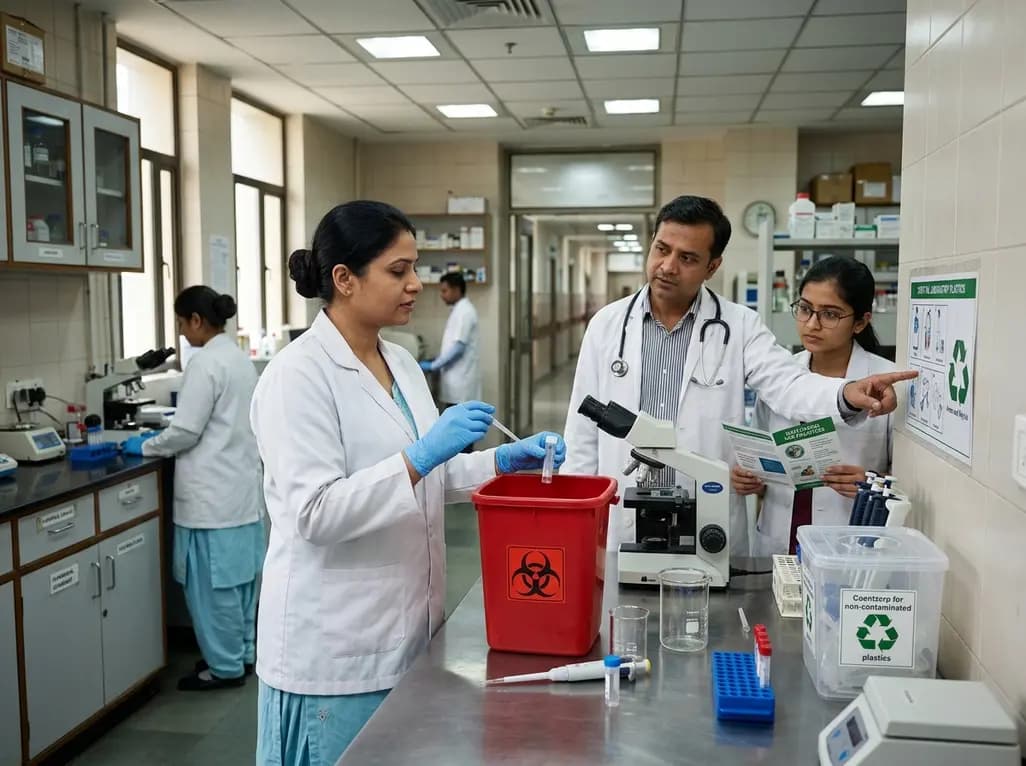
Modern diagnostic facilities and research institutions depend heavily on synthetic polymers to ensure sterility, biohazard safety, and reproducible analytical outcomes. Consequently, single-use consumables such as pipette tips, microcentrifuge tubes, culture plates, and specimen containers dominate daily workflows. However, this convenience generates immense ecological and biological burdens. Effective laboratory plastic waste management has therefore emerged as an urgent priority for pathologists, laboratory directors, and healthcare administrators. While institutional personnel often appreciate the environmental impact of their operations, translation of ecological awareness into daily operational compliance remains highly variable across different scientific disciplines.
Diagnostic laboratories generate tremendous volumes of hazardous and non-hazardous plastic debris every day. Routine clinical chemistry, molecular assays, and microbiology testing require disposable consumables to prevent cross-contamination and ensure sample integrity. Unfortunately, the linear product lifecycle of procurement, immediate use, and rapid disposal strains waste management streams. When non-contaminated polymers enter high-temperature incineration cycles alongside infectious biomedical waste, they release toxic dioxins, furans, and substantial greenhouse emissions. Conversely, improper segregation allows potentially contaminated materials to leak into standard municipal landfills, creating biological risks for municipal sanitation workers. Healthcare systems globally generate thousands of tonnes of medical plastic each week. Because clinical laboratories operate continuous shifts, their per-capita polymer consumption frequently exceeds standard clinical inpatient wards. Furthermore, chlorinated plastics like polyvinyl chloride pose distinct chemical breakdown challenges during thermal autoclaving and sterilization. Therefore, establishing efficient operational sorting protocols represents the first critical step toward reducing environmental pollution while preserving rigorous biosafety benchmarks.
Recent investigative findings evaluate the operational dynamics surrounding polymer disposal across academic, industrial, and clinical institutions. Researchers utilized cross-sectional survey methodologies to evaluate knowledge, attitude, and practice (KAP) scores among diverse laboratory cohorts. The results demonstrated a clear dissonance between subjective ecological awareness and concrete behavioural execution. Most participants exhibited moderate levels of factual knowledge and expressed positive attitudes toward sustainable environmental stewardship. Nevertheless, their self-reported practical compliance with waste reduction, decontaminative recycling, and material reuse scored poorly across multiple operational domains. Statistical evaluations confirmed a significant positive correlation between personal knowledge and positive attitudes. However, high enthusiasm alone failed to produce meaningful daily practice changes without external operational frameworks. Interestingly, professional occupation significantly influenced compliance levels. Industrial laboratory specialists achieved significantly higher practical adherence scores compared to academic researchers, university students, and routine clinical healthcare staff. This performance disparity highlights how corporate oversight and structured quality frameworks drive adherence more effectively than voluntary academic discretion.
Why do highly trained clinical and research professionals struggle to maintain sustainable workflows? The cross-sectional analysis identified institutional infrastructure as the decisive factor governing waste management outcomes. Facilities that implemented standardized, written sustainability protocols exhibited vastly superior daily compliance rates compared to unguided laboratories. Without clearly posted visual cues, accessible color-coded segregation bins, and documented standard operating procedures, personnel defaulted to the easiest disposal pathway. In clinical laboratories, fast turnaround times and heavy workloads often compel technologists to discard clean packaging and non-hazardous consumables directly into biohazard yellow bins. This defensive over-segregation dramatically inflates biohazard waste volume, raising institutional disposal costs unnecessarily. Therefore, establishing standardized operational protocols directly bridges the gap between worker intent and daily practice. When healthcare institutions formalize sustainability inside their standard quality management systems, sustainable actions become regular habits rather than optional burdens. Equitable access to dedicated decontamination facilities and designated clean recycling streams further empowers staff to segregate polymers correctly at the immediate point of generation.
Addressing the ecological footprint of diagnostics requires multi-tiered interventions that respect biosafety mandates. First, institutions must conduct comprehensive waste stream audits to separate contaminated biohazardous waste from clean logistical packaging. Up to eighty percent of total laboratory waste consists of non-infectious packaging, paper, and non-contact polymers that do not require high-temperature incineration. Second, facilities should adopt role-specific educational modules during onboarding and continuous professional development. Pathologists, technical supervisors, and laboratory technicians require customized training that clearly distinguishes biological hazards from recyclable materials. Third, laboratory procurement teams should leverage green purchasing principles. Procurement officers can prioritize suppliers that offer recyclable polypropylene consumables, take-back recycling programs for pipette tip racks, and minimal bulk packaging. In addition, research laboratories handling non-hazardous biological fluids can validate closed-loop chemical disinfection and autoclaving protocols to safely repurpose specific polymer containers. Integrating these operational steps aligns clinical laboratories with the United Nations Sustainable Development Goals while maintaining stringent diagnostic accuracy.
National biomedical waste frameworks require healthcare facilities to treat and dispose of hazardous materials systematically. In many regions, regulatory compliance focuses heavily on thermal destruction and deep burial to eliminate pathogen transmission. However, evolving environmental policies now demand the integration of circular economy principles within clinical infrastructure. Regulatory agencies encourage laboratories to phase out chlorinated plastics and install shredding, chemical disinfection, and non-burn autoclaving systems for recyclable polymers. Hospital administrators and laboratory managers must actively collaborate with licensed central biomedical waste treatment facilities to ensure segregated plastics reach verified recycling streams. Transitioning toward greener pathology laboratories does not compromise diagnostic precision or patient safety. Instead, systematic waste minimization enhances institutional cost efficiency by reducing heavy biohazard disposal surcharges. Through rigorous quality auditing, continuous personnel training, and sustained administrative leadership, modern laboratory medicine can deliver exemplary patient care while safeguarding public and planetary health.
Proper segregation separates hazardous infectious polymers from non-contaminated packaging and consumables. Non-contaminated plastics do not require high-temperature thermal incineration, which emits hazardous dioxins and greenhouse gases. Precise segregation at the generation site protects sanitation workers, preserves local landfill capacity, and lowers operational waste disposal costs for diagnostic healthcare facilities.
Laboratory directors can formalize written standard operating procedures, provide clear visual bin signage, and implement regular staff training. Furthermore, directors should perform routine waste audits, establish green procurement contracts with vendor take-back programs, and partner with certified recyclers who can safely handle autoclaved, non-infectious laboratory polymers.
No, sustainable waste practices strictly uphold established biosafety and infection control benchmarks. Clinicians never compromise patient safety or sample integrity. Sustainable initiatives focus on minimizing non-contact packaging, correctly classifying non-infectious waste streams, and safely sterilizing eligible non-hazardous plastics rather than reusing contaminated consumables indiscriminately.
Disclaimer: This content is for informational and educational purposes only. It is not intended to substitute for professional medical advice, diagnosis, or treatment. Always seek the advice of your physician or another qualified healthcare provider with any questions you may have regarding a medical condition. Refer to the latest local and national guidelines for clinical practice.
References
Tan YH et al. Knowledge, attitude, and practice of sustainable management of single-use plastic waste among laboratory users. Waste Manag Res. 2026 Aug 22. doi: 10.1177/0734242X261476576. PMID: 42630103.
Datta P et al. Biomedical waste management in India: Critical appraisal. J Lab Physicians. 2018;10(1):6-14. doi: 10.4103/JLP.JLP_89_17.
Al-Khatib IA et al. Healthcare plastic waste management and circular economy: Current status, challenges, and future perspectives. Environ Sci Pollut Res Int. 2023;30(18):51120-51135. doi: 10.1007/s11356-023-26154-y.

Read summarized clinical updates, watch expert medical content, and earn CME certifications right from your smartphone.
Open your smartphone camera to scan and install.





A recent study evaluates the knowledge, attitude, and practice gaps in sustainable single-use plastic waste management among laboratory professionals, emphasizing institutional protocols and targeted training to align scientific workflows with environmental sustainability goals.
last month

A scientific statement highlights the crucial role of nutrition in managing chronic heart failure. It emphasizes GLIM-based screening, individualized dietary patterns like the Mediterranean diet, appropriate protein and energy intake, avoiding unnecessary fluid restriction, and targeted iron supplementation.
Today

A nationwide South Korean study shows underreporting of smoking among women dropped from 57.4% to 36.4% between 2008 and 2021. However, over one-third of female smokers still conceal their habit, highlighting the critical role of cotinine verification in clinical risk assessment.
Today

PepsiCo and Monster Beverage have challenged the FSSAI ban on the energy drink label in Indian courts. While companies highlight supply disruptions, regulatory actions spotlight severe cardiovascular and metabolic risks associated with excessive caffeine, sugar, and taurine consumption, especially in adolescents.
Today
A new study evaluates the rheological stability of decellularized peripheral nerve matrix hydrogels under varied storage conditions. Findings show -80°C storage and freeze-drying preserve gelation kinetics and mechanical stiffness, offering key insights for shipping and translational clinical applications.
Today

A qualitative meta-synthesis highlights the complex interplay between gender dysphoria, minority stress, and eating disorders in transgender and gender-diverse individuals. Clinicians must recognize these distinct drivers to offer supportive, gender-affirming, and interdisciplinary eating disorder care.
Today
