.webp&w=384&q=75)

Loading, please wait...
Loading, please wait...
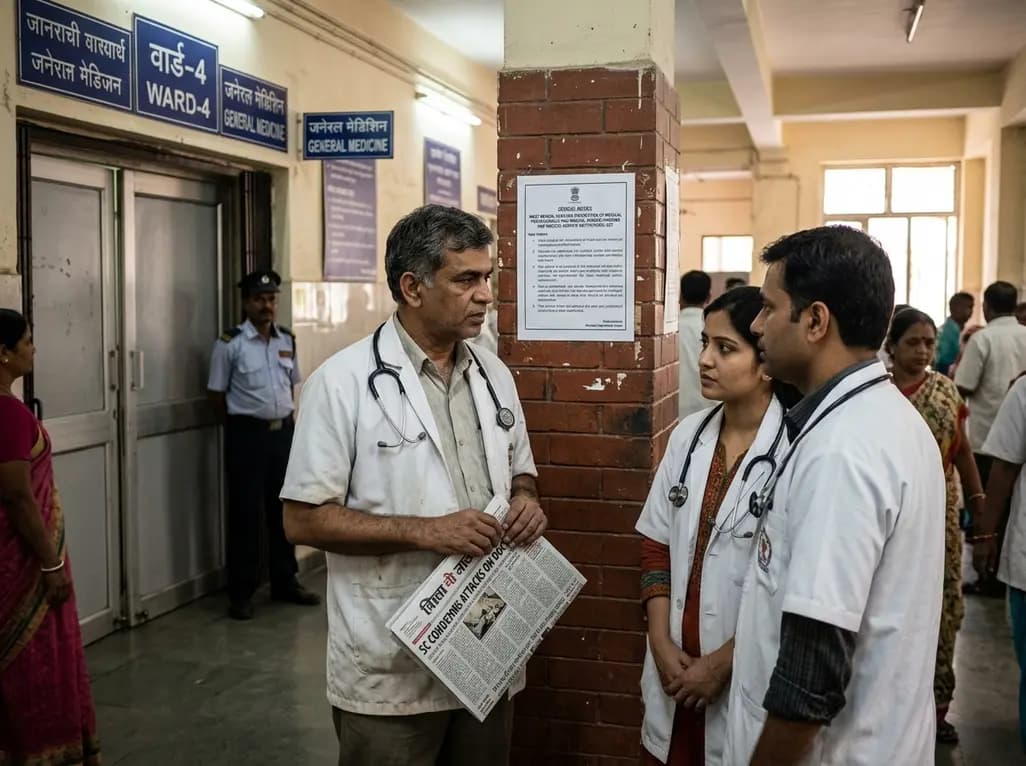
The Supreme Court of India recently issued a stern reprimand regarding recurring attacks on doctors in Maharashtra. A bench comprising Justice Vikram Nath and Justice Sandeep Mehta addressed these violent disruptions directly. Furthermore, the bench observed that repeated assaults on healthcare workers constitute a severe breakdown of law and order. The judges firmly stated that individuals attacking medical staff inside hospitals do not deserve to roam on streets. Consequently, this strong judicial posture highlights an urgent need to protect healthcare personnel. In addition, the remarks offer crucial reassurance to medical teams working in high-stress public clinical environments.
During the judicial proceedings, the Supreme Court expressed profound dismay over physical violence directed at healthcare professionals. The bench examined the alarming frequency of violent confrontations within government and municipal medical centers. Specifically, Justice Vikram Nath questioned how anyone could ever justify entering clinical premises to beat doctors brutally. The court observed that conditions are rapidly deteriorating for duty clinicians across state facilities. Therefore, perpetrators should face immediate detention rather than lenient pre-trial relief. Senior legal counsel attempted to distinguish between different regional mob events. However, the bench observed that a common ideology of lawlessness drives these coordinated attacks. Mob behavior routinely disrupts life-saving medical care and traumatizes junior residents and emergency staff. Consequently, the apex court insisted that authorities must send an uncompromising deterrent message nationwide. Medical practitioners cannot provide optimal clinical care under constant threats of physical intimidation. Thus, judicial oversight now demands strict accountability from local law enforcement agencies handling hospital violence cases. State administrations must treat hospital assaults as serious breaches of public order. Additionally, the court pointed out that tolerating such aggression normalizes violence against public servants. When doctors face assault, the entire healthcare delivery mechanism collapses for innocent patients waiting outside. Hence, prompt custodial detention serves as an essential safeguard for frontline medical teams.
The matter before the Supreme Court originated from an assault at Shastri Nagar Hospital in Dombivli. In July, a political corporator and his associates arrived at the civic medical facility following clinical disputes. Specifically, the altercation stemmed from disagreements surrounding the urgent obstetric care of a pregnant female patient. Instead of pursuing administrative redressal, the group launched an unprovoked physical attack on on-duty resident doctors. The assailants allegedly thrash medical officers, assault nursing personnel, and damage critical hospital infrastructure. Shockingly, CCTV cameras inside the facility recorded the aggressive altercation in vivid detail. Following the initial clash, local police registered formal criminal charges against the accused individuals. Nevertheless, a local magistrate court granted bail to the prime political figure shortly after arrest. In response, the Bombay High Court took suo motu cognisance of the assault to review this relief. Furthermore, the High Court stayed the bail order and imposed rigorous monitoring conditions on the accused. The High Court also directed an expedited investigation and trial to secure swift accountability. Dissatisfied with these strict directives, the accused corporator approached the Supreme Court to challenge the conditions. However, the apex bench firmly refused to entertain any arguments attempting to dilute institutional consequences.
The Supreme Court hearing produced pivotal legal moments regarding bail jurisprudence in hospital violence cases. Senior Advocate Mukul Rohatgi represented the accused and contested the accelerated trial schedule established by the High Court. He argued that expedited timelines unfairly prejudged the guilt of the accused individuals. Conversely, the bench firmly rejected this line of defense, reiterating that a clear deterrent message must go out. Furthermore, the bench signaled an immediate willingness to revoke the bail granted to the corporator entirely. Recognizing the stern judicial disposition, the defense quickly chose to withdraw its appeal against the stringent conditions. Subsequently, the Supreme Court turned its focus toward the Maharashtra government's petition seeking complete bail cancellation. The bench issued formal legal notice to the corporator and co-accused, demanding replies within three weeks. Meanwhile, reports emerged detailing another violent assault on medical workers in Palghar by similarly affiliated political cadres. Therefore, the apex court emphasized that systemic impunity for political figures attacking hospitals must end immediately. Pre-trial liberty becomes unsustainable when accused persons repeatedly endanger healthcare personnel and civil safety. Consequently, judicial attitudes toward bail in doctor assault cases are growing increasingly uncompromising across the Indian legal system.
Hospital violence imposes profound physical, emotional, and institutional burdens on medical personnel throughout India. Emergency departments, intensive care units, and labor wards face the highest risk of hostile mob confrontations. Frequently, unrealistic clinical expectations and grief over poor clinical prognoses trigger aggressive reactions from patient attendants. In many government facilities, severe resource shortages and high patient volumes exacerbate interpersonal tensions between doctors and families. Moreover, the lack of secure access control allows unauthorized political groups to storm sensitive clinical chambers freely. When violence erupts, healthcare workers suffer severe acute physical injuries, psychological trauma, and long-term burnout. Consequently, doctors often adopt defensive medical practices to avoid hostile confrontation during emergency clinical management. Such defensive medicine increases healthcare expenditure and delays essential, time-sensitive clinical decisions for vulnerable patients. Furthermore, frequent violent episodes undermine workforce retention in public hospitals, driving talent toward safer private sector environments. Therefore, healthcare administrations must recognize physical safety as an essential prerequisite for quality healthcare delivery. Protecting doctors inside examination rooms is not merely an institutional obligation; it directly preserves patient survival. Accordingly, hospital administrators must establish structural defenses, including rapid response security teams and panic alarm buttons. Robust physical infrastructure guarantees that clinicians can practice their specialized craft without fearing imminent physical violence.
Healthcare establishments must adopt multi-layered institutional policies to counter hospital aggression effectively. First, hospital managements must enforce strict visitor limitation protocols in high-risk emergency and intensive care zones. Additionally, installing high-definition surveillance cameras at every hospital entry point ensures reliable legal evidence during criminal investigations. Hospital authorities must also establish formal institutional standard operating procedures to manage sudden mob agitation. Whenever violence occurs, medical directors must file institutional First Information Reports promptly on behalf of injured staff. Individual resident doctors should never bear the solitary burden of prosecuting influential or politically connected offenders. Furthermore, state governments must strictly enforce local Medicare Service Persons and Medicare Service Institutions acts. These dedicated state statutes classify assaults against on-duty healthcare workers as non-bailable, cognizable criminal offenses. In addition, hospitals must provide structured de-escalation communication training for all triage nurses and resident physicians. Clear, empathetic clinical communication regarding critical patient status helps de-escalate emotional distress before volatile conflicts ignite. Ultimately, active judicial deterrence combined with institutional security frameworks will foster a safe clinical working environment. Consequently, healthcare workers will regain confidence in statutory protections. Through coordinated administrative vigilance and resolute legal action, healthcare centers can reclaim their sacred status as places of peaceful healing.
Q1: What legal protections safeguard doctors against violence in Maharashtra?
Healthcare professionals in Maharashtra receive legal protection under the Maharashtra Medicare Service Persons and Medicare Service Institutions Act. This specialized legislation renders any act of violence against healthcare personnel a cognizable and non-bailable criminal offense. Furthermore, offenders face imprisonment for up to three years along with mandatory monetary fines. In addition, courts enforce Indian Penal Code provisions against perpetrators who disrupt lawful public duty.
Q2: Why did the Supreme Court issue notice regarding the Dombivli bail?
The Supreme Court intervened because assaults on duty doctors severely disrupt institutional healthcare delivery and public order. Although a magistrate initially granted bail, the Bombay High Court intervened via suo motu proceedings. Subsequently, the Maharashtra government petitioned the Supreme Court to cancel this relief. Justice Vikram Nath remarked that perpetrators who thrash medical professionals do not deserve liberty, prompting formal notices.
Q3: How should hospital administrators handle violent incidents inside medical facilities?
Hospital administrations must implement comprehensive crisis protocols immediately upon any outbreak of aggression. Crucially, institutions must register an official police First Information Report on behalf of the hospital rather than leaving individual physicians vulnerable. Furthermore, management should deploy trained security personnel to isolate violent visitors, preserve CCTV footage, and provide immediate medical and psychological support to affected staff.
Disclaimer: This content is for informational and educational purposes only. It does not constitute medical advice or replace professional judgment. Refer to the latest local and national guidelines for clinical practice.
References

Read summarized clinical updates, watch expert medical content, and earn CME certifications right from your smartphone.
Open your smartphone camera to scan and install.





The Supreme Court of India has issued strong observations against hospital violence in Maharashtra, noting that perpetrators of healthcare assaults disrupt public order and do not deserve bail. Explore the legal ramifications of the Dombivli case, bail jurisprudence, and essential workplace safety measures.
last month

Review how tailored exercise programs benefit frail older patients with heart failure. Explore pathophysiological mechanisms, individualized training prescriptions, and strategies to overcome adherence barriers in clinical practice.
Today

Leucine Rich Bio has introduced South Asia's first comprehensive vaginal microbiome test, BugSpeaks. By profiling microbial dysbiosis, pathogens, and antimicrobial resistance, this next-generation diagnostic platform provides clinicians with deeper insights into recurrent infections, fertility, and reproductive health.
Today

In high-risk pulmonary embolism complicated by severe anemia and active uterine bleeding, systemic thrombolysis is contraindicated. Large-bore aspiration thrombectomy provides rapid hemodynamic rescue without fibrinolysis, supported by inferior vena cava filter placement and multidisciplinary critical care.
Today

This comparative study evaluates posterior labral tears with and without glenohumeral instability, highlighting distinct demographic patterns, MRI underestimation in stable shoulders, and successful arthroscopic repair outcomes.
Today

A clinical study demonstrates that early intervention with tocilizumab, either as monotherapy or bridged with corticosteroids, achieves significant proptosis reduction and resolves active inflammation in treatment-naive thyroid eye disease.
Today
