.webp&w=384&q=75)

Loading, please wait...
Loading, please wait...

Gestational trophoblastic neoplasia encompasses a spectrum of rare, highly curable malignancies that arise from placental trophoblastic cells. Because these neoplasms predominantly affect women of reproductive age, oncologists and gynecologists must prioritize long-term fertility and gonadal preservation during therapy. Multiagent systemic chemotherapy remains the cornerstone of management for high-risk disease. However, cytotoxic regimens often induce gonadal toxicity, follicular depletion, and transient amenorrhea. Anti-Müllerian hormone serves as a sensitive serum biomarker that directly reflects the growing follicular pool. Recent clinical evidence provides valuable longitudinal insight into ovarian reserve recovery following multiagent protocols, offering much-needed reassurance to clinicians and patients planning future pregnancies.
Multiagent chemotherapy protocols achieve cure rates exceeding ninety percent in patients with high-risk gestational trophoblastic neoplasia. Clinicians standardly deploy etoposide, methotrexate, actinomycin D, cyclophosphamide, and vincristine, commonly abbreviated as EMA/CO. Alternatively, specialized centers frequently utilize floxuridine or fluorouracil, actinomycin D, etoposide, and vincristine, known as the FAEV regimen. Although these intense regimens eradicate malignant trophoblasts effectively, cytotoxic agents exert collateral damage on resting primordial and growing primary follicles. Specifically, alkylating agents such as cyclophosphamide induce double-strand DNA breaks and trigger apoptotic cascades within granulosa cells. Consequently, serum anti-Müllerian hormone levels plunge precipitously during active treatment cycles. Fortunately, this suppression does not necessarily signify permanent premature ovarian insufficiency. Instead, growing cohorts demonstrate that the primordial pool often survives, initiating follicular recruitment once cytotoxic exposure ceases. Clinicians must understand these dynamic hormonal trajectories to counsel young survivors appropriately, mitigating undue psychological distress surrounding future reproductive capacity.
A recent real-world cohort investigation rigorously tracked anti-Müllerian hormone levels across consecutive timepoints in high-risk patients. At baseline before initiating cytotoxic regimens, patients demonstrated a healthy median hormone concentration of 2.73 ng/mL. However, during active chemotherapy, median levels dropped dramatically to an expected nadir of 0.04 ng/mL. This acute reduction highlights the profound temporary suppression that multiagent chemotherapy imposes on active granulosa cell activity. Remarkably, ovarian recovery commenced rapidly following treatment cessation. Within one month after therapy completion, median levels rebounded to 0.47 ng/mL. Furthermore, by six months post-chemotherapy, median concentrations climbed robustly to 1.26 ng/mL. Most importantly, nearly three-quarters of the evaluated cohort, specifically 73.5%, regained an anti-Müllerian hormone concentration equal to or exceeding 1.0 ng/mL. These compelling numerical findings illustrate that ovarian follicular recruitment reactivates rapidly in young women, establishing a reliable timeline for physiological rebound.
The choice of primary multiagent chemotherapy significantly shapes acute gonadal suppression patterns. In comparative analyses, patients receiving FAEV retained significantly higher hormone levels during active treatment and at one month post-treatment than those receiving EMA/CO. Specifically, geometric mean ratios favored FAEV by 2.19-fold during treatment and 2.55-fold at one month. This short-term advantage likely reflects the absence of cyclophosphamide in the FAEV regimen. Because cyclophosphamide causes direct cross-linking of DNA within dormant follicles, its inclusion in EMA/CO produces sharper initial gonadotoxicity. Nevertheless, by six months post-chemotherapy, both cohorts exhibited comparable recovery rates and hormone concentrations. Therefore, while FAEV induces less severe acute follicular suppression, EMA/CO remains compatible with excellent mid-term ovarian reserve recovery. Clinicians can confidently assure patients that while initial suppression varies by regimen, both protocols permit robust follicular restoration within six months after finishing systemic treatment.
Surgical intervention occasionally complements multiagent chemotherapy in refractory high-risk cases or severe uterine hemorrhage. Because surgical manipulation of uterine vessels might compromise collateral adnexal blood supply, clinicians frequently worry about accelerated follicular loss after hysterectomy. Notably, investigators evaluated eighteen patients who underwent concurrent hysterectomy alongside cytotoxic therapy. Generalized estimating equation models demonstrated that hysterectomy did not significantly impair longitudinal hormone trajectories or final recovery metrics compared with uterine preservation. When surgeons meticulously preserve the infundibulopelvic ligaments and ovarian blood flow, pelvic surgery avoids damaging the cortical follicle population. Consequently, patients requiring adjunctive hysterectomy for oncological control retain functional endocrine ovarian activity. Although these women lose natural gestational capacity, preserved endocrine function shields them from premature cardiovascular and bone health consequences. Furthermore, intact ovaries permit future biological parenthood through assisted reproductive technologies and gestational surrogacy when desired.
Uterus-preserving patients who achieve complete remission demonstrate excellent long-term fertility outcomes following multiagent chemotherapy. Cohort follow-up confirms high rates of spontaneous conception and successful live births among women actively attempting pregnancy after recovery. However, clinical oncologists standardly recommend postponing conception for twelve months following chemotherapy completion. This essential waiting period serves two paramount purposes. First, it spans the highest-risk interval for trophoblastic disease recurrence, ensuring that rising human chorionic gonadotropin titers represent true pregnancy rather than relapse. Second, it allows maturing oocytes to recover fully from transient cytotoxic mutagenesis. Clinicians should routinely monitor post-treatment menstrual resumption and obtain longitudinal hormone panels at six-month intervals. Collaborative care involving gynecologic oncologists and reproductive endocrinologists ensures comprehensive survivorship support, offering patient reassurance, structured preconception counseling, and personalized fertility timelines.
Serum anti-Müllerian hormone drops to near-undetectable levels during active chemotherapy, reaching a median nadir of 0.04 ng/mL. However, recovery begins almost immediately after stopping treatment. Levels rise to a median of 0.47 ng/mL by one month and reach 1.26 ng/mL by six months. Nearly three out of four patients restore levels above 1.0 ng/mL within six months, demonstrating rapid and significant functional ovarian recuperation.
The FAEV regimen produces significantly less acute follicular suppression during chemotherapy and at one month post-treatment compared to EMA/CO. This difference occurs because FAEV avoids cyclophosphamide, an alkylating agent known for direct gonadotoxicity. Nonetheless, by six months post-treatment, both regimens demonstrate similar recovery rates and comparable hormone concentrations. Therefore, both regimens offer excellent long-term gonadal preservation for reproductive-age survivors.
Yes, uterus-preserving survivors demonstrate excellent pregnancy and live birth rates without elevated congenital anomaly risks. However, clinicians universally advise waiting twelve months post-chemotherapy before attempting conception. This crucial waiting period minimizes potential teratogenic risks to recruited oocytes and avoids diagnostic confusion between normal pregnancy-associated human chorionic gonadotropin rises and early disease relapse, ensuring maternal oncologic safety throughout conception.
Disclaimer: This content is for informational and educational purposes only... Refer to the latest local and national guidelines for clinical practice.
References
Xue W et al. Longitudinal AMH trajectories, ovarian reserve recovery, and fertility outcomes after multiagent chemotherapy for high-risk gestational trophoblastic neoplasia: A real-world cohort study. Int J Gynaecol Obstet. 2026 Sep 03. doi: 10.1002/ijgo.71318. PMID: 42687833.
Wang X et al. Efficacies of FAEV and EMA/CO regimens as primary treatment for gestational trophoblastic neoplasia. Br J Cancer. 2022;127(4):645-652.
Bower M et al. EMA/CO for high-risk gestational trophoblastic tumors: results and middle- and long-term toxicity. J Clin Oncol. 1997;15(7):2636-2643.
Ngan HYS et al. Update on the diagnosis and management of gestational trophoblastic disease. Int J Gynaecol Obstet. 2018;143(Suppl 2):79-85.

Read summarized clinical updates, watch expert medical content, and earn CME certifications right from your smartphone.
Open your smartphone camera to scan and install.





A real-world cohort study evaluates anti-Müllerian hormone recovery and fertility outcomes in high-risk GTN patients treated with EMA/CO versus FAEV chemotherapy, demonstrating robust ovarian reserve recovery by six months post-treatment.
4 weeks back

Targeting ferroptosis provides a compelling strategy to dismantle hypoxia- and acidosis-driven immunosuppression in solid tumors, enhancing response to modern immunotherapy.
Today

Findings from Project Viva indicate that sustained postpartum weight retention, rather than excessive gestational weight gain alone, directly worsens women's mid-life cardiovascular health, degrading blood pressure and glycemic parameters decades after delivery.
Today
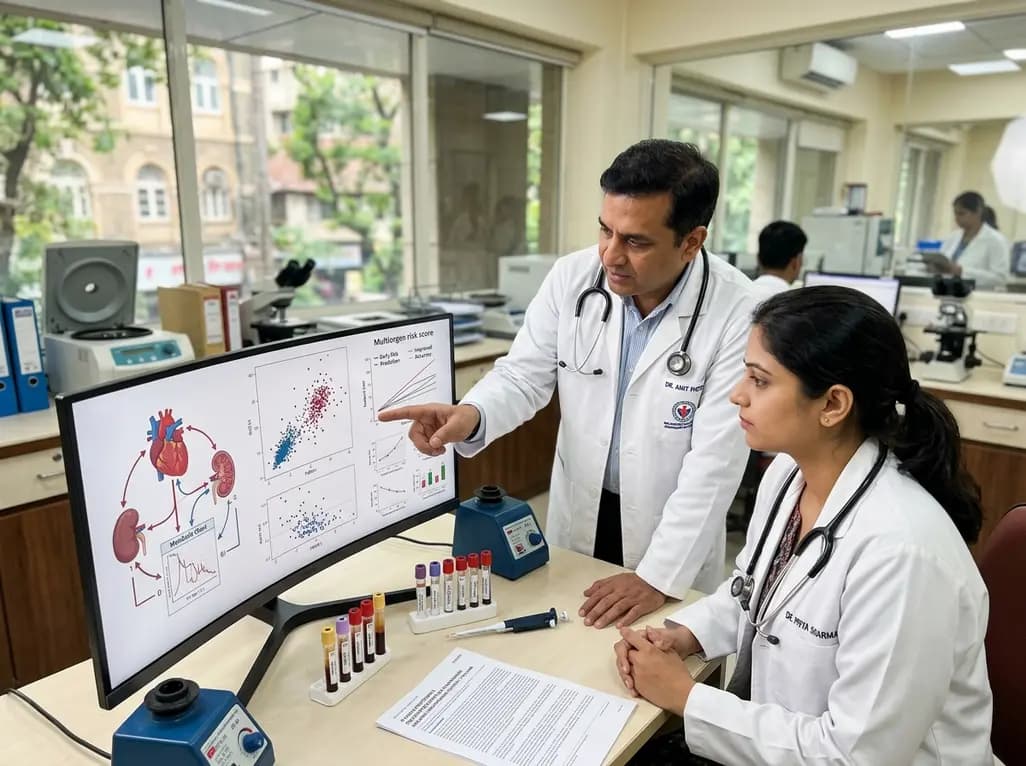
A large UK Biobank study reveals that plasma proteomic signatures capture preclinical organ damage and improve multiorgan risk prediction across early CKM syndrome stages 0 to 2 beyond traditional PREVENT clinical models.
Today

A retrospective CBCT study reveals that superior TMJ space asymmetry correlates moderately with occipital condyle-atlas-axis asymmetry in unilateral TMJ osteoarthritis, highlighting an imaging correlate between jaw biomechanics and upper cervical alignment rather than a standalone diagnostic marker.
Today

A Bayesian multilevel meta-analysis reveals that aerobic training combined with moderate carbohydrate restriction modestly lowers HbA1c in type 2 diabetes. However, sparse data and very low certainty leave incremental benefits over exercise or diet alone unproven, highlighting the need for individualized care.
Today
