.webp&w=384&q=75)

Loading, please wait...
Loading, please wait...
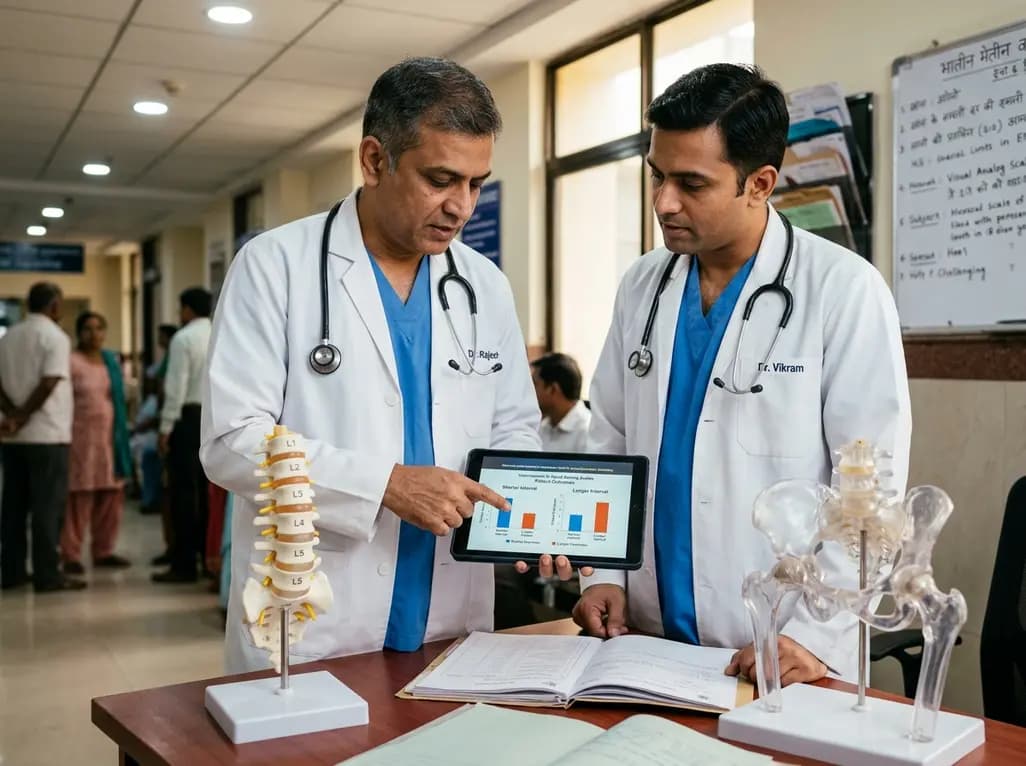
Managing concurrent degenerative conditions of the lumbosacral spine and hip presents a major surgical challenge. Clinicians frequently encounter hip-spine syndrome in older adults who suffer from debilitating joint pain. However, determining the optimal timing between spinal fusion and hip arthroplasty remains contentious. Recent clinical investigations suggest that staging these operations closer together offers notable functional advantages. Specifically, patients undergoing both procedures within one year report significantly better functional recovery.
Orthopedic and spine specialists frequently care for patients who present with concurrent spinal stenosis and severe hip osteoarthritis. Consequently, determining which joint serves as the primary pain generator requires rigorous clinical examination and diagnostic selective injections. Severe lumbar degeneration dramatically alters normal spinopelvic parameters by restricting physiological sacral slope and pelvic tilt. Furthermore, stiff spinal segments eliminate compensatory pelvic retroversion during sitting and forward bending movements. As a result, the adjacent coxofemoral joint experiences heightened mechanical shear forces and localized acetabular contact stress. Because both anatomical disorders share overlapping clinical manifestations, patients often suffer protracted functional decline before receiving surgical intervention. Traditional treatment pathways often postpone the secondary operation for years due to concerns over cumulative physiological stress. However, recent evidence indicates that prolonged delay severely impairs long-term physical recovery and functional independence. Additionally, persistent biomechanical compensation promotes asymmetric gait abnormalities and accelerated contralateral joint degeneration. Therefore, surgical teams must coordinate staged interventions to restore harmonious sagittal alignment without unnecessary procedural delays.
To evaluate surgical timing intervals, investigators completed a retrospective cohort study spanning from 2002 to 2025. The research cohort comprised 179 consecutive patients who underwent both primary lumbar spinal fusion and primary total hip arthroplasty. Importantly, the researchers included individuals receiving surgeries in either sequence, provided they completed twelve-month functional assessments. The authors stratified patients into distinct comparison groups based on whether the inter-surgery interval was under one year. Furthermore, the team assessed validated patient-reported outcomes using the Hip Disability and Osteoarthritis Outcome Score. Statistical comparisons utilized independent sample t-tests for continuous data and chi-square tests for categorical variables. Overall, baseline patient demographics and medical comorbidities demonstrated balanced distributions between the rapid and delayed surgical groups. In addition, the investigators monitored all revision procedures, surgical site complications, and structural failures across both cohorts. Consequently, this study design offers valuable real-world evidence regarding the prognostic significance of inter-stage surgical duration. Thus, surgical planners gain meaningful observational insight into managing complex multisite degenerative disease.
The study demonstrated notable functional advantages for patients who completed both operations within a condensed twelve-month timeframe. Specifically, patients in the shorter interval group achieved significantly greater improvements in twelve-month functional scores compared to delayed patients. These individuals reported superior relief from coxofemoral pain, greater daily activity participation, and higher overall joint satisfaction. Conversely, patients who waited longer than one year between procedures demonstrated considerably smaller improvements in functional recovery. Moreover, multivariable statistical regression confirmed that a shorter interval independently predicted substantial twelve-month functional improvement. Remarkably, compressing the surgical interval did not increase the incidence of subsequent spine or hip revision surgeries. Similarly, the researchers observed comparable rates of 90-day readmission and perioperative medical complications across both timing groups. Therefore, clinicians can safely conclude that shorter intervals do not sacrifice patient safety or compromise surgical fixation. Instead, prompt intervention relieves debilitating symptoms and enables earlier physical rehabilitation for severely impaired individuals. As a result, shortening the interval between stages represents an evidence-based method to optimize recovery trajectories.
The physiological mechanisms driving these superior functional gains relate directly to compensatory spinopelvic alignment dynamics. When surgeons address only one anatomical region, unresolved pathology in the adjacent kinetic joint perpetuates mechanical imbalance. For instance, severe hip flexion contractures drive anterior pelvic tilt and exacerbate lumbar lordosis during upright posture. Similarly, rigid lumbar fusion eliminates reciprocal pelvic motion, which forces the hip to hyperextend during ambulation. Consequently, persistent secondary joint disease subjects the newly operated segment to excessive eccentric wear and prosthetic impingement. Furthermore, prolonged surgical intervals force patients to maintain abnormal compensatory gait patterns for many months. In contrast, resolving both symptomatic pathologies within twelve months restores harmonious sagittal balance across the lumbo-pelvic complex. Additionally, timely intervention curtails progressive paraspinal muscle atrophy and prevents secondary hip abductor weakening. Thus, patients can engage in comprehensive physical therapy that restores symmetrical muscle activation and neuromuscular coordination. Ultimately, rapid structural stabilization eliminates chronic nociceptive input before irreversible pain centralization develops.
Managing concurrent hip and spine disease requires close collaboration between arthroplasty surgeons and spine specialists. Although surgeons must tailor procedural sequence to the dominant symptom generator, avoiding unnecessary delays remains paramount. Therefore, clinical teams should establish standardized staging protocols that re-evaluate the secondary joint promptly after initial recovery. Comprehensive preoperative assessments should include full-length standing and sitting radiographs to evaluate spinopelvic mobility and stiffness. In addition, clinicians must optimize medical comorbidities, bone mineral density, and nutritional status prior to the index procedure. Because consecutive surgeries place metabolic stress on the body, structured postoperative rehabilitation pathways facilitate safe physical reconditioning. Furthermore, educating patients about expected surgical milestones encourages active compliance throughout both procedural phases. When patients display persistent functional limitations following the initial procedure, clinicians should avoid prolonged observational waiting. Instead, early planning for the second stage allows surgeons to capitalize on active rehabilitation momentum. Consequently, adopting a proactive staging strategy restores functional mobility and optimizes long-term clinical success.
Coexisting lumbar spine disease and hip osteoarthritis create overlapping symptoms that frequently confuse clinical diagnosis. Specifically, degenerative spine pathology alters pelvic mechanics and reduces compensatory sagittal motion. Consequently, hip arthroplasty components face increased risk of postoperative impingement or dislocation if pelvic tilt changes. Therefore, orthopedic and spine teams must perform comprehensive radiographic evaluations in standing and sitting positions. This thorough assessment ensures correct component placement and prevents premature implant revision.
A shorter surgical interval resolves dual pathology before chronic muscle atrophy, postural deconditioning, and central sensitization become entrenched. Furthermore, completing both surgeries within one year enables coordinated physical rehabilitation of the entire spinopelvic kinetic chain. In contrast, prolonging the interval forces patients to cope with persistent secondary joint pain and progressive biomechanical compensation. Consequently, early definitive intervention accelerates functional recovery and delivers significantly higher gains in twelve-month hip disability outcome measures.
Clinical research indicates that completing hip arthroplasty and lumbar spinal fusion within one year does not elevate revision rates. Furthermore, bivariate comparisons demonstrate similar complication rates and structural durability between shorter and longer staging intervals. However, surgeons must carefully maintain strict sterile protocols and optimize patient nutrition, metabolic health, and bone quality prior to both procedures. Therefore, appropriate patient selection allows surgical teams to safely compress intervals without compromising implant fixation or clinical safety.
Disclaimer: This content is for informational and educational purposes only... Refer to the latest local and national guidelines for clinical practice.
References

Read summarized clinical updates, watch expert medical content, and earn CME certifications right from your smartphone.
Open your smartphone camera to scan and install.





A retrospective cohort study reveals that undergoing total hip arthroplasty and lumbar spinal fusion within a one-year interval significantly improves 12-month patient-reported outcomes in hip-spine syndrome without elevating surgical revision rates.
last month

As monsoon seasons elevate arboviral disease threats, Tamil Nadu has initiated an ICMR-monitored evaluation of the tetravalent dengue vaccine in Tenkasi district. Clinicians emphasize clinical monitoring, public prevention, and high-quality early pediatric care to reduce disease morbidity across endemic regions.
Today

Leucine Rich Bio has introduced South Asia's first comprehensive vaginal microbiome test, BugSpeaks. By profiling microbial dysbiosis, pathogens, and antimicrobial resistance, this next-generation diagnostic platform provides clinicians with deeper insights into recurrent infections, fertility, and reproductive health.
Today

Review how tailored exercise programs benefit frail older patients with heart failure. Explore pathophysiological mechanisms, individualized training prescriptions, and strategies to overcome adherence barriers in clinical practice.
Today

This comparative study evaluates posterior labral tears with and without glenohumeral instability, highlighting distinct demographic patterns, MRI underestimation in stable shoulders, and successful arthroscopic repair outcomes.
Today

A clinical study demonstrates that early intervention with tocilizumab, either as monotherapy or bridged with corticosteroids, achieves significant proptosis reduction and resolves active inflammation in treatment-naive thyroid eye disease.
Today
