

Loading, please wait...
Loading, please wait...

Autism spectrum disorder presents unique neurodevelopmental challenges that profoundly influence a child's academic, behavioral, and emotional trajectory. Autistic children frequently encounter high rates of school-related distress, leading to chronic absenteeism, sensory overload, and severe anxiety. Consequently, healthcare professionals understand that supporting autistic students requires strong collaboration between medical clinicians and educators. When pediatricians and child psychiatrists formulate individual treatment programs, the classroom environment often determines the ultimate success of therapeutic goals. However, mainstream educators often experience uncertainty when accommodating diverse neurodivergent behaviors. A recent landmark cross-sectional study in England investigated how educator knowledge, professional development, and institutional roles shape teacher self-efficacy. By examining these systemic determinants, clinicians gain crucial insights into school environments, enabling better advocacy and targeted multidisciplinary support for neurodivergent children.
Pediatricians and child psychiatrists frequently manage children presenting with school refusal, psychosomatic complaints, and acute behavioral meltdowns. Often, these clinical symptoms stem directly from unaccommodated sensory, executive functioning, and communication barriers in school classrooms. Therefore, clinical outcomes improve significantly when classroom teachers possess adequate knowledge and strong self-efficacy. The recent cross-sectional investigation evaluated 512 mainstream school educators across England using validated measurement instruments. Specifically, investigators administered the Knowledge of Autism Questionnaire-UK alongside the Teacher Self-Efficacy for Autism Scale. Overall, participating teachers exhibited moderate-to-high baseline knowledge, achieving a mean score of 26 out of 34 possible points. Additionally, educators reported relatively high confidence, with mean self-efficacy scores reaching 39.5 out of 48 points. These baseline numbers demonstrate that general awareness regarding neurodiversity has advanced considerably over the last decade. Nevertheless, significant disparities persist across different educator designations and training backgrounds. Mainstream educators frequently struggle to convert theoretical awareness into practical classroom adjustments. For instance, managing sensory dysregulation and social interaction challenges requires concrete, ongoing pedagogical adaptations rather than superficial awareness. Consequently, evaluating how specific professional attributes predict educator self-efficacy provides clinicians with actionable insights during clinical consultations with caregivers.
Within mainstream educational systems, designated roles create substantial disparities in educator competence and perceived capability. In the study cohort, Special Educational Needs Coordinators scored significantly higher than standard classroom teachers in both evaluated domains. Specifically, coordinators achieved superior autism knowledge scores with a notable effect size of 0.42. Furthermore, coordinators demonstrated elevated self-efficacy scores compared to classroom teachers, yielding an effect size of 0.16. These statistical differences reflect the intensive, specialized duties associated with coordinators who oversee institutional accommodations. Conversely, standard classroom instructors, who spend the largest proportion of daily contact hours with pupils, reported greater uncertainty. Clinicians in pediatric practice frequently observe this exact administrative divide during multi-agency discussions. While institutional coordinators understand inclusive educational frameworks, classroom teachers frequently execute daily lesson plans without specialized behavioral skills. Therefore, pediatricians must recognize that communication from school leadership does not guarantee uniform classroom implementation. When issuing medical recommendations for individualized educational programs, physicians should explicitly outline pragmatic, micro-level classroom modifications. Moreover, clinicians must encourage direct communication with primary instructors rather than relying entirely on administrative intermediaries. This proactive coordination ensures that evidence-based therapeutic recommendations translate directly into positive educational environments for the child.
Targeted professional development serves as an essential mechanism for elevating educator competence across primary and secondary schools. The survey data demonstrated that greater professional development volume strongly correlated with increased autism knowledge and elevated teacher self-efficacy. Specifically, professional development exposure accounted for substantial variance in knowledge scores and self-efficacy measures. In multivariable regression models, professional development volume remained a robust independent predictor of educator self-efficacy, showing a standardized beta coefficient of 0.25. However, the researchers discovered an important non-linear pattern in training outcomes. Specifically, educator knowledge and self-efficacy gains plateaued beyond intermediate thresholds of professional development exposure. Brief introductory modules yielded significant initial improvements, but repetitive didactic training failed to generate proportionate incremental benefits. Consequently, simply increasing the hourly duration of standard lectures does not necessarily cultivate superior pedagogical mastery. Instead, educators require advanced, experiential training models that incorporate reflective practice, real-time case consultations, and collaborative problem-solving. Clinicians can actively contribute to this paradigm by participating in community-based educational workshops. By offering neurobiological and behavioral insights, medical professionals help transform standard teacher training into actionable, clinical-grade classroom support strategies.
Intuition often suggests that veteran educators naturally possess superior capabilities in handling complex neurodevelopmental profiles. However, the study findings challenge this traditional assumption through robust statistical analysis. Although autism-specific teaching experience initially correlated with higher knowledge and modest self-efficacy gains, it failed to achieve significance in the multivariable regression model. Specifically, cumulative teaching experience did not independently predict teacher self-efficacy when controlling for structured professional development and specific educational roles. This finding reveals that passive, unstructured exposure to autistic pupils does not automatically cultivate effective educational competencies. Without formal training, repeated exposure may inadvertently reinforce entrenched misconceptions or ineffective behavioral management strategies. Furthermore, educators operating solely on trial-and-error experience often report elevated levels of occupational stress and pedagogical fatigue. Therefore, healthcare providers must not assume that senior teachers inherently provide superior accommodations compared to junior colleagues. Clinicians should assess the specific pedagogical strategies employed within the classroom rather than judging teacher competence by years in service. In addition, developmental pediatricians should actively provide educational materials that summarize evidence-based neurodevelopmental principles. Structured clinical guidance bridges the gap between raw classroom experience and effective neurodiversity-affirming educational practices.
The intersection of pediatric healthcare and education represents a vital frontier for improving developmental outcomes in neurodivergent youth. In India, pediatricians and child psychiatrists frequently encounter families struggling with school distress, sensory overload, and educational exclusion. Although statutory frameworks such as the Rights of Persons with Disabilities Act mandate inclusive education, practical classroom barriers persist widely. The empirical findings from England underscore systemic realities that apply directly to Indian clinical settings. Specifically, mainstream classroom teachers require structured professional training rather than unguided classroom exposure to build self-efficacy. Consequently, clinicians must expand their clinical focus beyond pharmacological and clinic-based behavioral therapies. When pediatricians evaluate children with autism spectrum disorder, assessing school fit, classroom environment, and educator support is crucial. Clinicians can draft individualized clinical-educational summary letters that explicitly translate clinical diagnoses into concrete classroom adjustments. For example, physicians can recommend structured visual timetables, quiet sensory retreat spaces, scheduled sensory breaks, and explicit verbal instructions. Moreover, medical societies can partner with academic institutions to establish targeted training modules for educators. By championing structured professional development for teachers, clinicians help foster educational ecosystems where autistic children thrive academically and socially.
Teachers who receive structured autism training demonstrate significantly higher self-efficacy and pedagogical competence. Consequently, trained educators identify sensory overload early, implement positive behavioral supports, and avoid punitive disciplinary measures. These proactive adjustments reduce school distress, alleviate chronic anxiety, and prevent behavioral meltdowns in autistic students. Furthermore, well-supported classrooms enhance academic engagement and social inclusion, allowing autistic children to achieve their full developmental potential within mainstream educational environments.
Pediatricians bridge clinical diagnoses and educational accommodations by preparing concrete, practical medical summary reports. Instead of relying solely on diagnostic labels, clinicians should outline specific neurodevelopmental vulnerabilities, sensory triggers, and communication preferences. Additionally, physicians should recommend actionable classroom modifications, including scheduled sensory breaks, visual schedules, and reduced auditory stimuli. Maintaining open, ongoing interdisciplinary communication with school educators ensures consistent therapeutic implementation and early identification of emerging academic distress.
Research demonstrates that passive teaching experience alone does not predict teacher self-efficacy because unguided exposure often reinforces misconceptions and trial-and-error habits. In contrast, formal professional development provides structured, evidence-based frameworks explaining neurodivergent cognition, sensory processing, and behavioral communication. Therefore, systematic professional training equips educators with practical behavioral toolkits and objective assessment strategies. Ultimately, intentional professional learning empowers teachers to manage complex classroom dynamics far more effectively than unstructured years of service.
Disclaimer: This content is for informational and educational purposes only and does not substitute for professional medical advice, diagnosis, or treatment. Refer to the latest local and national guidelines for clinical practice.
References

Read summarized clinical updates, watch expert medical content, and earn CME certifications right from your smartphone.
Open your smartphone camera to scan and install.





A cross-sectional survey of 512 teachers evaluates how training, experience, and educational roles influence autism knowledge and self-efficacy, highlighting key implications for pediatricians and child psychiatrists collaborating with mainstream schools.
Today

Patients with cardiovascular conditions face heightened health risks during extreme heatwaves. Discover findings from the ESC Patient Forum on climate change impacts, medication dilemmas, and actionable strategies for proactive heatwave preparedness in clinical practice.
Today

A large cohort study demonstrates that fetal growth restriction in a first pregnancy raises maternal cardiovascular risk within five years postpartum, including elevated rates of heart failure, stroke, and myocardial infarction. Clinicians must initiate proactive postpartum screening and cardiovascular prevention.
Today

Cardiovascular surgery is transforming rapidly across India as tertiary hospitals embrace robotic assistance and AI-driven planning. Delhi-NCR now spearheads this shift, demonstrating higher procedural volumes, lower tissue trauma, and accelerated patient recovery compared to conventional sternotomy approaches.
Today

A paired cadaveric study compared triple and quintuple percutaneous Achilles tendon lengthening. While quintuple hemisection showed numerically greater elongation, differences were not statistically significant.
Yesterday
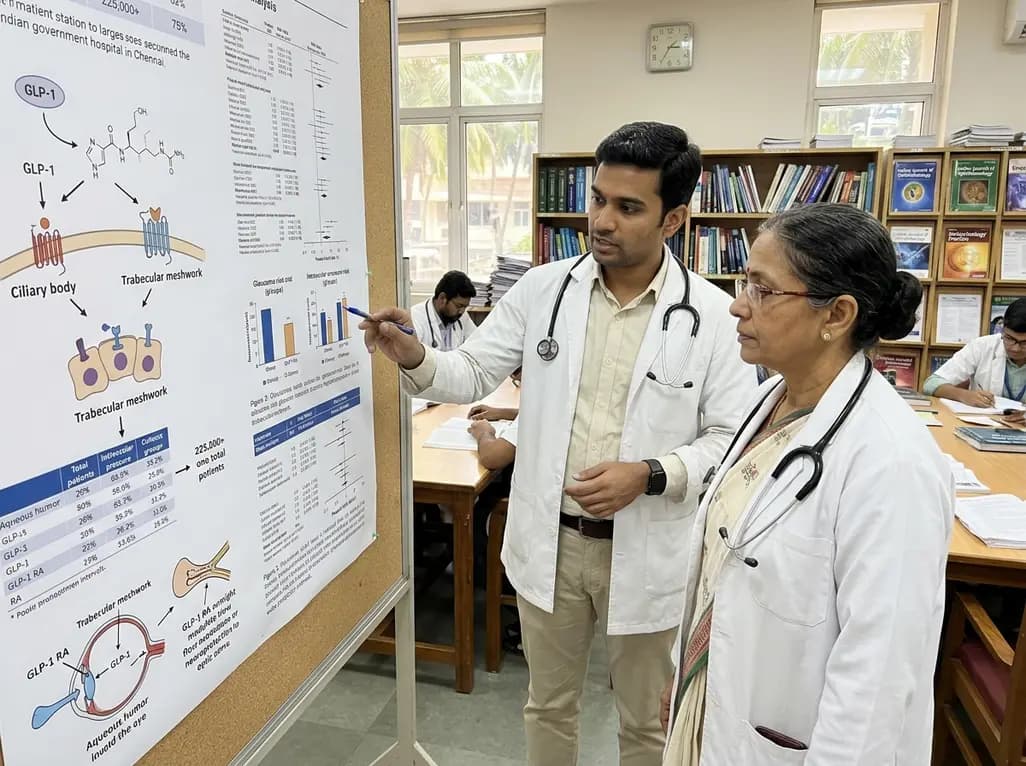
A systematic review and meta-analysis of over 225,000 patients explores whether GLP-1 receptor agonists reduce the risk of glaucoma and ocular hypertension. While pooled data show a 31% lower risk, low certainty and wide prediction intervals urge cautious optimism and further randomized trial evaluation.
Today
