.webp&w=384&q=75)

Loading, please wait...
Loading, please wait...

The Centre recently issued a directive urging states to implement standardised hospital rates across all private healthcare institutions. This move aims to curb inconsistent pricing and make health insurance more affordable for policyholders. Consequently, the Union department of financial services identified high healthcare costs as a major issue. Therefore, uniform package rates for common medical procedures will now become a priority for states. Furthermore, transparent billing in private hospitals should reduce the burden on health insurance premiums.
India's health insurance market is growing at 9% annually, yet affordability remains a significant challenge. Additionally, the government has called for stricter enforcement of the Clinical Establishments Act of 2010. Hospitals are now required to follow standard treatment guidelines issued by central and state authorities. Adherence to these protocols will help reduce variations and eliminate unnecessary medical procedures.
Moreover, the Centre stressed the need for robust grievance redressal mechanisms to resolve disputes. States must also ensure that hospitals adopt digital systems for claims processing immediately. The National Health Claims Exchange (NHCX) platform will help standardise health insurance data flows. This digital transition aims to improve transparency and foster patient trust in the healthcare system.
Meanwhile, broader reforms under the deregulation initiative propose allowing practitioners to work across states easily. This change aims to address the shortage of doctors in rural and border areas. Finally, a single-window clearance system will replace the current complex approval requirements for healthcare establishments. These measures collectively strive to standardise care quality and lower overall claims exposure for the insurance sector.
Q1: What is the primary goal of the National Health Claims Exchange (NHCX)?
The NHCX platform aims to standardise health insurance data flows and improve transparency between hospitals and insurers during claims processing.
Q2: How will the Clinical Establishments Act affect private hospitals?
The Act requires hospitals to follow standard treatment protocols and uniform package rates to reduce variations in healthcare costs.
Disclaimer: This content is for informational and educational purposes only. It does not constitute medical advice or replace professional judgment. Refer to the latest local and national guidelines for clinical practice.
References

Read summarized clinical updates, watch expert medical content, and earn CME certifications right from your smartphone.
Open your smartphone camera to scan and install.





The Centre mandates standardised hospital rates and transparent billing to control insurance premiums and improve healthcare affordability across Indian sta...
6 months ago
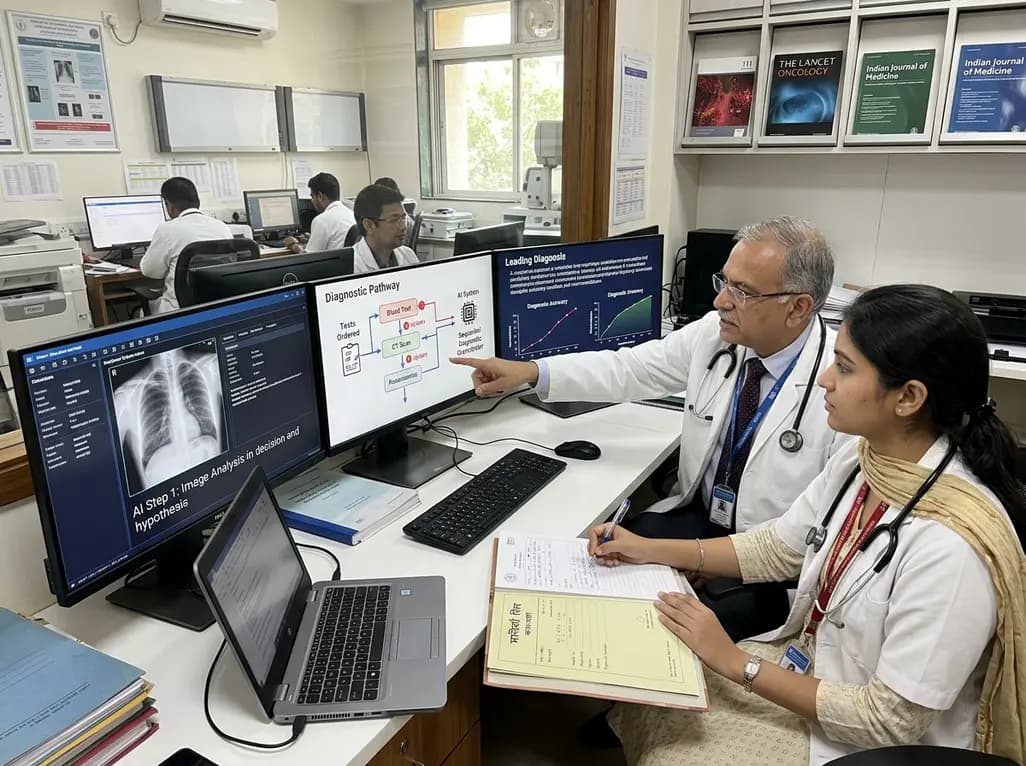
A breakthrough peer-reviewed study demonstrates that a sequential AI diagnosis system can mirror real-world clinical reasoning. By ordering stepwise tests and updating hypotheses dynamically, this multi-agent orchestrator achieved superior diagnostic accuracy while reducing investigative costs.
Today

A prenatal case highlights severe glutaric acidemia type II presenting as bilateral hyperechoic cystic kidneys at 18 weeks. Whole-exome sequencing revealed a novel homozygous ETFDH frameshift variant, demonstrating the power of rapid genetic testing in fetal renal anomalies.
Today

Review how tailored exercise programs benefit frail older patients with heart failure. Explore pathophysiological mechanisms, individualized training prescriptions, and strategies to overcome adherence barriers in clinical practice.
Yesterday

This comparative study evaluates posterior labral tears with and without glenohumeral instability, highlighting distinct demographic patterns, MRI underestimation in stable shoulders, and successful arthroscopic repair outcomes.
Yesterday

A clinical study demonstrates that early intervention with tocilizumab, either as monotherapy or bridged with corticosteroids, achieves significant proptosis reduction and resolves active inflammation in treatment-naive thyroid eye disease.
Yesterday
