

Loading, please wait...
Loading, please wait...

Automated convulsive seizure detection has emerged as a vital milestone in modern epilepsy care. Specifically, generalized tonic-clonic seizures present substantial morbidity and carry the primary risk for sudden unexpected death in epilepsy. Unfortunately, standard clinical electroencephalography remains confined to specialized hospital units. Consequently, patients living at home often lack continuous nocturnal surveillance. However, recent advancements in wearable technology now provide promising solutions for real-time monitoring. In a multicenter study published in Epilepsia, investigators evaluated an advanced deep learning framework designed for consumer smartwatches. This innovative system, termed Episave, utilizes wrist-worn accelerometer data to identify convulsive episodes reliably. Therefore, it provides an accessible, non-invasive digital safety net for individuals living with severe epilepsy.
Generalized convulsive seizures impose heavy physical and psychological burdens on patients and their families. In particular, convulsive episodes that occur during sleep represent the single highest risk factor for sudden unexpected death in epilepsy. When a seizure strikes overnight, postictal respiratory depression and airway compromise can rapidly prove fatal. Prompt human intervention, such as repositioning the patient or providing stimulation, significantly reduces mortality. Nevertheless, caregivers cannot maintain continuous visual vigilance throughout the night. Seizure diaries also fail to record nocturnal events accurately, as patients frequently suffer from postictal amnesia. Consequently, clinicians struggle to assess therapy efficacy accurately without objective long-term tracking. Wearable seizure monitors can bridge this critical diagnostic and safety gap. However, earlier generations of wearable motion detectors suffered from unacceptable false alarm rates. Everyday arm movements, such as brushing teeth or restless sleep, repeatedly triggered false alerts. Therefore, developers required sophisticated algorithms that differentiate normal physical activity from rhythmic convulsive patterns without missing dangerous clinical events.
To address past limitations, the research team engineered an ensemble-based convolutional neural network known as Episave. Specifically, the model analyzes acceleration amplitude derived from a triaxial wrist-worn accelerometer. Rather than relying on rigid heuristic thresholds, the neural network processes raw movement signals to extract intricate temporal and spectral features. Furthermore, the investigators incorporated a quantile-based aggregation mechanism to grant clinicians tunable sensitivity. This adaptable architecture allows healthcare providers to customize the alert threshold based on individual patient circumstances. During the initial training phase, investigators collected high-resolution data from thirty-seven patients across specialized monitoring centers. These individuals experienced a total of fifty-four confirmed convulsive seizures during continuous video-EEG recording. Through cross-validation on this dataset, researchers determined that an aggregation quantile of sixty yielded the optimal clinical balance. Notably, this setting achieved an impressive ninety-eight percent sensitivity while restricting false alarms to approximately once every six days. Thus, the model established a robust foundation for independent prospective validation.
Following algorithm development, the researchers conducted a rigorous prospective evaluation across eight European epilepsy monitoring units. In total, the independent validation cohort comprised 347 diverse patients who underwent simultaneous video electroencephalography and accelerometry. Within this extensive test population, thirty-three individuals experienced forty-nine generalized or bilateral convulsive seizures. When evaluated on this independent cohort using the predefined quantile, the deep learning model achieved ninety-six percent sensitivity. In addition, the system demonstrated a low false alarm rate of less than one event every eight days. Nighttime performance proved particularly outstanding, yielding merely one false alarm every sixty-one nights. Furthermore, the algorithm registered a median detection latency of only twenty-six seconds from seizure onset. Such rapid response times allow caregivers adequate opportunity to deliver critical life-saving care. Notably, an investigation into the two missed seizures revealed that one patient had their sensor-bearing wrist trapped against the bed rail. Consequently, the study confirmed that single-sensor accelerometers deliver exceptional clinical reliability under standard conditions.
The introduction of tunable sensitivity marks a major progression in automated convulsive seizure detection. Every clinical scenario presents unique priorities regarding sensitivity and false alarm tolerance. For instance, hospitalized patients or individuals living alone at extreme risk of death benefit from maximum sensitivity. In this study, adjusting the aggregation quantile enabled the algorithm to achieve one hundred percent detection sensitivity. However, this heightened alert mode increased the false alarm frequency to once every two days. Conversely, in stable ambulatory settings, frequent false alarms severely disrupt daily routines and exhaust caregiver patience. By selecting a conservative quantile, users achieved a remarkably low false alarm rate of one per one hundred days, retaining eighty-six percent sensitivity. Therefore, clinician-guided threshold adjustment empowers personalized disease management. Physicians can systematically calibrate the wearable device to match each patient's lifestyle and clinical vulnerability. Moreover, objective detection logs provide neurologists with accurate seizure counts. This continuous digital diary substantially enhances therapeutic decision-making during antiepileptic drug titration.
Beyond diagnostic accuracy, practical device usability determines whether patients will adopt wearable medical technologies over long periods. Historically, bulky dedicated medical hardware caused social stigma and poor user adherence. In contrast, modern commercial smartwatches blend seamlessly into daily life. Because the Episave algorithm requires only three-dimensional accelerometry data, developers can easily integrate it into widespread commercial smartwatches. This computational efficiency eliminates the need for expensive, proprietary sensors such as photoplethysmography or electrodermal activity arrays. Consequently, widespread deployment becomes economically feasible for diverse patient populations globally. For low- and middle-income nations like India, consumer smartwatch integration offers an affordable pathway to reduce epilepsy-related mortality. Family members can receive automated text messages or phone calls the moment a convulsive event begins. Furthermore, rapid emergency alerts ensure prompt administration of rescue intranasal midazolam or rectal diazepam. Ultimately, integrating deep learning algorithms into everyday smartwatches transforms epilepsy care, empowering patients and protecting lives worldwide.
The Episave model uses a convolutional neural network architecture that evaluates wrist acceleration amplitude. Consequently, it captures the rapid, rhythmic movements characteristic of convulsive seizures while filtering out typical daily activities. Moreover, the model allows clinicians to adjust sensitivity thresholds according to individual patient requirements.
High false alarm rates frequently cause alarm fatigue among patients and caregivers, often prompting them to abandon wearable devices altogether. Therefore, maintaining less than one false alarm per week preserves confidence in the system. Furthermore, it prevents unnecessary panic and allows emergency responders or families to act promptly when true seizures occur.
Yes, timely convulsive seizure detection enables immediate postictal intervention, which remains crucial in preventing sudden unexpected death in epilepsy. Because most fatal events occur during or following nocturnal convulsive seizures, rapid alerts notify family members or caregivers to check airway patency and administer rescue medications if necessary.
Disclaimer: This content is for informational and educational purposes only and should not be taken as professional medical advice. Always seek the advice of a qualified healthcare provider with any questions you may have regarding a medical condition. Refer to the latest local and national guidelines for clinical practice.
References

Read summarized clinical updates, watch expert medical content, and earn CME certifications right from your smartphone.
Open your smartphone camera to scan and install.





A prospective European study reveals that Episave, an ensemble deep-learning model using wrist accelerometers, detects convulsive seizures with 96% sensitivity and less than one false alarm every eight days, offering tunable protection on off-the-shelf smartwatches.
Today
A cross-sectional molecular epidemiological study evaluates HIV-1 transmission clusters and pretreatment drug resistance among treatment-naïve men who have sex with men. Findings highlight prominent CRF07_BC transmission and significant assortative mixing, informing targeted public health and antiretroviral strategies.
Today
A new study evaluates a multilingual digital health platform combining rule-based cervical cancer risk assessment, retrieval-augmented generation AI, and geospatial navigation. The tool dramatically reduces clinical hallucinations while providing actionable health guidance for underserved populations.
Today
A novel MOF-based platform encapsulates hemoglobin with catalytic platinum and ceria nanozymes to deliver oxygen while scavenging toxic reactive oxygen species. This study highlights key design principles for managing hypoxia and reperfusion injury while resolving crucial stability challenges.
Today
A vector coding study compares elite and sub-elite weightlifters during maximal snatch attempts, revealing that performance differences stem from phase-dependent knee-ankle coordination during transition and turnover phases rather than overall trajectory patterns.
Today
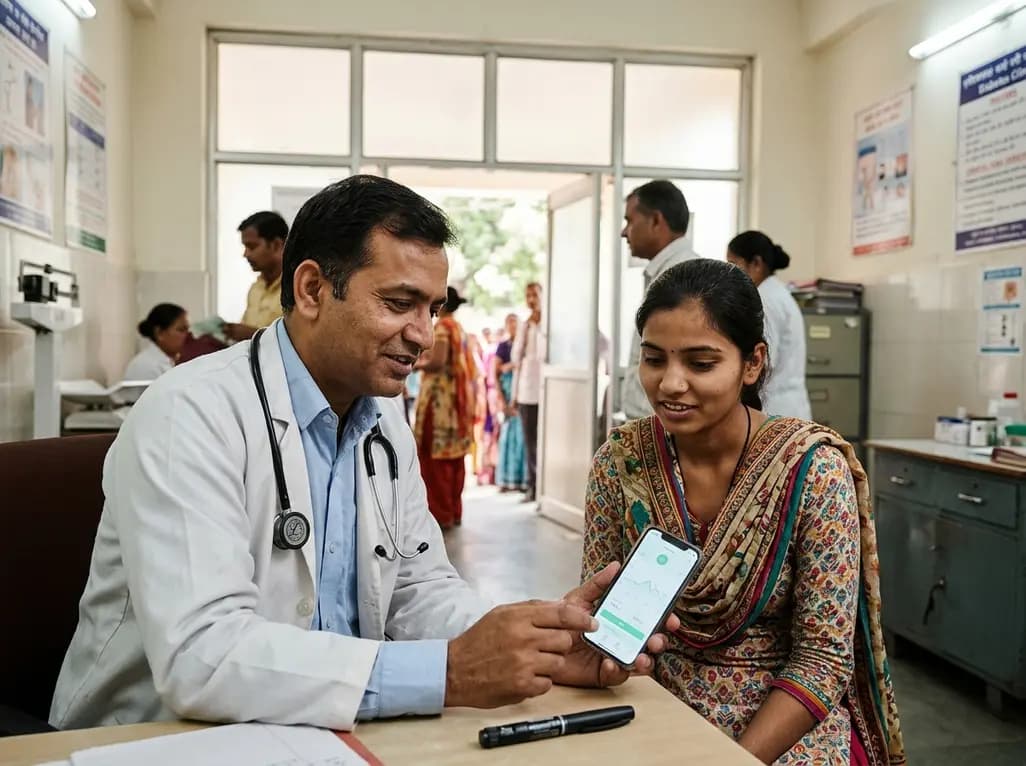
A pilot feasibility study demonstrates that a newly developed mobile app for bolus insulin dose adjustment significantly improves dosing confidence, treatment adherence, and hypoglycemia prevention for patients with type 1 diabetes while reducing provider workload in resource-limited clinical settings.
Today
