

Loading, please wait...
Loading, please wait...

Olympic weightlifting demands rapid explosive power and precise neuromuscular execution. Specifically, the snatch movement requires seamless lower limb interjoint coordination to transfer ground reaction forces into the barbell. Historically, clinical biomechanists evaluated individual joint excursions in isolation. However, isolated joint metrics cannot fully explain how multiple segments interact simultaneously during explosive athletic tasks. When weightlifters execute maximal one-repetition attempts, millisecond timing differences govern technical execution and bar trajectory. Therefore, modern sports scientists apply vector coding methodologies to quantify continuous joint coupling across the kinetic chain. In this groundbreaking study, researchers evaluated twenty competitive weightlifters divided into elite and sub-elite cohorts. Interestingly, both groups exhibited nearly identical gross coupling trajectories across the primary phases of the lift. Nevertheless, phase-specific vector analysis revealed critical discrepancies in distal motor control. These distinct strategies show that athletic mastery relies on nuanced temporal reorganisation rather than large postural deviations. Consequently, sports physicians and performance coaches must examine multi-joint coordination rather than isolated range of motion.
To evaluate competitive lifting mechanics, investigators recorded twenty male weightlifters in the 73-kg division during sanctioned competition. A high-speed dual-camera system captured three-dimensional kinematics during successful maximal snatch attempts. Subsequently, researchers computed sagittal-plane angles for the hip, knee, and ankle joints across six time-normalised phases. Vector coding then quantified coupling angles between hip-knee, hip-ankle, and knee-ankle pairs throughout the movement cycle. Furthermore, circular statistics and permutational multivariate analysis of variance evaluated phase-specific coordination modes. Coupling angle mapping characterized proximal versus distal joint dominance during every lift segment. Because vector coding classifies continuous motion into distinct coordination modes, it reveals whether one joint leads, lags, or moves synchronously with adjacent joints. For instance, in-phase coupling indicates simultaneous extension or flexion, whereas anti-phase coupling indicates reciprocal motion. Moreover, vector coding captures continuous kinetic changes that traditional peak-value metrics frequently overlook. Consequently, this analytical approach provides profound insights into motor control strategies under extreme loading conditions. Clinicians can identify specific phases where kinetic breakdowns threaten athletic longevity or induce joint injury.
The investigation revealed identical overall coupling-angle trajectories between elite and sub-elite lifters across all joint pairs. Thus, both groups maintained similar gross kinematic templates during the pull. However, researchers identified significant statistical differences in coordination-mode composition at the knee-ankle pair. Specifically, knee-ankle coordination differed during the transition phase as the barbell cleared the knees. During this critical juncture, elite lifters reorganised distal joint contributions far more efficiently than sub-elite peers. Additionally, significant differences emerged during the turnover under the barbell. In this phase, the athlete drops rapidly beneath the descending barbell to secure the overhead catch. Elite weightlifters demonstrated superior proximal-distal regulation, adjusting ankle dorsiflexion and knee flexion simultaneously. Conversely, sub-elite lifters exhibited delayed ankle involvement and less cohesive knee-ankle coupling. Meanwhile, hip-knee and hip-ankle pairs showed no significant differences between groups across any lifting phase. Therefore, distal motor regulation serves as the primary differentiator between elite and sub-elite performance during competitive snatches. These biomechanical nuances explain why elite athletes catch heavier loads without compromising balance or posture.
Understanding phase-dependent distal regulation provides critical guidance for orthopedic surgeons and sports medicine physicians. Weightlifters routinely experience patellar tendinopathy, knee ligament sprains, and chronic ankle impingement. Inappropriate knee-ankle coordination during high-velocity transitions dramatically increases shear stress across the anterior cruciate ligament and patellofemoral joint. When sub-elite lifters fail to synchronise ankle motion with knee flexion, excessive ground impact forces transmit directly into the knee joint. Therefore, sports clinicians must evaluate multi-joint movement quality during post-injury rehabilitation programs. Clinicians cannot rely solely on isolated quadriceps strength or passive ankle range of motion. Instead, functional rehabilitation protocols should emphasize dynamic kinetic chain synchronization under load. Furthermore, incorporating vector coding analytics into clinical return-to-sport testing helps identify residual neuromuscular deficits. By addressing coordination deficits during the transition and turnover phases, physical therapists can reduce re-injury risks. Moreover, targeted corrective exercises restore symmetrical load distribution across the lower extremities. Consequently, athletes regain high-level athletic performance while safeguarding vulnerable musculoskeletal structures from repetitive microtrauma.
Sports practitioners in India and worldwide must integrate kinetic chain biomechanics into strength and conditioning programs. Modern athletic regimens often focus heavily on absolute strength, prioritizing maximum back squat numbers. However, this study underscores that technical mastery hinges upon distal timing and temporal reorganisation. Coaches should implement specific movement drills that target the transition phase and barbell turnover. For example, athletes can perform hang snatches and drop snatches to refine rapid knee-ankle coupling. Additionally, plyometric drills and reactive balance training improve distal neuromuscular responsiveness. When conditioning specialists identify ankle stiffness or premature knee extension, they should prescribe targeted mobility drills. Addressing these kinetic chain inefficiencies prevents compensatory patterns that predispose lifters to overuse injuries. Furthermore, interdisciplinary collaboration between orthopedic specialists, physiotherapists, and strength coaches ensures holistic athlete care. By combining kinematic movement screening with individualized conditioning, practitioners optimize lifting mechanics and preserve athletic longevity. Thus, biomechanical analysis bridges the gap between laboratory science and clinical sports performance.
Vector coding is an advanced biomechanical analysis technique that quantifies the interaction between two adjacent joints across time. Instead of measuring isolated joint angles, this method calculates coupling angles between paired segments throughout a movement cycle. Consequently, vector coding categorises joint coordination into distinct modes, such as in-phase, anti-phase, or joint-dominant patterns. This provides clinicians with deeper insights into dynamic motor control and kinetic chain efficiency during complex athletic tasks.
The transition phase requires the weightlifter to quickly rebend the knees while the barbell ascends past knee level. Precise knee-ankle coordination enables the lifter to reposition their body underneath the bar without sacrificing vertical velocity. Furthermore, synchronized ankle motion helps maintain balance over the midfoot and optimizes force transmission. If knee-ankle coupling fails during this critical phase, the athlete loses leverage, risking barbell deceleration, balance failure, and acute knee strain.
Uncoordinated joint movements alter load distribution across lower extremity joints, amplifying mechanical stress on tendons, cartilage, and ligaments. For instance, erratic knee-ankle coupling during the turnover phase forces the patellar tendon and ankle joint to absorb excessive impact forces. Over time, these repetitive mechanical imbalances trigger chronic overuse injuries, including patellar tendinopathy and joint impingement. Correcting multi-joint coordination restores optimal kinetic chain mechanics and substantially reduces musculoskeletal injury risks.
Disclaimer: This content is for informational and educational purposes only... Refer to the latest local and national guidelines for clinical practice.
References

Read summarized clinical updates, watch expert medical content, and earn CME certifications right from your smartphone.
Open your smartphone camera to scan and install.





A vector coding study compares elite and sub-elite weightlifters during maximal snatch attempts, revealing that performance differences stem from phase-dependent knee-ankle coordination during transition and turnover phases rather than overall trajectory patterns.
Today
A nationwide Danish study confirms a strong association between DPP-4 inhibitors and bullous pemphigoid in type 2 diabetes. Risk is markedly elevated with current vildagliptin and linagliptin use compared to sitagliptin, highlighting crucial clinical considerations for prescribing physicians.
Today

A Swedish nationwide registry study of over 405,000 vaginal births shows that third-trimester SSRI exposure is linked to increased rates of labor induction, postpartum hemorrhage, and lower 5-minute Apgar scores, highlighting the need for balanced clinical risk-benefit counseling.
Today
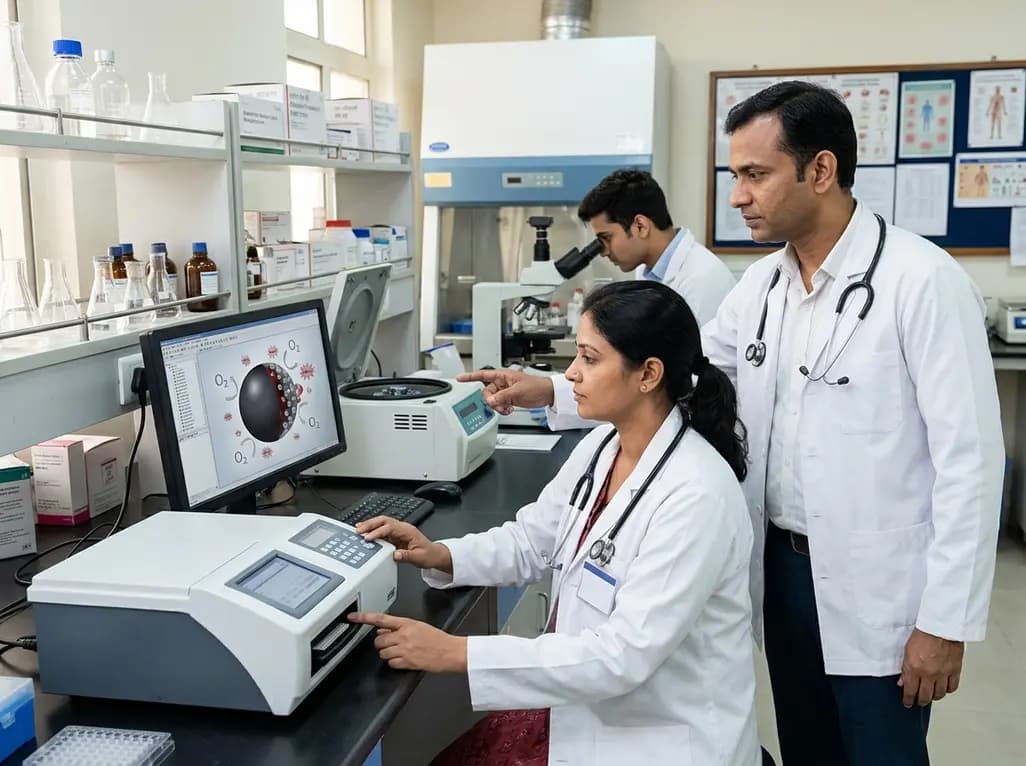
A novel MOF-based platform encapsulates hemoglobin with catalytic platinum and ceria nanozymes to deliver oxygen while scavenging toxic reactive oxygen species. This study highlights key design principles for managing hypoxia and reperfusion injury while resolving crucial stability challenges.
Today
A comprehensive review analyzes how early-career clinicians navigate AI in paediatric endocrinology. From automated bone age and closed-loop insulin systems to governance concerns and unregulated large language models, this article highlights key clinical applications and essential training frameworks.
Today
