.webp&w=384&q=75)

Loading, please wait...
Loading, please wait...
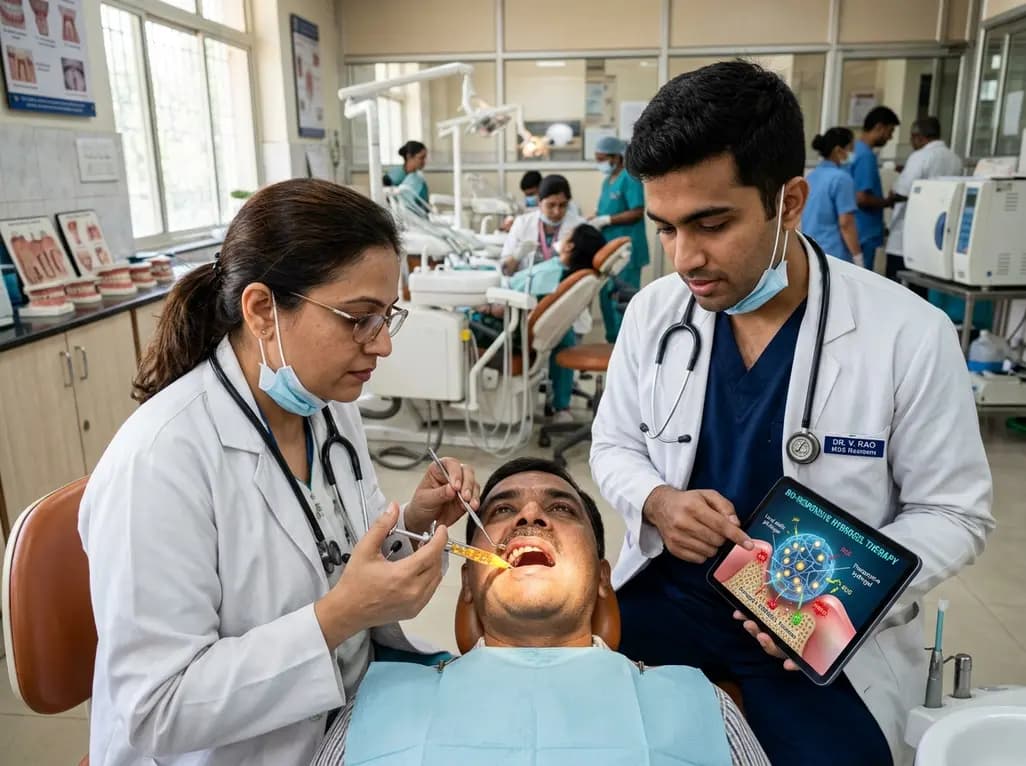
Periodontitis represents a severe chronic inflammatory disease that destroys tooth-supporting structures through complex microbial dysbiosis and host immune responses. Conventional clinical treatments, such as scaling and root planing, effectively reduce bacterial burden but fail to halt progressive tissue breakdown predictably. Consequently, dental scientists increasingly evaluate smart hydrogels for periodontitis to achieve targeted therapeutic delivery and regenerate native periodontal tissue architectures.
Subgingival plaque biofilms initiate persistent inflammatory cascades within the vulnerable gingival sulcus. Subsequently, dysregulated host neutrophils and macrophages infiltrate the tissues, producing high concentrations of reactive oxygen species and matrix metalloproteinases. These hostile biochemical factors rapidly degrade periodontal ligament fibers and progressively destroy alveolar bone. Therefore, managing this destructive microenvironment requires robust and continuous localized intervention. Standard dental therapies rely primarily on mechanical debridement combined with adjunctive local or systemic antimicrobials. However, rapid salivary clearance and continuous gingival crevicular fluid flow swiftly wash away therapeutic molecules before they take effect. Furthermore, systemic antimicrobials frequently cause undesirable systemic adverse events, while conventional localized delivery devices often release their pharmacological payloads too rapidly. In addition, increasing antimicrobial resistance worldwide significantly reduces the clinical efficacy of standard pharmacological agents. Crucially, traditional mechanical interventions do not actively guide the differentiation of endogenous stem cells or reconstruct lost alveolar bone architecture. Because of these persistent shortcomings, clinicians urgently require advanced biomaterial platforms that resist rapid oral clearance. Intelligent biomaterials must actively counteract local inflammatory insults while simultaneously directing osteogenesis and cementogenesis.
To overcome oral drug clearance, researchers engineer smart hydrogels for periodontitis from highly biocompatible natural and synthetic polymers. These three-dimensional hydrated networks closely mimic the extracellular matrix of native periodontium. Consequently, they offer an ideal biomechanical framework for cellular adhesion, migration, and proliferation. Natural biopolymers such as alginate, chitosan, gelatin, and hyaluronic acid provide remarkable biocompatibility and enzymatic degradability. Conversely, synthetic polymers like polyethylene glycol and polyvinyl alcohol offer tunable mechanical stiffness and predictable degradation kinetics. Furthermore, bioengineers introduce dynamic covalent crosslinks or supramolecular physical bonds into these polymeric backbones. As a result, the hydrogel matrices acquire desirable shear-thinning and self-healing properties. This fluid behavior allows clinicians to inject the formulation directly into deep, irregularly shaped periodontal pockets using minimally invasive techniques. Once injected, the material rapidly transitions into a stable matrix under physiological conditions. Moreover, researchers can encapsulate antibacterial agents, cytokines, and osteogenic progenitor cells within these porous networks without compromising their therapeutic viability. Thus, biomimetic engineering successfully transforms passive hydrogels into versatile platforms that integrate seamlessly into diseased periodontal tissues.
Diseased periodontal pockets display unique biochemical changes compared to healthy oral tissues. Pathogenic anaerobic bacteria ferment carbohydrates and secrete acidic metabolites, which lowers the local microenvironmental pH significantly. Similarly, activated immune cells produce massive amounts of reactive oxygen species and matrix metalloproteinases during chronic inflammation. Smart polymeric platforms exploit these pathological cues to achieve precise, on-demand therapeutic release. Specifically, pH-sensitive hydrogels contain ionizable functional groups that protonate or deprotonate in acidic sulcular fluid. This charge alteration induces matrix swelling and accelerates drug discharge right at the infection epicenter. In addition, researchers incorporate reactive oxygen species-cleavable chemical linkers, such as boronate esters and thioethers, into the hydrogel structure. Consequently, oxidative bursts trigger scaffold degradation, which rapidly releases encapsulated antimicrobial and anti-inflammatory factors. Furthermore, matrix metalloproteinase-cleavable peptide substrates enable enzyme-triggered payload release during peak tissue destruction phases. Outside endogenous triggers, exogenous signals like near-infrared light or magnetic fields can trigger localized hyperthermia and drug release. Therefore, stimuli-responsive mechanisms prevent premature drug leakage, diminish unnecessary drug toxicity, and maintain therapeutic concentrations precisely during active disease flare-ups.
Controlling the hostile inflammatory cascade constitutes an indispensable prerequisite for successful periodontal tissue regeneration. Prolonged dominance of pro-inflammatory M1 macrophages sustains osteoclastogenesis and prevents osteogenic differentiation. Fortunately, smart hydrogels can deliver immunomodulatory factors that efficiently reprogram these immune cells toward a pro-regenerative M2 phenotype. By actively scavenging excessive reactive oxygen species, these antioxidant biomaterials rescue resident periodontal ligament stem cells from apoptotic cell death. Moreover, hydrogels can sustain the localized release of bone morphogenetic proteins, vascular endothelial growth factors, and stromal cell-derived factors. Consequently, the local microenvironment transitions smoothly from persistent tissue destruction to active cellular regeneration. Periodontal ligament stem cells migrate into the porous hydrogel scaffold, where they differentiate into functional osteoblasts and cementoblasts. Meanwhile, localized angiogenic signaling promotes new capillary formation, supplying essential oxygen and nutrients to newly developing bone tissue. In addition, composite hydrogels containing bioactive ceramics, such as nano-hydroxyapatite or bioactive glass, enhance mechanical integrity and promote robust biomineralization. Therefore, by coupling microenvironment reprogramming with targeted osteogenesis, smart hydrogels drive coordinated reconstruction of the periodontal ligament, root cementum, and alveolar bone.
Despite extraordinary preclinical results, transferring smart hydrogel technologies into routine periodontal practice presents notable challenges. First, hydrogels must withstand continuous masticatory stresses, salivary enzyme degradation, and high crevicular fluid clearance rates in the oral cavity. If a hydrogel degrades too quickly or dislodges mechanically, its regenerative efficacy declines abruptly. Second, industrial manufacturing requires scalable, highly reproducible fabrication methods that preserve strict batch-to-batch consistency. Sterilization procedures present another significant obstacle, because conventional heat or gamma irradiation can degrade sensitive polymer backbones or inactivate encapsulated bioactive proteins. Furthermore, complex multi-stimuli responsive systems face stringent regulatory approval pathways worldwide. Regulatory agencies require extensive safety documentation, including long-term biocompatibility assays and detailed degradation profiles in human tissues. In addition, clinicians need user-friendly delivery systems, such as pre-filled syringes that set rapidly within wet oral environments. Economic feasibility also represents an essential consideration, as expensive nano-engineered hydrogels must demonstrate clear superiority over standard surgical grafts to justify their higher costs. Nevertheless, continued interdisciplinary collaboration among periodontists, material scientists, and regulatory bodies will accelerate the clinical adoption of these intelligent therapeutic devices.
Traditional local drug delivery devices release their pharmacological payloads through passive diffusion, which often results in an initial burst release followed by rapid subtherapeutic clearance. In contrast, smart hydrogels respond dynamically to specific pathological cues within the periodontal pocket, such as low pH, elevated reactive oxygen species, or specific enzymes. Consequently, they release therapeutic agents exclusively during active inflammation, maintaining therapeutic levels while reducing overall drug toxicity.
Endogenous triggers originate directly from the altered biochemical environment of the diseased periodontal pocket. Pathogenic bacterial metabolism creates an acidic local pH, whereas activated host immune cells generate elevated levels of reactive oxygen species and matrix metalloproteinases. Therefore, researchers incorporate acid-labile bonds, redox-sensitive crosslinkers, or enzyme-cleavable peptides into the hydrogel matrix. These specific pathological triggers induce matrix degradation or swelling, allowing targeted release of antimicrobials and regenerative factors.
Yes, smart hydrogels actively foster true regeneration by coordinating multiple biological processes simultaneously. By neutralizing inflammatory reactive oxygen species and shifting macrophages to a pro-healing M2 phenotype, these scaffolds create a favorable regenerative niche. Furthermore, they provide a three-dimensional biomimetic matrix that guides periodontal ligament stem cell recruitment and differentiation. Consequently, they promote the organized formation of new alveolar bone, cementum, and functionally aligned periodontal ligament fibers.
Disclaimer: This content is for informational and educational purposes only... Refer to the latest local and national guidelines for clinical practice.
References

Read summarized clinical updates, watch expert medical content, and earn CME certifications right from your smartphone.
Open your smartphone camera to scan and install.





Smart hydrogels responsive to pathological microenvironments offer an advanced approach for periodontitis therapy. By reacting to local pH, ROS, and enzymes, these biomaterials deliver targeted therapeutics, suppress chronic inflammation, and actively promote periodontal tissue and alveolar bone regeneration.
Today

Union Health Minister JP Nadda highlighted patient safety, clinical hygiene, and institutional quality at ABVIMS and Dr RML Hospital on World Patient Safety Day 2026. The national strategy emphasizes NQAS certification, Ayushman Bharat expansions, PMBJP generic access, and safe lifelong management of chronic diseases.
Today

Prelacteal feeding persists in South Asian communities despite known clinical risks. This review examines determinants from Chitral, pathophysiological hazards, and pediatric strategies to eliminate harmful feeds and support exclusive breastfeeding.
Today

A randomized controlled trial demonstrates that theory-driven personalized mobile messaging reduces the risk of consecutive walking goal failures by 33 percent, highlighting the vital role of digital health tools in sustaining long-term exercise habits and chronic disease prevention.
Today

A comparative cohort study demonstrates that patients undergoing total hip arthroplasty after prior hip arthroscopy achieve comparable functional recovery, low complication rates, and equivalent implant survivorship when conversion occurs after six months.
Today

A cross-sectional study of 320 adults evaluated the link between habitual fasting duration and dietary quality using Nutrition Quotient scores, highlighting the clinical necessity of balancing time-restricted eating with nutrient density and meal quality in routine metabolic practice.
Today
