.webp&w=384&q=75)

Loading, please wait...
Loading, please wait...

High-pressure arterial bleeding remains a critical clinical challenge for emergency responders and surgeons. Consequently, researchers developed a novel hemostatic arterial sealant named SFM@STF to provide rapid bleeding control. This Janus-structured material utilizes a bilayer design to ensure both mechanical strength and biological adhesion. Specifically, the adhesive layer mimics mussel proteins to bond firmly to wet tissues even under pressure.
The sealant features two distinct layers with specialized functions. The adhesive STF layer incorporates tannic acid and fibrin within a silk fibroin network. This combination creates a double-network hydrogel that ensures robust bonding to wet biological surfaces. Conversely, the SFM layer provides a supportive membrane composed of crystalline β-sheet structures. This second layer offers the mechanical robustness necessary to resist high burst pressures found in arterial systems.
In various tests, the SFM@STF sealant demonstrated exceptional results in arterial injury models. It achieved a wet tissue adhesion strength of 43.43 kPa. Furthermore, the material maintained a low swelling ratio and superior structural stability. Remarkably, the sealant also continuously promotes endothelial regeneration without inducing thrombosis. Consequently, it presents a promising alternative to traditional compressive hemostatic methods.
Clinical applications require high standards of safety and cytocompatibility. Fortunately, the silk fibroin-based sealant showed a low hemolysis rate and excellent cell compatibility. These factors suggest that the material is safe for internal use during complex surgeries. Additionally, its ability to promote tissue healing without secondary complications marks a significant advancement in biomaterials.
Its Janus-structured bilayer design allows it to provide both high-strength adhesion to wet tissues and the mechanical toughness needed to resist high-pressure blood flow.
The layer mimics mussel proteins by using a double-network hydrogel with hydrophobic and catechol groups, which create strong bonds even in aqueous environments.
Yes, studies indicate that the sealant continuously promotes endothelial regeneration and does not cause thrombosis, aiding in the natural recovery of the vessel.
Disclaimer: This content is for informational and educational purposes only. It does not constitute medical advice or professional services. Always consult a qualified healthcare provider for medical diagnosis or treatment. Refer to the latest local and national guidelines for clinical practice.
References
1. Leng Y et al. Silk Fibroin-Based Hemostatic Sealant with Robust Wet Adhesion and High Burst Pressure Resistance for Arterial Bleeding Control. ACS Biomater Sci Eng. 2026 Mar 02. doi: 10.1021/acsbiomaterials.6c00059. PMID: 41766635.
2. Bai S, et al. A silk-based sealant with tough adhesion for instant hemostasis of bleeding tissues. Nanoscale Horiz. 2021;6(1):123-128.
3. Alishiri R, et al. The Effect of Silk Fibroin Additive on the Properties of Tannic Acid-Based Bioadhesives. nih.gov. Feb 2026.

Read summarized clinical updates, watch expert medical content, and earn CME certifications right from your smartphone.
Open your smartphone camera to scan and install.





A novel Janus-structured silk fibroin sealant (SFM@STF) provides robust wet adhesion and rapid hemostasis for managing high-pressure arterial bleeding....
7 months ago

A breakthrough ultrathin multimodal sensor decouples physical hemodynamic monitoring from disposable electrochemical calibration, achieving long-term wearable glucose prediction with 81.36% accuracy and a 9.12% MARD. This offers a robust, drift-free solution for outpatient metabolic surveillance.
Today

A clinical review of menopause and neurology highlights the neurobiological impacts of midlife hormonal shifts on cognition, epilepsy, migraine, multiple sclerosis, and stroke, emphasizing safe hormone therapy prescribing.
Today

Co-administering antiseizure medications and DOACs frequently causes pharmacokinetic interactions, subtherapeutic drug levels, and thromboembolic failures. This review highlights enzyme induction risks, unpredictable outcomes with levetiracetam, and the vital role of therapeutic drug monitoring.
Today

A comparative review of tension band wiring and intramedullary screw fixation in thumb metacarpophalangeal arthrodesis, evaluating union rates, hardware complications, and clinical outcomes.
Today
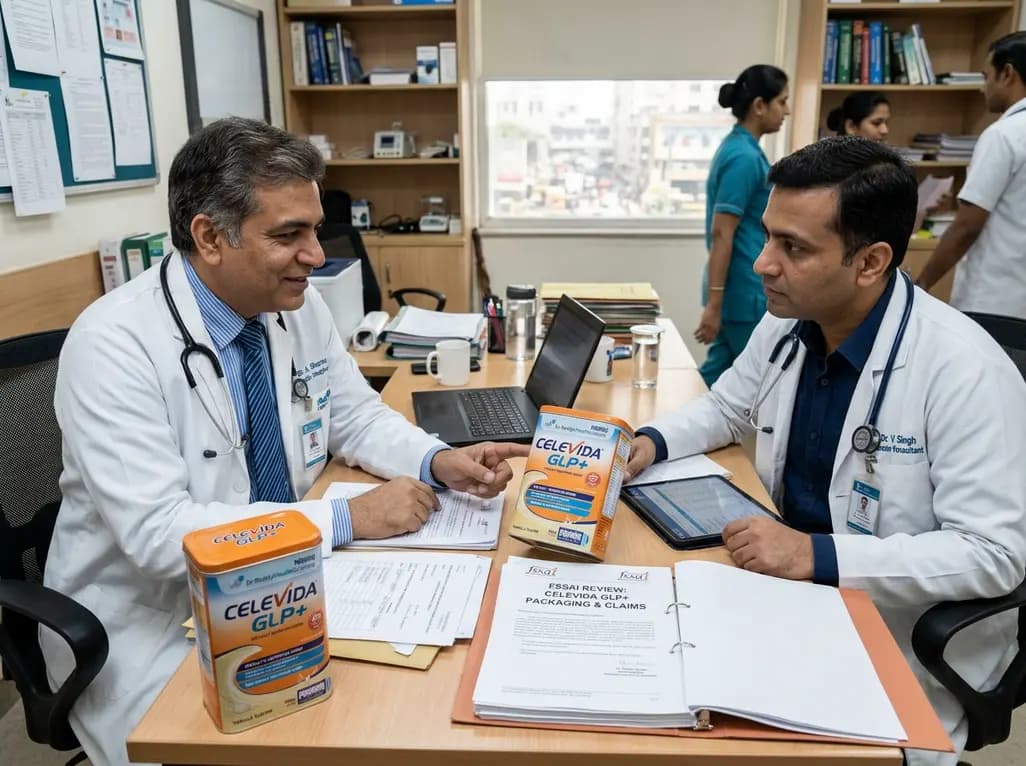
Following regulatory scrutiny from FSSAI regarding promotional representations and lean muscle preservation claims, Dr. Reddy's Laboratories and Nestlé Health Science are currently reviewing the branding and marketing strategy for their joint nutritional supplement Celevida GLP+.
Today
